


Consulate brings a taste of France to Jeddah

1 / 3
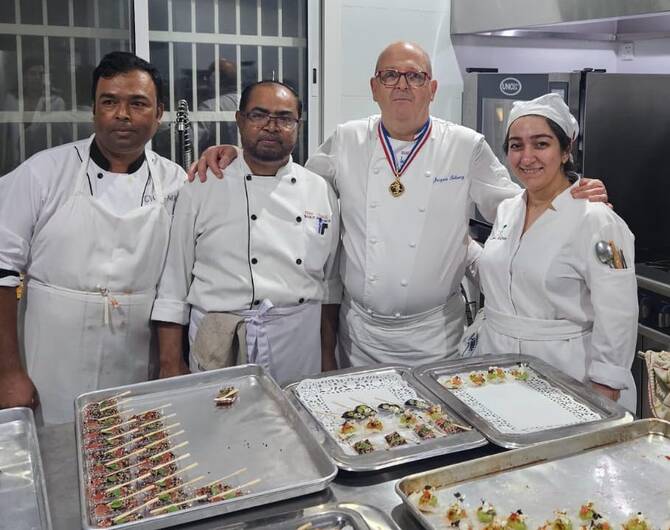
Chef Jacques Rolancy was joined by Saudi chef Asma Al-Khan, a Le Cordon Bleu Paris graduate, who assisted him throughout the day in preparing the exclusive menu. (AN Photo)
2 / 3
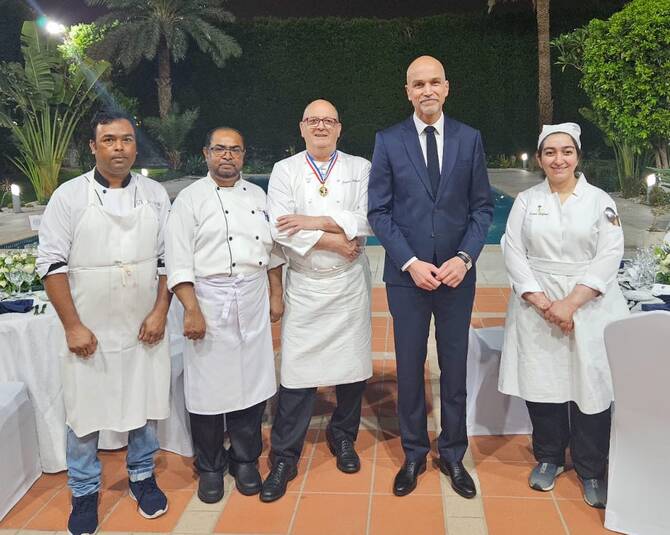
The French Consul General in Jeddah with the chefs at the event. (AN Photo)
3 / 3
Chef Jacques Rolancy prepared a range of dishes for the event at the French consulate in Jeddah. (AN Photo)
Short Url
Updated 11 April 2025
Follow

Consulate brings a taste of France to Jeddah

  • An evening of fine dining hosted by the French consulate general takes place in Jeddah
  • French chef Jacques Rolancy is joined by Saudi chef Asma Al-Khan, a graduate of Le Cordon Bleu in Paris

JEDDAH: Gastronomy met diplomacy in Jeddah on Thursday with an evening of fine dining hosted by the French consulate general.

The event, held at the consulate, was part of this year’s Gout de/Good France. The initiative, launched in 2015 by the French Ministry for Europe and Foreign Affairs and renowned chef Alain Ducasse, aims to promote French cuisine — recognized by UNESCO in 2010 as part of the world’s intangible cultural heritage.

Consul General of France in Jeddah Mohammed Nehad opened the evening with a speech that highlighted the role of gastronomy in fostering cultural cooperation between his country and Saudi Arabia.

The dinner was prepared by chef Jacques Rolancy, a “Meilleur Ouvrier de France” — the title translates as “best craftsman.”

Rolancy has worked in several Michelin-starred restaurants and is a member of the French Culinary Academy and Association of Master Chefs of France. He is committed to sharing his expertise and preserving the French culinary heritage.

He was assisted by Saudi chef Asma Al-Khan, a graduate of Le Cordon Bleu in Paris, who helped prepare the special menu.

Al-Khan told Arab News: “I was observing how the chef worked and honestly, he was impressively fast and precise. I assisted with various tasks in the kitchen and took part in preparing and plating the dishes.”

She also explained why she continued to learn about French cuisine.

“I love how they use very minimal spices — often just salt and black pepper. That allows the original flavors of the ingredients, like meat or vegetables, to shine without being overwhelmed by seasoning. You get to taste the true flavor of the food,” she said.

The dinner menu featured foie gras escalope, marinated salmon, white radish and candied ginger with a soy vinaigrette.

Rolancy told Arab News: “This dish is one I created 10 years ago. It’s one of my signature dishes. I love to travel, discover new ingredients and experiment with how different products can complement each other.”

Also served was a traditional French dish of roasted veal fillet with green pea puree, figs, red peppers, strawberries and a touch of wasabi, as well as sliced Camembert — either plain or paired with mashed banana and a sprinkle of cinnamon in a delicate sauce. For dessert, there was a chocolate and coffee tartlet.

The event marked Rolancy’s second visit to the Kingdom. “I really enjoyed it. It’s a country full of culinary expression and creativity,” he said. “I tried different Saudi dishes when I was in Riyadh. Some of the spices felt familiar, like cardamom and clove. We use those in French cooking too.”

The evening highlighted the excellence of French culinary expertise and strengthened cultural and professional ties with Saudi partners.


Threat to Kingdom’s security is ‘red line’ that will be ‘addressed and neutralized,’ Saudi envoy says

Updated 14 January 2026
Follow

Threat to Kingdom’s security is ‘red line’ that will be ‘addressed and neutralized,’ Saudi envoy says

  • Abdulaziz Alwasil tells UN Security Council the situation in southern Yemen is ‘a just cause with social and historic dimensions’ that can only be resolved through dialogue
  • Recent military activity in the south was unilateral, resulting in an escalation that harms the interests of Yemeni people and undermines efforts to address issues in the south, he said

NEW YORK CITY: Any attempt to threaten Saudi Arabia’s national security is a “red line” and will be met with decisive action, the Kingdom’s ambassador to the UN told the Security Council on Wednesday.

Speaking during a meeting of the council to discuss Yemen, Abdulaziz Alwasil said the situation in the south of the country is “a just cause with social and historic dimensions” that can only be resolved through dialogue.

“We stress that any attempt to threaten our national security is a red line, and we will not hesitate to take the necessary actions and steps to address it and neutralize it,” he added.

Alwasil reaffirmed Saudi Arabia’s support for Yemeni President Rashad Al-Alimi, the Presidential Leadership Council, and the Yemeni government in their efforts to achieve security, stability, development and peace while preserving national unity.

He said military activity by Southern Transitional Council forces in Hadramout and Al-Mahra on Dec. 2, 2025, was unilateral, did not have the approval of the Presidential Leadership Council, and was not carried out in coordination with the Coalition to Restore Legitimacy in Yemen.

It had resulted in an unjustified escalation that harmed the interests of the Yemeni people, undermined efforts to address the issues in the south, and ran counter to the coalition’s objectives, Alwasil added.

The Kingdom, working with its coalition partners, the Presidential Leadership Council and the Yemeni government, had moved to contain the situation by dispatching a military force to coordinate arrangements with the Southern Transitional Council in Aden, he said.

The aim was to ensure the return of the southern council’s forces to their previous positions outside of Hadramout and Al-Mahra, and the handover of camps to legitimate government forces and local authorities in line with agreed procedures, Alwasil added.

He expressed regret over the military operations that took place in Hadramout and Al-Mahra, close to Saudi Arabia’s southern border, which he said posed a direct threat to the Kingdom’s national security, as well as the security of Yemen and regional stability. Such steps were extremely dangerous, he added, and contradicted the principles on which the Coalition to Restore Legitimacy in Yemen had been founded.

Alwasil welcomed a prisoner and detainee exchange agreement signed in Muscat on Dec. 23, which he described as an important humanitarian measure to alleviate suffering and build confidence.

He praised Oman for hosting and sponsoring the consultations and supporting negotiations, and commended the efforts of UN’s special envoy for Yemen, Hans Grundberg, the International Committee of the Red Cross and all others that has played a part.

Regarding the political efforts to resolve the crisis, Alwasil said Saudi Arabia welcomed President Al-Alimi’s call for an inclusive conference in Riyadh to bring together all stakeholders to discuss just solutions to the situation in southern Yemen.

Preparations for the conference have begun, he added, in cooperation with the Yemeni government and southern representatives, reflecting the close ties between the two countries and their shared interests in stabilizing Yemen.

He urged all southern stakeholders to participate actively and constructively in the talks, to help find comprehensive and just solutions that meet the legitimate aspirations of the people of southern Yemen.

Alwasil called on all Yemeni forces and stakeholders to cooperate and intensify their efforts to reach a lasting political settlement that would ensure security and stability.

He described the southern issue as “a just cause with social and historic dimensions,” adding that “the only way to address it is through dialogue that leads to a comprehensive political solution” based on nationally and internationally agreed terms of reference.