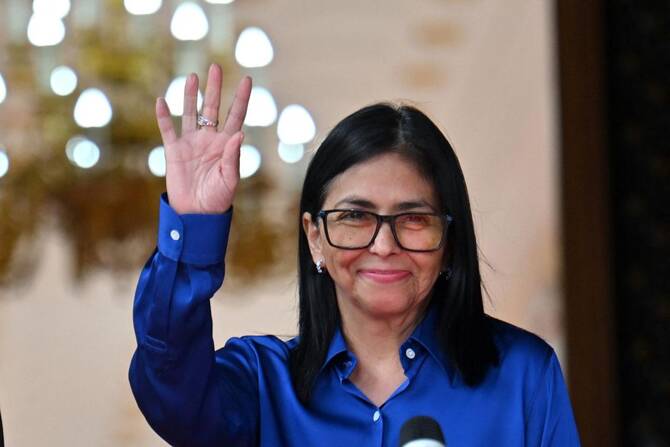
CARACAS: Venezuela’s interim president Delcy Rodriguez declared Wednesday her country was entering a new era marked by greater tolerance toward political rivals, following the US ouster of her former boss Nicolas Maduro.
At her first press conference since Maduro’s dramatic capture by US forces on January 3, Rodriguez cast herself as a unifier.
Following 12 years of repressive rule by Maduro, Venezuela is “opening up to a new political era,” Maduro’s former deputy told reporters at the presidential palace.
The new Venezuela, she said, “allows for understanding despite differences and through ideological and political diversity.”
After toppling Maduro, US President Donald Trump agreed to let Rodriguez take over, provided she toes Washington’s line.
- Calls for ‘peace’ -
In doing so, Trump sidelined the leader of the anti-Maduro opposition, Nobel Peace Prize laureate Maria Corina Machado, claiming she did not have enough “respect” in Venezuela.
Machado will meet Trump on Thursday at the White House to press her demands for a democratic transition that includes herself and Edmundo Gonzalez Urrutia, her candidate in 2024 elections which the opposition claims were stolen by Maduro.
So far, Trump has focused his energies on securing access to Venezuela’s vast oil reserves.
But he claimed that he had also been planning a second attack on Venezuela until the government last week announced the release of “large numbers” of the dissenters languishing in prison, sometimes for years.
Rodriguez claimed authorities had released 406 prisoners since December in a process that accelerated since last week, and which she said “has not yet concluded.”
The Foro Penal legal rights NGO, which defends many of the detainees, gave a much smaller tally of around 180 freed.
AFP’s count, based on data from NGOs and opposition parties, showed 70 people going free since January 8.
They include some Americans, a US State Department official confirmed on Tuesday, without saying how many.
The trickle of releases continued on Wednesday, with the release of 17 journalists and media workers.
Roland Carreno, a journalist and prominent opposition activist, who was detained in August 2024 during post-election protests, was part of the group.
According to the National Union of Press Workers he spent “one year, five months, and 12 days” behind bars.
A member of the Popular Will party, he was previously imprisoned between 2020 and 2023 on charges of terrorism — a charge frequently used to lock up opposition members in Venezuela.
In a video shared by another freed journalist, he called for “peace and reconciliation.”
Political analyst Nicmer Evans, director of the Punto de Corte news outlet was also released.
- Balancing act -
Rodriguez has been engaged in a delicate balancing act, trying to meet US demands without alienating the Maduro loyalists, who control the security forces and intelligence services.
To avoid scenes of jubilant opposition activists punching the air as they walk free from prison, the authorities have been releasing them quietly at other locations, far from the TV cameras and relatives waiting outside detention centers.
Carreno was released at a shopping mall.
Former presidential candidate Enrique Marquez, one of the first to be released, was driven home in a patrol car.
A number of Spanish and Italian citizens have also walked free from Venezuelan prisons in the past week.
The United States had already secured freedom for some of its nationals in a deal with Maduro last year.
- X access restored -
Domestically, Venezuelans regained one freedom on Tuesday — the ability to post on social media platform X, which had been blocked for more than a year by Maduro’s government.
Rodriguez updated her profile’s bio to “acting president” — she served as vice president under Maduro — and wrote: “Let us stay united, moving toward economic stability, social justice, and the welfare state we deserve to aspire to.”
Maduro’s X account was updated Tuesday with a photo of the deposed leader and his wife, Cilia Flores.
“We want you back,” the post reads.


![]()

Venezuela looking to ‘new era’ after Maduro ouster, says interim leader
Short Url
https://arab.news/rqzh8
Venezuela looking to ‘new era’ after Maduro ouster, says interim leader
- After toppling Maduro, US President Donald Trump agreed to let Delcy Rodriguez take over, provided she toes Washington’s line
- The new Venezuela, she said, “allows for understanding despite differences and through ideological and political diversity”


Latest updates


© 2026 SAUDI RESEARCH & PUBLISHING COMPANY, All Rights Reserved And subject to Terms of Use Agreement.