GAZA: Umm Rifaat Radwan, the mother of a Gaza medic killed alongside 14 colleagues by Israeli soldiers, had hoped her son’s body would not be among those retrieved after the attack.
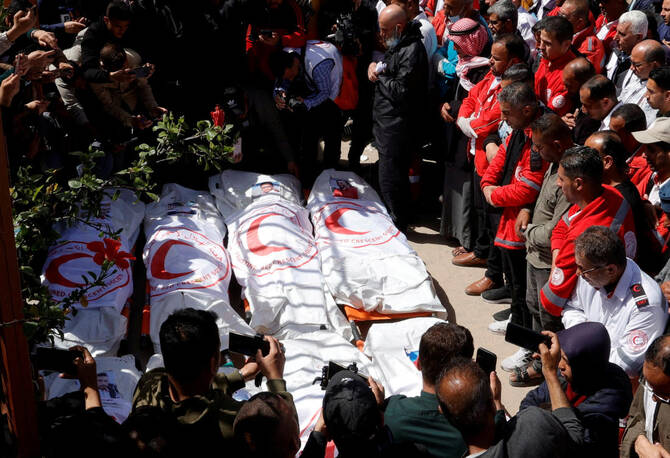
Rifaat Radwan was part of a team of medics and rescuers from the Palestine Red Crescent Society and Gaza’s civil defense agency who were shot dead on March 23 near Rafah as they responded to calls for help after an Israeli air strike.
Their deaths sparked international condemnation and renewed scrutiny over the risks aid workers face in Gaza, where war has raged since Hamas’s October 7, 2023 attack on Israel triggered Israel’s military campaign.
Israel’s army chief, Lt. Gen. Eyal Zamir, has ordered an investigation into the March 23 incident.
The bodies of the 15 emergency personnel were discovered buried in the sand days later, and were recovered in two separate operations, the United Nations and the Red Crescent said.
“They began pulling them out two by two” from a hole, Umm Rifaat, 48, told AFP, describing how the bodies were retrieved from what rescuers called a “mass grave.”
“I thought maybe he wasn’t among them — perhaps he had been detained. I even prostrated after the afternoon prayer in gratitude.
“Then my husband told me that Rifaat had been found inside the hole,” she said.
The 23-year-old Rifaat and his family hailed from Rafah, but had been displaced during the war to the central Gazan city of Deir el-Balah.
On March 23, he and the 14 others were killed in the Tal Al-Sultan area near Rafah, in what the sole survivor of the attack, Mundhir Abed, described as a violent ambush by Israeli forces.
Abed told AFP earlier that the team was shot dead by Israeli soldiers in the early morning.
Umm Rifaat, wearing a long black abaya and veil exposing only her eyes, spoke with quiet composure as she recalled the moment her worst fears were confirmed.
Some of the bodies recovered by rescuers had been handcuffed, according to the Red Crescent, but an Israeli military official denied this.
On Thursday, government spokesman David Mencer repeated Israel’s claim that “six Hamas terrorists” were among the dead.
“What were Hamas terrorists doing in ambulances?” he asked.
The Israeli attack appears to have occurred in two phases.
Rifaat himself partly captured video and audio of the second assault on his convoy of ambulances and a firetruck before he was killed.
The Israeli military official told journalists that soldiers who were in the area received a report about a convoy “moving in the dark in a suspicious way toward them” without headlights, prompting them to fire at the vehicles from a distance.
“They thought they had an encounter with terrorists,” the official said.
But Rifaat’s video, released by the Red Crescent, contradicted this account.
The footage from the phone found on Rifaat’s body shows ambulances moving with their headlights and emergency lights clearly switched on.
“He proved his innocence with his own hands, that he is innocent in the face of the (Israeli) army’s allegations,” Rifaat’s mother said.
“What happened to them is beyond the mind’s comprehension. It is unacceptable by any measure — legal, religious or human.”
Speaking to AFP from the displaced family’s makeshift shelter in Deir el-Balah, Umm Rifaat scrolled through photos of her son on her phone.
Her husband recalled the passion with which Rifaat worked as a paramedic.
“Every day he came home from work with his clothes stained in blood,” Anwar Radwan said, adding that his son had volunteered to do the job after the Gaza war erupted in October 2023.
“He never sought a salary — this was rather a calling he loved with all his blood and soul. What drove him was simply his humanity,” Rifaat’s father said.
“He loved helping people,” added Umm Rifaat.
His father saw Rifaat’s body and told Umm Rifaat that their son’s face had been “deformed.”
She chose not to see the body, preferring instead to preserve her memory of him as he was in life.
“He was like the moon — handsome and fair-skinned,” Umm Rifaat said.

Killed Gaza medic’s mother says he ‘loved helping people’
Short Url
https://arab.news/249tk
Killed Gaza medic’s mother says he ‘loved helping people’
- Rifaat Radwan, a medic from the Palestine Red Crescent Society, was one of 15 killed in an attck by Israel that has sparked outrage
- His family describe their sorrow at losing their son said being a medic 'was his calling'
Hamas to elect first leader since Sinwar killed by Israel
- Role left vacant since Israel killed Yahya Sinwar in 2024
- Khalil Al-Hayya and Khaled Meshaal are seen as frontrunners
CAIRO: Hamas is expected to elect a new leader this month, two sources in the group told Reuters, filling the role left vacant since Israel killed Yahya Sinwar in 2024 despite concerns that a successor could suffer the same fate.
Khalil Al-Hayya and Khaled Meshaal are seen as frontrunners for the helm at a vital moment for the militant Islamist group, battered by two years of war ignited by its October 7, 2023 attack on Israel and facing international demands to disarm.
Both men reside in Qatar and sit on a five-man council that has run Hamas since Israel killed Sinwar, a mastermind of the October 7 attack. His predecessor, Ismail Haniyeh, was assassinated by Israel while on a visit to Iran in 2024.
The election process has already begun, the sources said. The leader is chosen in a secret ballot by Hamas’ Shoura Council, a 50-member body that includes Hamas members in the Israeli-occupied West Bank, the Gaza Strip, and exile.
A Hamas spokesperson declined to comment.
Tough challenges
The sources said a deputy leader will also be elected to replace Saleh Al-Arouri, who was killed by an Israeli airstrike in Lebanon in 2024.
Sources close to Hamas said it was determined to conclude the vote, though some preferred an extension of collective leadership.
Hamas watchers regard Meshaal as part of a pragmatic wing with good ties to Sunni Muslim countries, and Hayya, the group’s lead negotiator, as part of a camp that deepened its relations with Iran.
Hamas faces some of the toughest challenges since it was founded in 1987. While fighting has largely abated in Gaza since the US-brokered ceasefire in October, Israel still holds almost half the coastal enclave, attacks continue, and conditions for Gaza’s 2 million people remain dire.
Hamas has also drawn criticism within Gaza because of the heavy toll inflicted by the war, with much of the enclave reduced to ruins and more than 71,000 people killed, according to Gaza health authorities.
Hamas-led militants killed some 1,200 people and abducted 251 others in the October 7 cross-border assault on Israel.
US President Donald Trump’s ceasefire plan for Gaza demands Hamas disarm and foresees the enclave being run by a technocratic Palestinian administration overseen by an international body called the Board of Peace.
Targeted by Israel
Hamas has so far refused to disarm, saying the question of armed resistance is a matter for wider debate among Palestinian factions and that it would be ready to surrender its weapons to a future Palestinian state, an outcome Israel has ruled out.
Hamas is designated as a terrorist organization by Western powers including the United States.
Born in Gaza, Hayya was among Hamas leaders targeted by an Israeli airstrike on Qatar in September.
Israeli Prime Minister Benjamin Netanyahu later expressed regret to the emir of Qatar — a US ally — in a three-way call with Trump and affirmed Israel would not conduct such an attack again in the future, the White House said at the time.
Meshaal previously led Hamas for almost two decades. Israeli agents tried to assassinate him in Jordan in 1997 by injecting him with poison.
His relations with Iran were strained in 2012 when he distanced Hamas from Tehran’s Syrian ally, the now-ousted President Bashar Assad, early in the Arab Spring uprisings.
Hamas was founded as the Palestinian branch of the Muslim Brotherhood and is the main rival to the Palestinians’ Fatah national movement led by 90-year-old President Mahmoud Abbas.
Hamas’ founding charter called for the destruction of Israel, although its leaders have at times offered a long-term truce with Israel in return for a viable Palestinian state on all Palestinian territory occupied by Israel in the 1967 war.
Israel regards this approach as a ruse.
Analyst Reham Owda said there were limited differences between Hayya and Meshaal over the conflict with Israel but believed Meshaal had better chances as he could “market (Hamas) internationally and help rebuild its capabilities.”
Khalil Al-Hayya and Khaled Meshaal are seen as frontrunners for the helm at a vital moment for the militant Islamist group, battered by two years of war ignited by its October 7, 2023 attack on Israel and facing international demands to disarm.
Both men reside in Qatar and sit on a five-man council that has run Hamas since Israel killed Sinwar, a mastermind of the October 7 attack. His predecessor, Ismail Haniyeh, was assassinated by Israel while on a visit to Iran in 2024.
The election process has already begun, the sources said. The leader is chosen in a secret ballot by Hamas’ Shoura Council, a 50-member body that includes Hamas members in the Israeli-occupied West Bank, the Gaza Strip, and exile.
A Hamas spokesperson declined to comment.
Tough challenges
The sources said a deputy leader will also be elected to replace Saleh Al-Arouri, who was killed by an Israeli airstrike in Lebanon in 2024.
Sources close to Hamas said it was determined to conclude the vote, though some preferred an extension of collective leadership.
Hamas watchers regard Meshaal as part of a pragmatic wing with good ties to Sunni Muslim countries, and Hayya, the group’s lead negotiator, as part of a camp that deepened its relations with Iran.
Hamas faces some of the toughest challenges since it was founded in 1987. While fighting has largely abated in Gaza since the US-brokered ceasefire in October, Israel still holds almost half the coastal enclave, attacks continue, and conditions for Gaza’s 2 million people remain dire.
Hamas has also drawn criticism within Gaza because of the heavy toll inflicted by the war, with much of the enclave reduced to ruins and more than 71,000 people killed, according to Gaza health authorities.
Hamas-led militants killed some 1,200 people and abducted 251 others in the October 7 cross-border assault on Israel.
US President Donald Trump’s ceasefire plan for Gaza demands Hamas disarm and foresees the enclave being run by a technocratic Palestinian administration overseen by an international body called the Board of Peace.
Targeted by Israel
Hamas has so far refused to disarm, saying the question of armed resistance is a matter for wider debate among Palestinian factions and that it would be ready to surrender its weapons to a future Palestinian state, an outcome Israel has ruled out.
Hamas is designated as a terrorist organization by Western powers including the United States.
Born in Gaza, Hayya was among Hamas leaders targeted by an Israeli airstrike on Qatar in September.
Israeli Prime Minister Benjamin Netanyahu later expressed regret to the emir of Qatar — a US ally — in a three-way call with Trump and affirmed Israel would not conduct such an attack again in the future, the White House said at the time.
Meshaal previously led Hamas for almost two decades. Israeli agents tried to assassinate him in Jordan in 1997 by injecting him with poison.
His relations with Iran were strained in 2012 when he distanced Hamas from Tehran’s Syrian ally, the now-ousted President Bashar Assad, early in the Arab Spring uprisings.
Hamas was founded as the Palestinian branch of the Muslim Brotherhood and is the main rival to the Palestinians’ Fatah national movement led by 90-year-old President Mahmoud Abbas.
Hamas’ founding charter called for the destruction of Israel, although its leaders have at times offered a long-term truce with Israel in return for a viable Palestinian state on all Palestinian territory occupied by Israel in the 1967 war.
Israel regards this approach as a ruse.
Analyst Reham Owda said there were limited differences between Hayya and Meshaal over the conflict with Israel but believed Meshaal had better chances as he could “market (Hamas) internationally and help rebuild its capabilities.”
© 2026 SAUDI RESEARCH & PUBLISHING COMPANY, All Rights Reserved And subject to Terms of Use Agreement.


