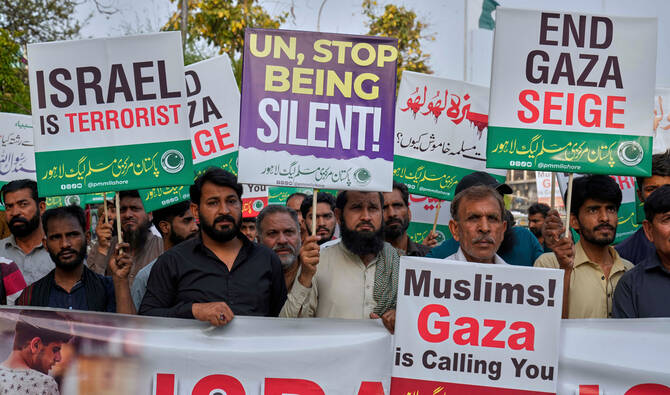
KARACHI: Three Kentucky Fried Chicken restaurants and one Domino’s Pizza outlet were attacked in the Pakistani city of Karachi over the past three days, causing some damage but no injuries, police said, describing the assaults as being motivated by anger over Israel’s war in Gaza.
Boycott campaigns have hit Western brands in many Muslim countries since the start of Israel’s latest war on Gaza in October 2023, spearheaded by the BDS Movement, a global, Palestinian-led campaign advocating for non-violent pressure on Israel to respect Palestinian rights under international law. The movement calls for the boycott of certain companies and organizations that it says have invested in Israel or donate to its military and are directly profiting from its economy.
While not officially on the BDS boycott list, KFC has faced backlash from pro-Palestinian advocates in many countries who believe the brand’s operations in Israel contribute to the conflict. KFC, owned by Yum! Brands, has faced boycotts in many Arab nations and accusations of supporting Israel due to Yum! Brands’ investments in Israeli-based startups, but the company maintains it is non-political and denies supporting the Israeli military or government. Dominos is on the boycott list of the BDS, which says it donates to the Israeli military, an accusation the company denies. There is, however, an Israeli subsidiary of Domino’s Pizza.
“A mob of about 100 to 150 people attempted to ransack a multinational food chain outlet and block the main highway,” Senior Superintendent of Police (SSP) in the Malir area, Kashif Abbasi, to Arab News, confirming that the outlet was a local branch of KFC.
He said police acted promptly, dispersed the crowd and prevented damage to the building while arresting nine suspects.
On Tuesday, a mob of around 35 people attacked KFC and Domino’s Pizza restaurants in Karachi, with ten suspects arrested.
“The attack on the food outlets was motivated by anger over the situation in Gaza,” said Syed Asad Raza, Deputy Inspector General (DIG).
“There is a similar pattern across the Muslim World, especially Bangladesh and other countries, mostly incited through social media.”
In a third attack on Monday over a dozen men hurled stones at a KFC outlet and broke its windows.
“They were unable to enter the outlet and fled due to the prompt response of the police. No arrests have been made, but we have registered a case against the unidentified attackers,” Dr. Farrukh Raza, Senior Superintendent of Police for East Karachi, told Arab News.
On Wednesday, media also reported attacks on a KFC branch in the eastern Pakistani city of Lahore.
The attacks have been widely blamed on the Tehreek-e-Labbaik Pakistan (TLP) religious-political party, known to lead violent protests in the country, most prominently in support of blasphemy laws.
However, TLP spokesperson Rehan Mohsin Khan distanced the party from the attacks on the KFC and Domino’s Pizza restaurants and told Arab News that while TLP’s stance on the Palestine issue was “clear,” violent protests were “not part of our policy.”
“If one or two members of Tehreek-e-Labbaik Pakistan were present among the protesters out of their love for Gaza, it does not mean that it was the policy of the party or we support violence,” he said.
“We are in favor of peaceful protests, and we are trying to pressure the Pakistani government to officially boycott all these products.”

KFC, Domino’s Pizza outlets attacked in Pakistan over Gaza war — police
https://arab.news/c9spz
KFC, Domino’s Pizza outlets attacked in Pakistan over Gaza war — police
- Mobs have attacked KFC and Domino’s Pizza outlets in Pakistan’s commercial capital of Karachi in three separate assaults since Monday
- Attacks widely blamed on TLP religious-political party which denies involvement and says using peaceful means to force boycotts
Pakistani economists flag debt sustainability risks as foreign loans surge in FY26
- Pakistan received $2.98 billion from bilateral, global lenders from July to November this year, official data shows
- Economists urge government to take structural reforms to boost exports, cut energy costs, ensure rupee stability
KARACHI: Pakistani economists on Wednesday warned the government against debt sustainability risks as the country’s foreign loan receipts surged to nearly $3 billion in the first five months of the current fiscal year, data from the economic affairs ministry showed.
Pakistan received 16 percent more financing, which is $2.98 billion, from bilateral and multilateral lenders during the July to November period of the current fiscal year compared to last year, the economic affairs’ ministry data showed.
Pakistan, as per the data, seeks to raise $19.8 billion in loans this year through June, which include $16.7 billion non-project and $3.11 billion project loans from multilateral lenders such as the Asian Development Bank (ADB), Asian Infrastructure Investment Bank (AIIB), Islamic Development Bank (IsDB), European Union (EU), European Investment Bank (EIB), UNICEF and others.
Pakistan’s bilateral lenders include the countries of China, Saudi Arabia, Kuwait, Oman, the US, Denmark, France, Germany, Italy, Japan and South Korea
“As long as you are utilizing the loan for economic recovery and growth, it is understood,” Sana Tawfik, head of research at the Karachi-based brokerage firm Arif Habib Limited, told Arab News.
“But in the long term, it is not sustainable to rely only on loans. Foreign reserves should be built on FDI [foreign direct investment] and not on loans,” she added.
Pakistan’s finance adviser Khurram Schehzad and finance ministry spokesperson Qamar Sarwar Abbasi did not respond to requests for comment.
Cash-strapped Pakistan came close to a sovereign default in 2023 before a last-gasp financial bailout by the International Monetary Fund (IMF) averted the risk.
While Pakistan has lowered inflation and registered other economic gains, the country’s $15.9 billion foreign reserves mostly come from the IMF in budgetary support and bank deposits from countries such as Saudi Arabia and China.
The cash-strapped country will seek $13.5 billion in budgetary support, $700 million in short-term loans from the IsDB, $1.44 billion as program loans, $1 billion worth of oil on deferred payments and $3.11 billion as project loans by June, the data said.
Prime Minister Shehbaz Sharif’s government also plans to raise $400 million through issuing international bonds, $3.1 billion in loans from foreign commercial banks, $410 million from the IMF, $609 million through Naya Pakistan Certificates (NPCs) and $5 billion as time deposits from Saudi Arabia, and $4 billion as safe deposit from China.
“Long-term solution is not to take loans and this only adds up to the existing external account,” Tawfik said.
She, however, appreciated the government’s ability to reduce its current account deficit in recent months. The economist noted that Pakistan, in the short run, could manage its current account deficit if it remains in the $1.5 billion range throughout the year.
She urged the government to focus on increasing exports, noting its debt servicing requirement was $25.8 billion this year.
Tawfik called for long-term reforms such as reducing the cost of doing business, cutting energy costs, clearing Pakistan’s longstanding power sector debt and keeping the rupee stable to attract increased remittances from Pakistanis working abroad.
“In the long run, we must focus on increasing Pakistan’s exports, remittances, and FDI,” the economist said. “FDI is the most important.”
‘OBVIOUSLY A RISK FACTOR’
However, neither are Pakistan’s exports on the rise nor is FDI. Pakistan’s current account deficit widened by 37 percent to $16 billion from July to November this year. This was due to a 6.4 percent decline in exports to $12.8 billion and a 13 percent hike in imports to $28 billion, data from the Pakistan Bureau of Statistics (PBS) showed.
FDI dropped by more than 25 percent to $927 million during the same period and has never surged beyond $3 billion in nearly 20 years, data from Pakistan’s central bank shows.
“Our debt sustainability will be questioned at any point if we, going forward, are not able to match these debt flows or counter these debt flows with growth and remittances and exports,” Muhammad Saad Ali, head of research at Lucky Investments Ltd, told Arab News.
He noted that debt sustainability is “obviously a risk factor” as Pakistan has not increased its FDI nor exports during the period when its foreign debt has increased.
However, he said that there was a positive side to the 16 percent rise in foreign debt receipts as well, adding that recent macroeconomic improvements have enabled Islamabad to borrow more from global lenders.
But the risks remain.
“You (government) are increasing your debt and your debt sustainability will come into question again if global factors or global environment turn south,” he warned.


