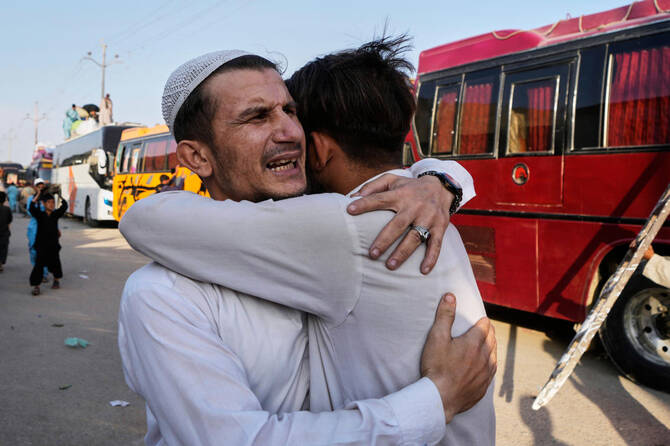
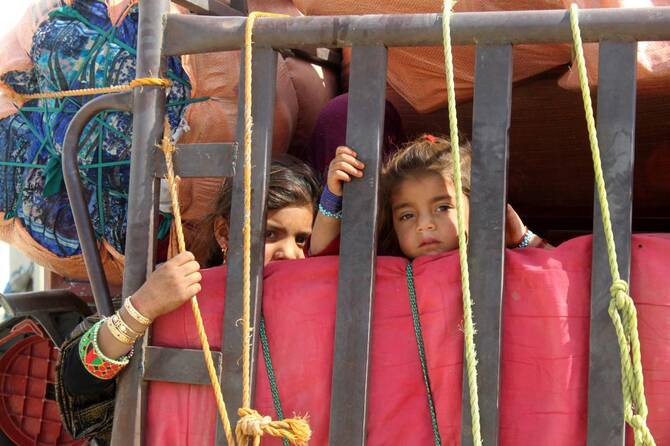
KARACHI: Convoys of Afghans pressured to leave Pakistan are driving to the border, fearing the “humiliation” of arrest, as the government’s crackdown on migrants sees widespread public support.
Islamabad wants to deport 800,000 Afghans after canceling their residence permits — the second phase of a deportation program which has already pushed out around 800,000 undocumented Afghans since 2023.
According to the UN refugee agency, more than 24,665 Afghans have left Pakistan since April 1, 10,741 of whom were deported.
“People say the police will come and carry out raids. That is the fear. Everyone is worried about that,” Rahmat Ullah, an Afghan migrant in the megacity Karachi told AFP.
“For a man with a family, nothing is worse than seeing the police take his women from his home. Can anything be more humiliating than this? It would be better if they just killed us instead,” added Nizam Gull, as he backed his belongings and prepared to return to Afghanistan.
Abdul Shah Bukhari, a community leader in one of the largest informal Afghan settlements in the coastal city, has watched multiple buses leave daily for the Afghan border, about 700 kilometers away.
The maze of makeshift homes has grown over decades with the arrival of families fleeing successive wars in Afghanistan. But now, he said “people are leaving voluntarily.”
“What is the need to cause distress or harassment?” said Bukhari.
Ghulam Hazrat, a truck driver, said he reached the Chaman border crossing with Afghanistan after days of police harassment in Karachi.
“We had to leave behind our home. We were being harassed every day.”
In Peshawar, the capital of Khyber Pakhtunkhwa, on the Afghan border, police climb mosque minarets to order Afghans to leave: “The stay of Afghan nationals in Pakistan has expired. They are requested to return to Afghanistan voluntarily.”
Police warnings are not only aimed at Afghans, but also at Pakistani landlords.
“Two police officers came to my house on Sunday and told me that if there are any Afghan nationals living here they should be evicted,” Farhan Ahmad told AFP.
Human Rights Watch has slammed “abusive tactics” used to pressure Afghans to return to their country, “where they risk persecution by the Taliban and face dire economic conditions.”
In September 2023, hundreds of thousands of undocumented Afghans poured across the border into Afghanistan in the days leading up to a deadline to leave, after weeks of police raids and the demolition of homes.
After decades of hosting millions of Afghan refugees, there is widespread support among the Pakistani public for the deportations.
“They eat here, live here, but are against us. Terrorism is coming from there (Afghanistan), and they should leave; that is their country. We did a lot for them,” Pervaiz Akhtar, a university teacher, told AFP at a market in the capital Islamabad.
“Come with a valid visa, and then come and do business with us,” said Muhammad Shafiq, a 55-year-old businessman.
His views echo the Pakistani government, which for months has blamed rising violence in the border regions on “Afghan-backed perpetrators” and argued that the country can no longer support such a large migrant population.
However, analysts have said the deportation drive is political.
Relations between Kabul and Islamabad have soured since the Taliban returned to power in 2021.
“The timing and manner of their deportation indicates it is part of Pakistan’s policy of mounting pressure on the Taliban,” Maleeha Lodhi, the former permanent representative of Pakistan to the UN told AFP.
“This should have been done in a humane, voluntary and gradual way.”

Pressure builds on Afghans fearing arrest in Pakistan
Short Url
https://arab.news/mfuug
Pressure builds on Afghans fearing arrest in Pakistan
- According to the UN refugee agency, more than 24,665 Afghans have left Pakistan since April 1, 10,741 of whom were deported
Cambodia-Thailand border clashes enter second week
BANTEAY MEANCHEY: Renewed border clashes between Cambodia and Thailand entered a second week Sunday after Bangkok denied US President Donald Trump’s claim that a truce had been agreed to halt the deadly fighting.
The conflict, rooted in a colonial-era demarcation dispute along their 800-kilometer (500-mile) border, has displaced around 800,000 people, officials said.
“I have been here for six days and I feel sad that the fighting continues,” 63-year-old Sean Leap told AFP at an evacuation center in Cambodia’s border province of Banteay Meanchey on Sunday.
“I want it to stop,” he said, adding he was worried about his home and livestock.
At least 25 people have been killed, including 14 Thai soldiers and 11 Cambodian civilians, officials said.
Each side blames the other for instigating the clashes, claiming self-defense and trading accusations of attacks on civilians.
Trump, who earlier backed a truce and follow-on agreement, said Friday the Southeast Asian neighbors had agreed to halt fighting.
But Thai leaders later said no ceasefire deal was made, and both governments said Sunday morning clashes were ongoing.
Thai defense ministry spokesman Surasant Kongsiri said Cambodia shelled and bombed several border provinces overnight.
Thai defense ministry spokesman Surasant Kongsiri said Cambodia shelled and bombed several border provinces overnight and into Sunday.
Cambodia’s defense ministry spokeswoman Maly Socheata, meanwhile, said Thailand continued to fire mortars and bombs into border areas since midnight.
- Closed border crossings -
After Trump’s promised truce did not come to pass, Cambodia shut its border crossings with Thailand on Saturday, leaving migrant workers stranded.
Under a makeshift tent at an evacuation site in Cambodia’s Banteay Meanchey, Cheav Sokun told AFP her husband in Thailand wanted to return home.
She and her son left Thailand alongside tens of thousands of other Cambodian migrant workers during July’s deadly clashes, but her spouse stayed to work as a gardener with his “good Thai boss.”
“He asked me to return first. After that, the border was closed so he cannot come back,” the 38-year-old said.
“I worry about him, but I tell him not to go around... We are afraid that if they know that we are Cambodians, they would attack us,” she said.
Across the border in Thailand’s Surin province, music teacher Watthanachai Kamngam, 38, told AFP he watched several rockets trail across the dark, early morning sky on Sunday before hearing explosions in the distance.
Watthanachai has been painting colorful scenes of tanks, Thai flags and soldiers carrying the wounded on the walls of concrete bunkers since the July clashes which killed dozens.
“As I live through the fighting, I just want to record this moment — to show that this is really our reality,” he told AFP last week.
Amid the fighting, the Thai military has imposed an overnight curfew from 7:00 p.m. to 5:00 am (1200 to 2200 GMT) in parts of Sa Kaeo and Trat provinces.
The United States, China and Malaysia, as chair of the regional bloc ASEAN, brokered a ceasefire in July.
In October, Trump backed a follow-on joint declaration between Thailand and Cambodia, touting new trade deals after they agreed to prolong their truce.
But Thailand suspended the agreement the following month after Thai soldiers were wounded by land mines at the border.
Trump last week pledged he would “make a couple of phone calls” to get the earlier brokered truce back on track.
But Thai Prime Minister Anutin Charnvirakul told journalists on Saturday that Trump “didn’t mention whether we should make a ceasefire” during their Friday phone call.
Anutin said there were “no signs” Trump would connect further US-Thailand trade talks with the border conflict, but also said the US president had guaranteed Thailand would get “better benefits than other countries.”
The conflict, rooted in a colonial-era demarcation dispute along their 800-kilometer (500-mile) border, has displaced around 800,000 people, officials said.
“I have been here for six days and I feel sad that the fighting continues,” 63-year-old Sean Leap told AFP at an evacuation center in Cambodia’s border province of Banteay Meanchey on Sunday.
“I want it to stop,” he said, adding he was worried about his home and livestock.
At least 25 people have been killed, including 14 Thai soldiers and 11 Cambodian civilians, officials said.
Each side blames the other for instigating the clashes, claiming self-defense and trading accusations of attacks on civilians.
Trump, who earlier backed a truce and follow-on agreement, said Friday the Southeast Asian neighbors had agreed to halt fighting.
But Thai leaders later said no ceasefire deal was made, and both governments said Sunday morning clashes were ongoing.
Thai defense ministry spokesman Surasant Kongsiri said Cambodia shelled and bombed several border provinces overnight.
Thai defense ministry spokesman Surasant Kongsiri said Cambodia shelled and bombed several border provinces overnight and into Sunday.
Cambodia’s defense ministry spokeswoman Maly Socheata, meanwhile, said Thailand continued to fire mortars and bombs into border areas since midnight.
- Closed border crossings -
After Trump’s promised truce did not come to pass, Cambodia shut its border crossings with Thailand on Saturday, leaving migrant workers stranded.
Under a makeshift tent at an evacuation site in Cambodia’s Banteay Meanchey, Cheav Sokun told AFP her husband in Thailand wanted to return home.
She and her son left Thailand alongside tens of thousands of other Cambodian migrant workers during July’s deadly clashes, but her spouse stayed to work as a gardener with his “good Thai boss.”
“He asked me to return first. After that, the border was closed so he cannot come back,” the 38-year-old said.
“I worry about him, but I tell him not to go around... We are afraid that if they know that we are Cambodians, they would attack us,” she said.
Across the border in Thailand’s Surin province, music teacher Watthanachai Kamngam, 38, told AFP he watched several rockets trail across the dark, early morning sky on Sunday before hearing explosions in the distance.
Watthanachai has been painting colorful scenes of tanks, Thai flags and soldiers carrying the wounded on the walls of concrete bunkers since the July clashes which killed dozens.
“As I live through the fighting, I just want to record this moment — to show that this is really our reality,” he told AFP last week.
Amid the fighting, the Thai military has imposed an overnight curfew from 7:00 p.m. to 5:00 am (1200 to 2200 GMT) in parts of Sa Kaeo and Trat provinces.
The United States, China and Malaysia, as chair of the regional bloc ASEAN, brokered a ceasefire in July.
In October, Trump backed a follow-on joint declaration between Thailand and Cambodia, touting new trade deals after they agreed to prolong their truce.
But Thailand suspended the agreement the following month after Thai soldiers were wounded by land mines at the border.
Trump last week pledged he would “make a couple of phone calls” to get the earlier brokered truce back on track.
But Thai Prime Minister Anutin Charnvirakul told journalists on Saturday that Trump “didn’t mention whether we should make a ceasefire” during their Friday phone call.
Anutin said there were “no signs” Trump would connect further US-Thailand trade talks with the border conflict, but also said the US president had guaranteed Thailand would get “better benefits than other countries.”
© 2025 SAUDI RESEARCH & PUBLISHING COMPANY, All Rights Reserved And subject to Terms of Use Agreement.