NEW YORK: The United States will exit the World Health Organization, President Donald Trump said on Monday, saying the global health agency had mishandled the COVID-19 pandemic and other international health crises.
Trump said the WHO had failed to act independently from the “inappropriate political influence of WHO member states” and required “unfairly onerous payments” from the US that are disproportionate to the sums provided by other, larger countries, such as China.
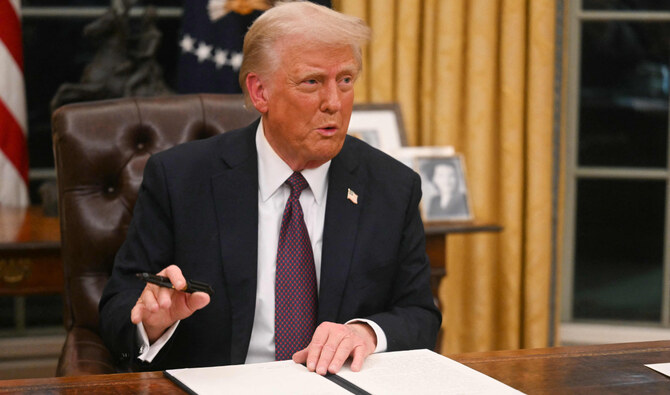
“World Health ripped us off, everybody rips off the United States. It’s not going to happen anymore,” Trump said at the signing.
The move means the US will leave the United Nations health agency in 12 months’ time and stop all financial contributions to its work. The United States is by far the WHO’s biggest financial backer, contributing around 18 percent of its overall funding. WHO’s most recent two-year budget, for 2024-2025, was $6.8 billion.
Trump’s withdrawal from the WHO is not unexpected. He took steps to quit the body in 2020, during his first term as president, accusing the WHO of aiding China’s efforts to “mislead the world” about the origins of COVID.
WHO vigorously denies the allegation and says it continues to press Beijing to share data to determine whether COVID emerged from human contact with infected animals or due to research into similar viruses in a domestic laboratory.

Trump signs executive order withdrawing from the World Health Organization
Short Url
https://arab.news/8c58c
Trump signs executive order withdrawing from the World Health Organization
- He said the WHO had failed to act independently from the ‘inappropriate political influence of WHO member states’
US approves $11 billion in arms sales to Taiwan: Taipei
TAIPEI: Washington has approved $11 billion-worth of arms to Taiwan, Taipei said Thursday, announcing one of the largest weapons packages for the island as it seeks to deter a potential Chinese invasion.
While Washington is traditionally Taiwan’s biggest arms supplier, remarks by US President Donald Trump raised doubts about his willingness to defend the democratic island.
Taiwan has ramped up its defense spending in the past decade as China has intensified military pressure, but Trump’s administration has pushed the island to do more to protect itself.
The arms sale announced on Thursday, which still needs US Congressional approval, would be the second since Trump returned to office in January, after the $330 million sale of parts and components in November.
The latest, much bigger cache features HIMARS rocket systems, howitzers, anti-tank missiles, drones and other equipment, according to Taipei’s foreign ministry.
“This is the second arms sale to Taiwan announced during the Trump administration’s second term, once again demonstrating the US’s firm commitment to Taiwan’s security,” Taipei’s foreign ministry said.
The potential size of the sale rivals the $18 billion authorized under former US president George W. Bush in 2001, although that was ultimately downsized after commercial negotiations.
Bush ended up selling $15.6 billion-worth of weapons to Taiwan over his eight years in office.
During Trump’s first term, the United States approved $10 billion in arms sales to Taiwan, including $8 billion for fighter jets.
The latest package is expected to soon receive a Congressional rubber stamp, given the cross-party consensus on Taiwan’s defense.
Taiwan maintains its own defense industry but the island would be massively outgunned in a conflict with China, and so remains heavily reliant on US arms.
The latest arms sale shows Washington has continued to assist Taipei in “rapidly building robust deterrence capabilities,” Taiwan’s defense ministry said in a statement.
Taiwanese President Lai Ching-te’s government has vowed to ramp up defense spending to more than three percent of the GDP next year and five percent by 2030, following US pressure.
It is also plans to seek up to NT$1 trillion in special funding to upgrade the island’s air defense systems and increase capacity to produce and store ammunition.
The defense spending proposals need backing from the island’s opposition-controlled parliament before they can take effect.
China deploys military aircraft and warships around Taiwan on a near-daily basis, which analysts describe as “grey-zone” operations — coercive tactics that fall short of an act of war.
Taipei’s defense ministry said 40 Chinese military aircraft, including fighters, choppers and drones, as well as eight naval vessels, were detected around Taiwan in a 24-hour period ending early Thursday.
On Tuesday, Beijing’s third and newest aircraft carrier, the Fujian, sailed through the Taiwan Strait, according to Taipei.
While Washington is traditionally Taiwan’s biggest arms supplier, remarks by US President Donald Trump raised doubts about his willingness to defend the democratic island.
Taiwan has ramped up its defense spending in the past decade as China has intensified military pressure, but Trump’s administration has pushed the island to do more to protect itself.
The arms sale announced on Thursday, which still needs US Congressional approval, would be the second since Trump returned to office in January, after the $330 million sale of parts and components in November.
The latest, much bigger cache features HIMARS rocket systems, howitzers, anti-tank missiles, drones and other equipment, according to Taipei’s foreign ministry.
“This is the second arms sale to Taiwan announced during the Trump administration’s second term, once again demonstrating the US’s firm commitment to Taiwan’s security,” Taipei’s foreign ministry said.
The potential size of the sale rivals the $18 billion authorized under former US president George W. Bush in 2001, although that was ultimately downsized after commercial negotiations.
Bush ended up selling $15.6 billion-worth of weapons to Taiwan over his eight years in office.
During Trump’s first term, the United States approved $10 billion in arms sales to Taiwan, including $8 billion for fighter jets.
The latest package is expected to soon receive a Congressional rubber stamp, given the cross-party consensus on Taiwan’s defense.
Taiwan maintains its own defense industry but the island would be massively outgunned in a conflict with China, and so remains heavily reliant on US arms.
The latest arms sale shows Washington has continued to assist Taipei in “rapidly building robust deterrence capabilities,” Taiwan’s defense ministry said in a statement.
Taiwanese President Lai Ching-te’s government has vowed to ramp up defense spending to more than three percent of the GDP next year and five percent by 2030, following US pressure.
It is also plans to seek up to NT$1 trillion in special funding to upgrade the island’s air defense systems and increase capacity to produce and store ammunition.
The defense spending proposals need backing from the island’s opposition-controlled parliament before they can take effect.
China deploys military aircraft and warships around Taiwan on a near-daily basis, which analysts describe as “grey-zone” operations — coercive tactics that fall short of an act of war.
Taipei’s defense ministry said 40 Chinese military aircraft, including fighters, choppers and drones, as well as eight naval vessels, were detected around Taiwan in a 24-hour period ending early Thursday.
On Tuesday, Beijing’s third and newest aircraft carrier, the Fujian, sailed through the Taiwan Strait, according to Taipei.
© 2025 SAUDI RESEARCH & PUBLISHING COMPANY, All Rights Reserved And subject to Terms of Use Agreement.


