ISLAMABAD: US companies are seeking to invest in Pakistan’s largely untapped minerals sector that boasts one of the world’s largest copper and gold deposits, the Pakistani government said Wednesday.
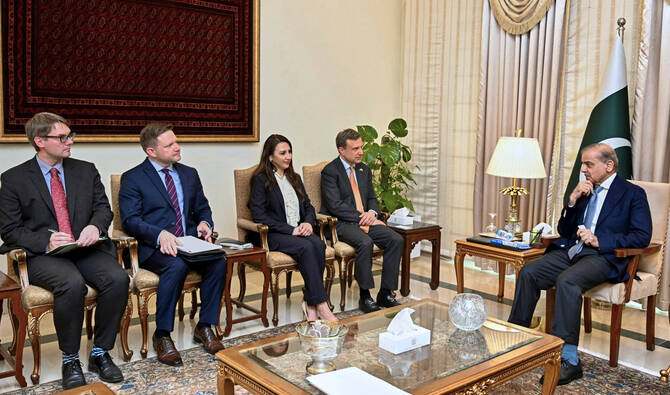
Eric Meyer, Senior Bureau Official for the State Department’s Bureau of South and Central Asian Affairs, conveyed that interest directly to Pakistani Prime Minister Shehbaz Sharif during meeting in Islamabad, according to a government statement.
The meeting came a day after Meyer attended the Pakistan Minerals Investment Forum, an international summit aimed at attracting foreign investment in the country’s mining sector. Apart from gold and copper, Pakistan is also rich in lithium used to make batteries, as well as other minerals.
The summit has drawn participation from major international companies, including Canada-based Barrick Gold, as well as government officials from the United States, Saudi Arabia, China, Turkiye, the United Kingdom, Azerbaijan, and other nations.
Pakistan’s massive copper and gold deposits are located in Reko Diq, a district in restive Balochistan, which has witnessed a surge in attacks by Baloch separatists in recent years. Pakistan’s powerful army chief Gen. Asim Munir had told foreign companies and investors at the summit that the military would ensure their security.
The statement said Meyer “acknowledged the potential of Pakistan’s mineral sector,” adding that American companies are interested in exploring investment opportunities.
He reaffirmed Washington’s interest in expanding bilateral cooperation, including in such sectors as trade, investment, and counterterrorism, the statement said. Sharif said Pakistan’s minerals sector offered “immense opportunities” and encouraged US companies to take advantage of the investment potential.
Sharif expressed Islamabad’s desire to strengthen ties with the Trump administration. Meyer’s visit marks the first by a Trump administration official since the US imposed a 29 percent tariff on Pakistani exports as part of his trade war.
Sharif’s office said in a statement later Wednesday that the Pakistani prime minister will dispatch a high-level delegation to Washington to negotiate with Trump administration officials over the tariffs issue and to discuss how to enhance bilateral trade.


![]()

Pakistan says US companies seek to invest in country’s untapped minerals sector
Short Url
https://arab.news/9rncy
Pakistan says US companies seek to invest in country’s untapped minerals sector
- Senior US official Eric Meyer conveyed that interest directly to Pakistani PM Shehbaz Sharif during ongoing Islamabad visit
- Meyer is in Pakistan to attend an international summit aimed at attracting foreign investment in country’s mining sector
Latest updates


© 2026 SAUDI RESEARCH & PUBLISHING COMPANY, All Rights Reserved And subject to Terms of Use Agreement.