Pakistan discusses energy reforms, airport investment on Davos sidelines

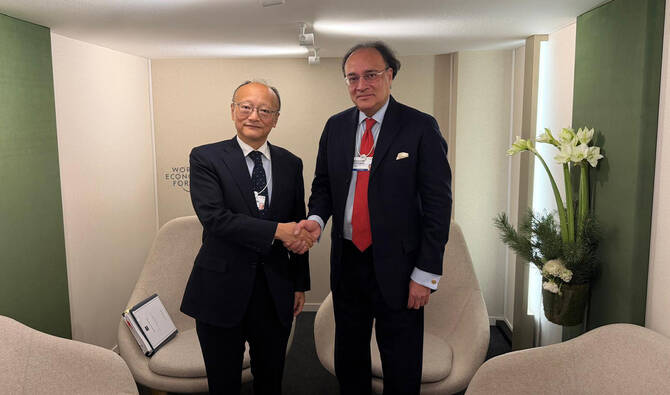
Finance Minister of Pakistan Muhammad Aurangzeb (right) shaking hands with President of the Asian Development Bank, Masato Kanda, in Davos, Switzerland, in a picture shared by the Finance Ministry of Pakistan on January 21, 2026.
Short Url
Updated 21 January 2026
Follow

Pakistan discusses energy reforms, airport investment on Davos sidelines

  • The finance chief meets ADB, aviation firm to promote private sector participation
  • Muhammad Aurangzeb flags airport outsourcing and private investment opportunities

ISLAMABAD: Federal Minister for Finance and Revenue Muhammad Aurangzeb held talks with the Asian Development Bank and an international aviation services company, a government statement said on Wednesday, to discuss energy sector reforms and private investment in airport operations.

The meetings took place on the sidelines of the World Economic Forum in Davos, where Aurangzeb outlined Pakistan’s recent economic stabilization efforts and its plans to expand private sector participation and international partnerships.

“The past year has marked a decisive shift toward macroeconomic stability,” he said in conversation with ADB President Masato Kanda, according to a statement circulated by the Finance Division.

“Discussions also covered efforts to modernize Pakistan’s energy sector and advance sustainable and clean energy solutions,” the statement added. “The Finance Minister highlighted ongoing reforms aimed at improving efficiency, strengthening systems, and supporting long-term economic sustainability.”

Aurangzeb emphasized the importance of continued collaboration with development partners, including ADB, to support these reforms and unlock Pakistan’s growth potential.

The ADB president reaffirmed the Bank’s commitment to Pakistan, highlighting ADB’s focus on ensuring timely and effective delivery of development outcomes.

The finance minister separately met with Hassan El Houry, chairperson of Menzies Aviation, to explore opportunities for improving airport services, operational efficiency, and private investment.

During the meeting, he briefed El Houry on plans to outsource operations at Islamabad, Karachi, and Lahore airports, saying the improving economic environment was creating space for international partnerships, according to the statement.

Menzies Aviation expressed interest in expanding its engagement in Pakistan and discussed ways to enhance service quality and the overall passenger experience.


Pakistan says repaid over $13.06 billion domestic debt early in last 14 months

Updated 29 January 2026
Follow

Pakistan says repaid over $13.06 billion domestic debt early in last 14 months

  • Finance adviser says repayment shows “decisive shift” toward fiscal discipline, responsible economic management
  • Says Pakistan’s total public debt has declined from over $286.6 billion in June 2025 to $284.7 billion in November 2025

KARACHI: Pakistan has repaid Rs3,650 billion [$13.06 billion] in domestic debt before time during the last 14 months, Adviser to the Finance Minister Khurram Schehzad said on Thursday, adding that the achievement reflected a shift in the country’s approach toward fiscal discipline. 

Schehzad said Pakistan has been repaying its debt before maturity, owed to the market as well as the State Bank of Pakistan (SBP), since December 2024. He said the government had repaid the central bank Rs300 billion [$1.08 billion] in its latest repayment on Thursday. 

“This landmark achievement reflects a decisive shift toward fiscal discipline, credibility, and responsible economic management,” Schehzad wrote on social media platform X. 

Giving a breakdown of what he said was Pakistan’s “early debt retirement journey,” the finance official said Pakistan retired Rs1,000 billion [$3.576 billion] in December 2024, Rs500 billion [$1.78 billion] in June 2025, Rs1,160 billion [$4.150 billion] in August 2025, Rs200 billion [$715 million] in October 2025, Rs494 billion [$1.76 billion] in December 2025 and $1.08 billion in January 2026. 

He said with the latest debt repaid today, the July to January period of fiscal year 2026 alone recorded Rs2,150 billion [$7.69 billion] in early retirement, which was 44 percent higher than the debt retired in FY25.

He said of the total early repayments, the government has repaid 65 percent of the central bank’s debt, 30 percent of the treasury bills debt and five percent of the Pakistan Investment Bonds (PIBs) debt. 

The official said Pakistan’s total public debt has declined from over Rs 80.5 trillion [$286.6 billion] in June 2025 to Rs80 trillion [$284.7 billion] in November 2025. 

“Crucially, Pakistan’s debt-to-GDP ratio, around 74 percent in FY22, has declined to around 70 percent, reflecting a broader strengthening of fiscal fundamentals alongside disciplined debt management,” Schehzad wrote. 

Pakistan’s government has said the country’s fragile economy is on an upward trajectory. The South Asian country has been trying to navigate a tricky path to economic recovery under a $7 billion loan from the International Monetary Fund.