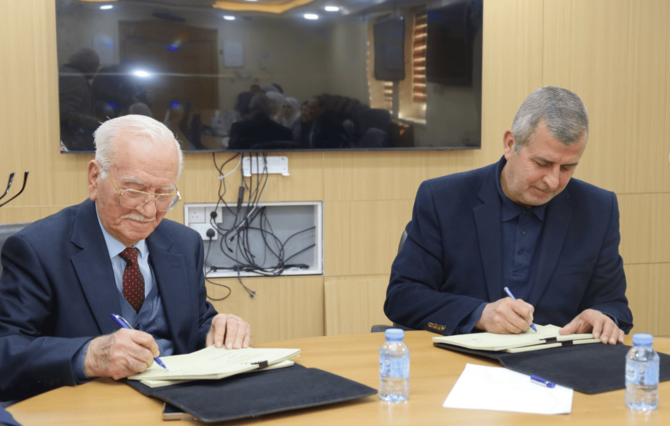
Jordan signs 2 mineral exploration MoUs in Southern regions 

The deals were signed by Minister of Energy and Mineral Resources Saleh Kharabsheh and Bassam Fakhouri, director general of the Chemical and Mining Industries Co. X/@PetranewsEN
Short Url
Updated 21 January 2026
Follow

Jordan signs 2 mineral exploration MoUs in Southern regions 

JEDDAH: Jordan signed two agreements to explore mineral resources in Wadi Abu Al-Buraq and Samra Al-Taybeh in the southern part of the country, aiming to attract investment and create jobs. 

The first memorandum of understanding allows prospecting for base, precious, critical and strategic minerals — including rare earth elements — across 13.9 sq. km in the Jabal Samra Al-Taybeh area for a period of 67 weeks, the Jordan News Agency, also known as Petra, reported. 

The second MoU covers the exploration of gold ore, as well as base, precious, critical, and strategic minerals, and rare earth elements, over 106 sq. km in the Jabal Abu Al-Buraq area for 98 weeks. 

Mining is a central pillar of Jordan’s Economic Modernization Vision, which aims to raise the sector’s contribution to gross domestic product to 2.1 percent by 2033, expand employment to 27,000 workers and lift exports to 3.4 billion Jordanian dinars ($4.8 billion).

The government estimates untapped opportunities at about $1.14 billion, including in calcium phosphate and specialized phosphate products. 

The deals were signed by Minister of Energy and Mineral Resources Saleh Kharabsheh and Bassam Fakhouri, director general of the Chemical and Mining Industries Co. 

“At the signing ceremony, Kharabsheh said the step will strengthen the mining sector’s contribution to the national economy and support investment, knowledge transfer, and job creation under an integrated national program to develop and utilize Jordan’s mineral resources,” Petra reported. 

He added that the MoUs support the government’s strategy to expand responsible investment and foster partnerships with qualified national and international firms, facilitating technology transfer and creating jobs for Jordanians. 

The minister said the agreements build on earlier MoUs covering gold, copper, rare earth elements, phosphate and lithium, with three additional agreements currently under negotiation. 

Jordan’s mining industries currently export to 61 countries, with India accounting for 44 percent of shipments, followed by Indonesia, China, Egypt and Brazil, according to a Jordan Chamber of Industry report cited by Petra. Exports rose 12 percent in the first nine months of the year to 859 million dinars. 

The sector, which includes phosphate, potash and chemical minerals, employs around 8,000 people directly and supplies most of Jordan’s domestic demand. 


New ownership rules spark foreign demand for Saudi real estate

Updated 9 sec ago
Follow

New ownership rules spark foreign demand for Saudi real estate

RIYADH: Property developers in Saudi Arabia are seeing increased interest from international investors following the Kingdom’s recent amendments to real estate ownership laws, industry figures told Arab News.

Speaking at the Real Estate Future Forum in Riyadh, developers said the new regulations permitting foreign ownership of land are beginning to influence market behavior, including decisions by developers and speculators.

The updated regulatory framework officially came into effect on Jan. 22, enabling non-Saudis to apply for property ownership through the Saudi Arabia Real Estate digital platform.

Under the new rules, foreign individuals, companies, and entities are allowed to own property across the Kingdom, including in major urban centers such as Riyadh and Jeddah. Ownership in Makkah and Madinah, however, remains limited to Saudi companies and Muslim individuals.

Developers say the policy shift is already shaping large-scale projects, including Alma Destination on the Red Sea coast.

The waterfront mixed-use tourism development is opening opportunities for hospitality operators and investors, with plans encompassing residential units, hospitality offerings, marina facilities, and entertainment venues.

Zuhair Bakheet, CEO of Al Thuraya Al Omranya Properties and master developer of Alma Destination. Supplied

Zuhair Bakheet, CEO of Al Thuraya Al Omranya Properties and master developer of Alma Destination, said the project’s location in Jeddah, situated between the holy cities of Makkah and Madinah, enhances its appeal to international buyers.

“If we attract people who would love to have a unit within the Makkah and Madinah region, it’s a good option. If we think of Muslim countries like … Malaysia, Indonesia, Egypt, they would love to have a unit within close proximity of the holy cities,” he said.

Another developer factoring the regulatory change into its strategy is Emaar Economic City, the main developer of King Abdullah Economic City.

Emaar Economic City Chief Investment Officer Ali Al-Khatib told Arab News that the new framework represents a major shift for the sector. “We believe these new regulations for non-Saudi ownership are a significant turning point in the real estate sector in the Kingdom, and specifically for King Abdullah Economic City.

“We’ve already seen interest before the system was launched from last year … we’ve had interests from all around the world from Southeast Asia, from Africa, from Europe, from the West.”