Israel fulfilling ‘none’ of its legal duties as an occupying power, UN chief warns

Palestinians receive food aid from an UNRWA distribution center at the Nuseirat refugee camp in the central Gaza Strip, Mar. 3, 2025. (AFP)
Short Url
Updated 08 April 2025
Follow

Israel fulfilling ‘none’ of its legal duties as an occupying power, UN chief warns

  • Gaza is ‘killing field’ and civilians caught in ‘endless death loop,’ says Secretary-General Antonio Guterres
  • West Bank could spiral into a similar crisis unless urgent steps are taken to protect civilians, end dehumanization and restore peace, he adds

NEW YORK CITY: The UN secretary-general evoked several provisions of the Fourth Geneva Convention on Tuesday to remind Israeli authorities of an occupying power’s “unequivocal” obligations under international law.

The obligations Antonio Guterres highlighted included ensuring the welfare of the civilian population, the supply of food and medicine, and the maintenance of public health services.

“None of that is happening today,” he said. “No humanitarian supplies can enter Gaza. At the crossing points, food, medicine and shelter supplies are piling up and vital equipment is stuck.”

Speaking in New York to reporters, the UN chief described Gaza’s current path as a dead end that is “totally intolerable” in the eyes of international law and history.

He also warned that the situation in the West Bank could spiral into a similar crisis unless urgent steps are taken to protect civilians, end dehumanization and restore peace.

Guterres called for an immediate, unconditional ceasefire in Gaza and full humanitarian access to be restored. It has been more than a month since aid entered the territory, he added, exacerbating an already devastating humanitarian crisis.

“More than an entire month has passed without a drop of aid into Gaza,” he said. “No food. No fuel. No medicine. No commercial supplies. As aid has dried up, the floodgates of horror have reopened.”
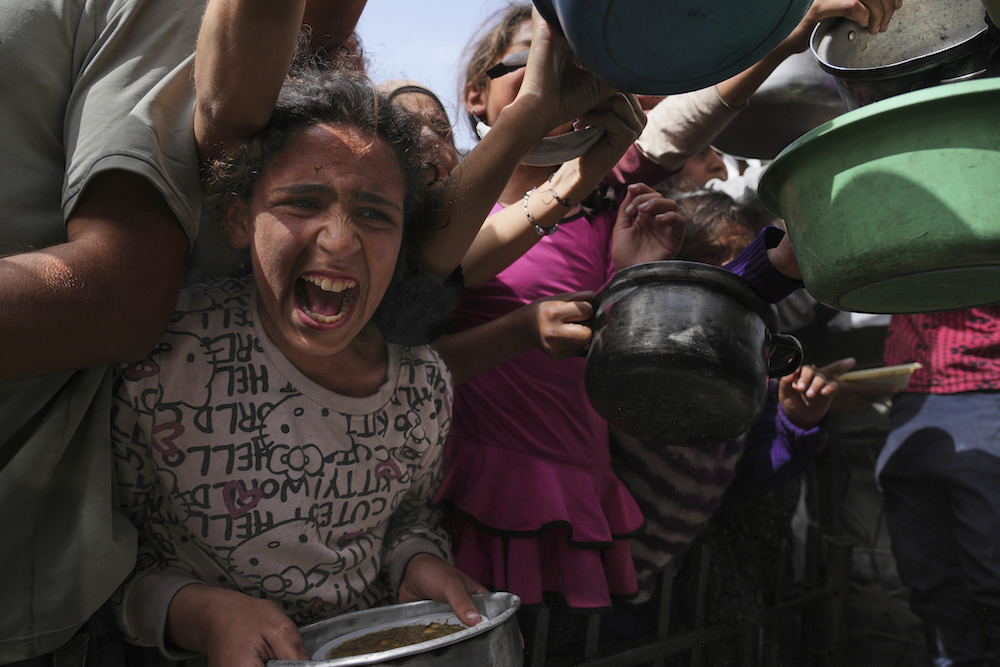


A Palestinian girl struggles as she and others try to get donated food at a distribution center in Beit Lahiya in the northern Gaza Strip. (AP)

Guterres condemned proposals by Israeli authorities to introduce “authorization mechanisms” for the delivery of aid that risk further controlling and “callously limiting aid, down to the last calorie and grain of flour.”

He said the UN “will not participate in any arrangement that does not fully respect the humanitarian principles: humanity, impartiality, independence and neutrality.”

He warned that “the situation in Gaza has become a killing field” and civilians are trapped in an “endless death loop” as a result of the blockade on food, medicine, fuel and other essential supplies.

“Ceasefires work,” Guterres said. “During that ceasefire (between January and March this year), humanitarian organizations successfully delivered critical aid, including food and medical supplies, to Gaza. Guns fell silent, obstacles were removed, looting ended and we were able to deliver lifesaving supplies to virtually every part of the Gaza Strip.

“That all ended with the shattering of the ceasefire. Hope sank for Palestinian families in Gaza and families of hostages in Israel.”

Guterres expressed deep concern about the continuing detention of hostages by Hamas and other militant groups in Gaza. He met the families of the hostages on Monday and reiterated his call for their immediate release.

“With crossing points into Gaza shut and aid blockaded, security is in shambles and our capacity to deliver has been strangled,” he continued.

He reiterated the declaration made by UN humanitarian organizations on Monday, who said in a joint statement that “assertions that there is now enough food to feed all Palestinians in Gaza are far from the reality on the ground, and commodities are running extremely low.”

Guterres said: “We must stick to our core principles. It is time to end the dehumanization, protect civilians, release the hostages, ensure lifesaving aid and renew the ceasefire.

“The world may be running out of words to describe the situation in Gaza but we will never run away from the truth.”


Lebanon PM publishes long-awaited banking law draft

Updated 4 sec ago
Follow

Lebanon PM publishes long-awaited banking law draft

  • The law stipulates that each of the state, the central bank, commercial banks and depositors will share the losses accrued as a result of the financial crisis.
  • Depositors with a limit of $100,000, over the course of four years

BEIRUT: Lebanese Prime Minister Nawaf Salam published on Friday a long-awaited banking draft bill, which distributes losses from the 2019 economic crisis between banks and the state.
The draft law is a key demand from the international community, which has conditioned economic aid to Lebanon on financial reforms.
In a televised speech, Salam said “this draft law constitutes a roadmap to getting out of the crisis” that still grips Lebanon.
The draft will be discussed by the Lebanese cabinet on Monday before being sent to parliament, where it could be blocked.
The law stipulates that each of the state, the central bank, commercial banks and depositors will share the losses accrued as a result of the financial crisis.
Depositors, who lost access to their funds after the crisis, will be able to retrieve their money, with a limit of $100,000, over the course of four years.
Salam said that 85 percent of depositors had less than $100,000 in their accounts.
The wealthiest depositors will see the remainder of their money compensated by asset-backed securities.
“I know that many of you are listening today with hearts full of anger, anger at a state that abandoned you,” Salam said.
“This bill may not be perfect... but it is a realistic and fair step toward restoring rights, halting the collapse.”

- ‘Banks are angry’ -

The International Monetary Fund, which closely monitored the drafting of the bill, had previously insisted on the need to “restore the viability of the banking sector consistent with international standards” and protect small depositors.
The Associations of Banks in Lebanon criticized the draft law on Monday, saying in a statement that it contains “serious shortcomings” and harms commercial banks.
“Banks are angry because the law opens the door to them sharing any part of the losses,” said Sami Zougheib, researcher at The Policy Initiative, a Beirut-based think tank.
He told AFP that banks would have preferred that the state bear full responsibility.
The text provides for the recapitalization of failing banks, while the government’s debt to the Central Bank will be converted into bonds.
Salam said that the bill aims to “revive the banking sector” which had collapsed, giving free rein to a parallel economy based on cash transactions, which facilitate money laundering and illicit trade.
According to government estimates, the losses resulting from the financial crisis amounted to about $70 billion, a figure that is expected to have increased over the six years that the crisis was left unaddressed.
Since assuming power, Salam and President Joseph Aoun have pledged to implement the necessary reforms and legislation.
In April, Lebanon’s parliament adopted a bank restructuring law, as the previous legislation was believed to have allowed a flight of capital at the outbreak of the 2019 crisis.
The new bill stipulates that politically exposed persons and major shareholders who transferred significant capital outside the country from 2019 onwards — while ordinary depositors were deprived of their savings — must return them within three months or face fines.
The draft law could still be blocked by parliament even if the cabinet approves it.
“Many lawmakers are directly exposed as large depositors or bank shareholders, politically allied with bank owners, and unwilling to pass a law that either angers banks or angers depositors,” Zougheib said.
Politicians and banking officials have repeatedly obstructed the reforms required by the international community for Lebanon to receive financial support.