WASHINGTON: Israeli Prime Minister Benjamin Netanyahu met Donald Trump at the White House on Monday, becoming the first foreign leader to personally plead for a reprieve from stinging US tariffs that have shaken the world.
Netanyahu and Trump are also set to discuss Gaza, where a short-lived US-brokered truce between Israel and Hamas has collapsed, and growing tensions with Iran.
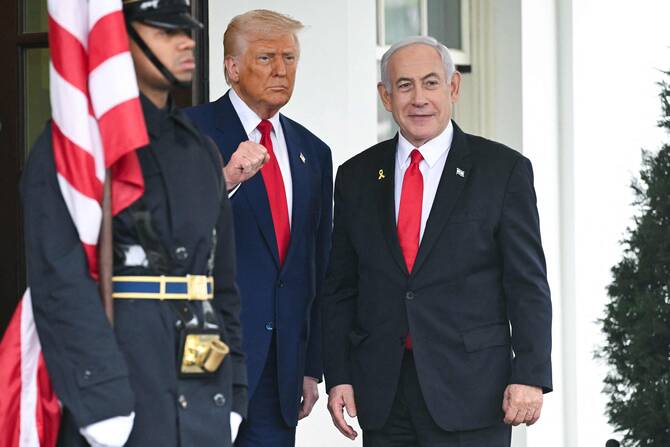
Trump greeted Netanyahu outside the West Wing and pumped his fist, before the two leaders — both wearing dark suits, red ties and white shirts — went inside for a meeting in the Oval Office.
A planned press conference between the two leaders was canceled at short notice without explanation in an unusual move. During his last visit, Netanyahu and Trump both spoke to reporters in the Oval and then held a press conference.
The Israeli premier’s visit is his second to Trump since the US president returned to power and comes at short notice — just days after Trump slapped a 17 percent tariff on Israel in his “Liberation Day” announcement last week.
Trump refused to exempt the top beneficiary of US military aid from his global tariff salvo as he said Washington had a significant trade deficit with Israel.
Netanyahu said on his way to Washington on Sunday that they would discuss “the hostages, achieving victory in Gaza, and of course the tariff regime that has also been imposed on Israel.”
“I’m the first international leader, the first foreign leader who will meet with President Trump on a matter so crucial to Israel’s economy,” he said in a video statement.
“There is a long line of leaders who want to do this. I believe this reflects the special personal relationship and the unique bond between the United States and Israel, which is so vital at this time.”
Netanyahu met with US Commerce Secretary Howard Lutnick and US Trade Representative Jamieson Greer on Sunday night soon after his arrival, according to his office.
The Israeli premier also met Trump’s special Middle East envoy Steve Witkoff on Monday.
Trump told reporters on Sunday that “We’re going to talk about trade, and we’re going to talk about the obvious subject.”
“There’s a lot of things going on with the Middle East right now that have to be silenced,” he added.
Israel’s war in Gaza, sparked by Hamas’s October 2023 attack, and the fate of the Israeli and US hostages still held in Gaza will be a major subject of discussion.
Israel resumed intense strikes on Gaza on March 18, and the weeks-long ceasefire with Hamas that the United States, Egypt and Qatar had brokered collapsed.
Trump has so far backed Israel to the hilt, accusing Hamas of failing to release the hostages.
The United States has also brushed off an incident in which 15 medics and rescuers were killed by Israeli forces last month in Gaza, sparking international condemnation.
Israel’s army chief on Monday ordered a “deeper” investigation into the attack.
France’s President Emmanuel Macron said Monday he had organized a call to Trump with the leaders of Egypt and Jordan during a visit to Cairo, with the leaders also calling for an immediate return to the truce.
The leaders also insisted that the Palestinian Authority alone must be in charge of the post-war governance of the Gaza Strip — rejecting Trump’s plan for the US to “own” the enclave after the war.
On Iran, Trump has been pressing for “direct talks” with Tehran on a new deal to curb the Islamic republic’s nuclear program.
But Iranian foreign ministry spokesman Esmail Baghai said Tehran’s proposal for indirect negotiations was “generous, responsible and wise.”
There has been widespread speculation that Israel, possibly with US help, might attack Iranian facilities if no agreement is reached.
Netanyahu arrived direct from a visit to Hungary where Prime Minister Viktor Orban pulled his country out of the International Criminal Court (ICC) because the court issued an arrest warrant for the Israeli leader over the Gaza war.
Both leaders also spoke by phone with Trump on Thursday.

Netanyahu meets Trump for tariff and Gaza talks
Short Url
https://arab.news/2trh5
Netanyahu meets Trump for tariff and Gaza talks
- Analysts said Netanyahu would seek to secure an exemption from the tariffs for Israel
- Netanyahu will also discuss the war sparked by Hamas’s October 2023 attack, the Israeli hostages still held in Gaza, and the “growing threat from Iran”
Deal is signed in Beirut to transfer 300 Syrian prisoners in Lebanon to their home country
- Lebanon’s Deputy Prime Minister Tarek Mitri and Syria’s Justice Minister Mazhar Al-Wais expressed hope that this step will boost confidence and progress relations
- Lebanon and Syria have signed an agreement to transfer over 300 Syrian detainees from Lebanese prisons to continue their sentences in Syria
BEIRUT: Lebanon and Syria signed an agreement Friday to transfer more than 300 Syrians from Lebanese prisons to continue serving their sentences in their home country, a step that will likely help improve strained relations between the two neighbors.
The signing came a week after Lebanon’s Cabinet approved a treaty with Syria for the transfer of prisoners. The deal was signed at the government headquarters in the Lebanese capital, Beirut, by Lebanon’s Deputy Prime Minister Tarek Mitri and Syria’s Justice Minister Mazhar Al-Wais.
“This is a very important first step on the road of a comprehensive treatement regarding Syrian prisoners in Lebanese prisons,” Mitri told reporters, adding that the implementation of the agreement would start on Saturday.
“Both countries want to move forward but there are some pending matters,” Al-Wais said. “This step will boost existing confidence and we hope that relations will progress more.”
Mitri said that next, officials from the two neighboring countries, will discuss the transfer of Syrian detainees who are still waiting trial in Lebanon.
Lebanon and Syria have a complicated history, with grievances on both sides. Many Lebanese resent nearly three decades of domination and military presence in their country by Syrian forces that ended in 2005.
Many Syrians resent the role played by the Lebanese militant group Hezbollah when it entered Syria’s civil war that broke out in 2011 in defense of then-President Bashar Assad and his government. Assad was overthrown in December 2024 and fled to Russia where he is now in exile.
After Assad’s fall, relations with Syria’s new Islamist-led authorities remained tense and skirmishes occurred along the unmarked border between the two nations.
Mitri also said Saturday’s signing was “an expression of a joint political will that states that the Lebanese-Syrian relations are based on confidence and mutual respect.”
Asked whether the deal will include Lebanese citizens such as Sunni Muslim cleric Ahmed Al-Assir, Mitri said that it only covers Syrian prisoners.
There are about 2,500 Syrian prisoners in Lebanese prisons and jails, some of whom are held on charges related to their involvement with armed opposition groups that sought to overthrow Assad — in some cases, the same groups that are now ruling Syria.
Earlier this week, Mitri told The Associated Press that most of the detainees who will be transferred to Syria were not convicted of violent crimes. Some of those convicted of violent crimes may be transferred if they have already served seven and a half years of their sentence in Lebanon, he said.
The signing came a week after Lebanon’s Cabinet approved a treaty with Syria for the transfer of prisoners. The deal was signed at the government headquarters in the Lebanese capital, Beirut, by Lebanon’s Deputy Prime Minister Tarek Mitri and Syria’s Justice Minister Mazhar Al-Wais.
“This is a very important first step on the road of a comprehensive treatement regarding Syrian prisoners in Lebanese prisons,” Mitri told reporters, adding that the implementation of the agreement would start on Saturday.
“Both countries want to move forward but there are some pending matters,” Al-Wais said. “This step will boost existing confidence and we hope that relations will progress more.”
Mitri said that next, officials from the two neighboring countries, will discuss the transfer of Syrian detainees who are still waiting trial in Lebanon.
Lebanon and Syria have a complicated history, with grievances on both sides. Many Lebanese resent nearly three decades of domination and military presence in their country by Syrian forces that ended in 2005.
Many Syrians resent the role played by the Lebanese militant group Hezbollah when it entered Syria’s civil war that broke out in 2011 in defense of then-President Bashar Assad and his government. Assad was overthrown in December 2024 and fled to Russia where he is now in exile.
After Assad’s fall, relations with Syria’s new Islamist-led authorities remained tense and skirmishes occurred along the unmarked border between the two nations.
Mitri also said Saturday’s signing was “an expression of a joint political will that states that the Lebanese-Syrian relations are based on confidence and mutual respect.”
Asked whether the deal will include Lebanese citizens such as Sunni Muslim cleric Ahmed Al-Assir, Mitri said that it only covers Syrian prisoners.
There are about 2,500 Syrian prisoners in Lebanese prisons and jails, some of whom are held on charges related to their involvement with armed opposition groups that sought to overthrow Assad — in some cases, the same groups that are now ruling Syria.
Earlier this week, Mitri told The Associated Press that most of the detainees who will be transferred to Syria were not convicted of violent crimes. Some of those convicted of violent crimes may be transferred if they have already served seven and a half years of their sentence in Lebanon, he said.
© 2026 SAUDI RESEARCH & PUBLISHING COMPANY, All Rights Reserved And subject to Terms of Use Agreement.


