Artist of ‘distorted’ portrait says Trump complaint harming business

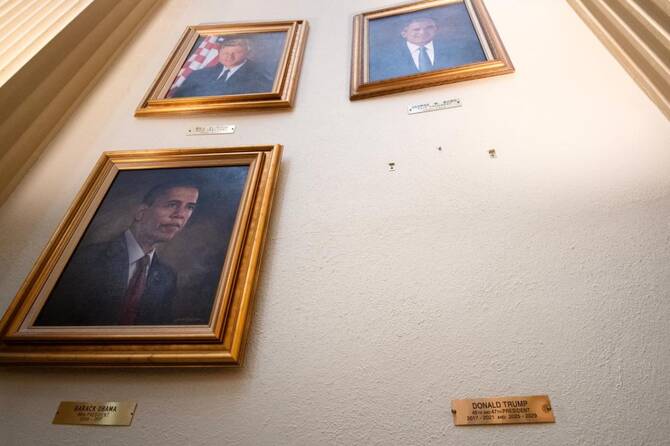
Colorado removed the official portrait of Trump from display in the state’s capitol building last month after the president complained that it was deliberately unflattering. (AFP)
Short Url
Updated 06 April 2025
Follow

Artist of ‘distorted’ portrait says Trump complaint harming business

WASHINGTON: The artist who painted US President Donald Trump in what he criticized as a “purposefully distorted” portrait has said his remarks have harmed her business.
Colorado removed the official portrait of Trump from display in the state’s capitol building last month after the president complained that it was deliberately unflattering.
“Nobody likes a bad picture or painting of themselves, but the one in Colorado, in the State Capitol... along with all other Presidents, was purposefully distorted,” Trump wrote on his Truth Social platform on March 24.
“The artist also did President Obama, and he looks wonderful, but the one on me is truly the worst,” Trump said.
The 78-year-old Republican called for the oil painting to be taken down, and said the artist, Sarah Boardman, “must have lost her talent as she got older.”
The Democrat-controlled Colorado legislature said the same day as Trump’s complaint that the painting would be removed from the gallery in the capitol’s rotunda — where it had been hung since 2019 — and placed in storage.
Boardman has responded to Trump’s critique in a statement on her website, saying she completed the work “accurately, without ‘purposeful distortion,’ political bias, or any attempt to caricature the subject, actual or implied.”
“President Trump is entitled to comment freely, as we all are, but the additional allegations that I ‘purposefully distorted’ the portrait, and that I ‘must have lost my talent as I got older’ are now directly and negatively impacting my business of over 41 years,” the British-born artist said.
Boardman added in the undated statement that for the six years that the portrait of Trump hung in the Colorado capitol, she “received overwhelmingly positive reviews” on the commissioned work.
However, since Trump’s comments “that has changed for the worst,” she said.
In addition to Trump and former president Barack Obama, Boardman was also commissioned to paint a portrait of ex-president George W. Bush.


English museum shines light on Mary Shelley and her Gothic classic ‘Frankenstein’  

Updated 55 min 47 sec ago
Follow

English museum shines light on Mary Shelley and her Gothic classic ‘Frankenstein’  

  • Museum in English city of Bath celebrates work of Mary Shelley

BATH: On a window of a Bath townhouse, one of the southwestern ​English city’s most famous residents looks out at passersby. Inside is Mary Shelley’s House of Frankenstein, a museum dedicated to the writer and her Gothic novel, published in 1818, which has inspired numerous screen adaptations, with the latest being Mexican filmmaker Guillermo del Toro’s Oscar contender.
“‘Frankenstein’ is regarded as one of the most important books in English literature ... It’s the world’s first science fiction novel,” said Chris Harris, co-founder and director of the immersive attraction.
“It’s a very modern story ... he’s trying to fit in, but he’s abandoned ... and rejected and ‌has prejudice thrown ‌toward him. And you think, well, from prejudice comes violence, ​which is ‌happening ⁠nowadays.”
‘FEAR ABOUT ​CHANGE’

Born ⁠Mary Wollstonecraft Godwin, Shelley came up with the idea for “Frankenstein; or, the Modern Prometheus” at 18 years old. She and her future husband, poet Percy Bysshe Shelley, were staying by Lake Geneva in 1816 with Lord Byron when the latter challenged their group to write a ghost story. She found inspiration there.
Back in England, she moved to Bath, where she penned key chapters before finishing the book — about the scientist Victor Frankenstein, who brings to life a creature ⁠assembled from body parts — in the town of Marlow.
“It plays on ‌people’s fears about change,” Harris said. “Now Frankenstein is a ‌metaphor for anything we’re scared of.”
The first “Frankenstein” adaptation was ​a musical, he said.
“The Creature in her ‌book is sensitive, he talks ... but in the play, he was rendered into a ‌monster. He didn’t talk, he was mute. He just went around killing people,” Harris said.
“So, right from the off, he’s been sort of invented in a slightly different way. And that’s happened all the way through the evolution of film and theater ... So it’s interesting to see del Toro’s ‌film; they’re exploring a different side of him.”
OSCAR AND BAFTA NOMINATIONS
That film, with nine Oscar nominations including best picture, shows actor ⁠Jacob Elordi’s Creature as ⁠gentle and hungry for knowledge but facing resentment. Elordi received Best Supporting Actor nods at the Oscars and Sunday’s BAFTA Film Awards, Britain’s top movie honors, where “Frankenstein” has eight nominations.
While del Toro’s movie differs from the book in several ways, including omitting the Creature’s murders, Harris said physically it was “a similar recreation” of Shelley’s description.
The museum has its own animatronic, standing in Victor Frankenstein’s recreated laboratory. Elsewhere, visitors learn about Shelley’s life, tragedies she faced and her interest in science.
Nearby, by Bath Abbey, is a 2018 plaque marking where Shelley lived in 1816-1817 and worked on the book. Bath is also associated with another female novelist, Jane Austen, who is celebrated annually with a festival. Harris, who opened his museum in 2021, says ​Shelley deserves more recognition.
“We just want ​people to understand that this is an extraordinary young woman who came up with one of the most enduring books ever written, that will never go out of fashion.”