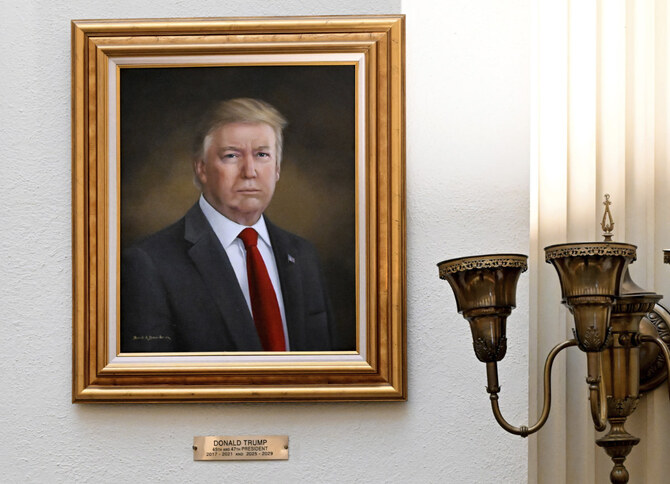
DENVER: A painting of Donald Trump hanging with other presidential portraits at the Colorado state Capitol will be taken down after Trump claimed that his was “purposefully distorted,” according to a letter obtained by The Associated Press.
House Democrats said in a statement that the oil painting would be taken down at the request of Republican leaders in the Legislature. Colorado Republicans raised more than $10,000 through a GoFundMe account to commission the oil painting, which was unveiled in 2019.
Senate Minority Leader Paul Lundeen, a Republican, said that he requested for Trump’s portrait to be taken down and replaced by one “that depicts his contemporary likeness.”
“If the GOP wants to spend time and money on which portrait of Trump hangs in the Capitol, then that’s up to them,” the Democrats said.
The portrait was installed alongside other paintings of US presidents. Before the installation, a prankster placed a picture of Russian President Vladimir Putin near the spot intended for Trump.
Initially, people objected to artist Sarah Boardman’s depiction of Trump as “nonconfrontational” and “thoughtful” in the portrait, according to an interview with Colorado Times Recorder from the time.
But in a Sunday night post on his Truth Social platform, Trump said he would prefer no picture at all over the one that hangs in the Colorado Capitol. The Republican lauded a nearby portrait of former President Barack Obama – also by Boardman – saying “he looks wonderful.”
“Nobody likes a bad picture or painting of themselves, but the one in Colorado, in the state Capitol, put up by the Governor, along with all other Presidents, was purposefully distorted to a level that even I, perhaps, have never seen before,” Trump wrote.
The portraits are not the purview of the Colorado governor’s office but the Colorado Building Advisory Committee. The ones up to and including President Jimmy Carter were donated as a collection. The others were donated by political parties or, more recently, paid for by outside fundraising.
The Legislature’s executive committee, made up of both Democratic and Republican leadership, signed a letter directing the removal of Trump’s portrait. Lundeen, the Republican senator who requested it, noted that Grover Cleveland, whose presidential terms were separated like Trump’s, had a portrait from his second term.
Boardman did not immediately respond to a request for comment from The Associated Press. In interviews from the time with The Denver Post, Boardman said it was important that her depictions of both Obama and Trump looked apolitical.
“There will always be dissent, so pleasing one group will always inflame another. I consider a neutrally thoughtful, and nonconfrontational, portrait allows everyone to reach their own conclusions in their own time,” Boardman told the Colorado Times Recorder in 2019.
Trump’s Sunday night comments had prompted a steady stream of visitors to pose for photos with the painting before the announcement that it would be taken down.
Aaron Howe, visiting from Wyoming on Monday, stood in front of Trump’s portrait, looking down at photos of the president on his phone, then back up at the portrait.
“Honestly he looks a little chubby,” said Howe of the portrait, but “better than I could do.”
“I don’t know anything about the artist,” said Howe, who voted for Trump. “It could be taken one way or the other.”
Kaylee Williamson, an 18-year-old Trump supporter from Arkansas, got a photo with the portrait.
“I think it looks like him. I guess he’s smoother than all the other ones,” she said. “I think it’s fine.”


![]()

Trump’s portrait to be taken down at Colorado Capitol after president claimed it was ‘distorted’
Short Url
https://arab.news/b3h4d
Trump’s portrait to be taken down at Colorado Capitol after president claimed it was ‘distorted’
- Trump’s Sunday night comments had prompted a steady stream of visitors to pose for photos with the painting before the announcement that it would be taken down


Latest updates


Recommended


© 2026 SAUDI RESEARCH & PUBLISHING COMPANY, All Rights Reserved And subject to Terms of Use Agreement.