

English museum shines light on Mary Shelley and her Gothic classic ‘Frankenstein’  

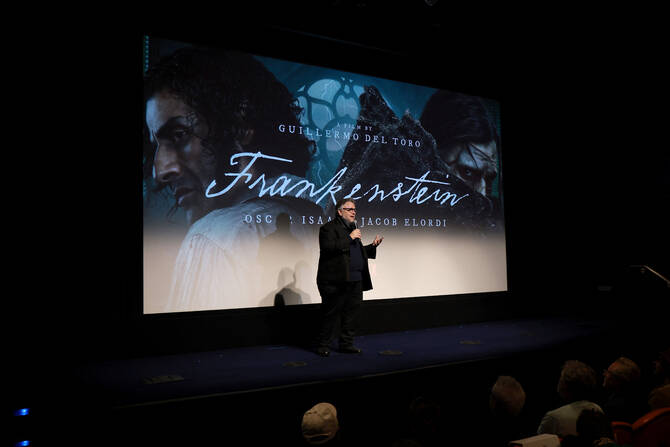
While del Toro’s movie differs from the book in several ways, including omitting the Creature’s murders, Harris said physically it was “a similar recreation” of Shelley’s description. (AFP filephoto)
Short Url
Updated 16 February 2026
Follow

English museum shines light on Mary Shelley and her Gothic classic ‘Frankenstein’  

  • Museum in English city of Bath celebrates work of Mary Shelley

BATH: On a window of a Bath townhouse, one of the southwestern ​English city’s most famous residents looks out at passersby. Inside is Mary Shelley’s House of Frankenstein, a museum dedicated to the writer and her Gothic novel, published in 1818, which has inspired numerous screen adaptations, with the latest being Mexican filmmaker Guillermo del Toro’s Oscar contender.
“‘Frankenstein’ is regarded as one of the most important books in English literature ... It’s the world’s first science fiction novel,” said Chris Harris, co-founder and director of the immersive attraction.
“It’s a very modern story ... he’s trying to fit in, but he’s abandoned ... and rejected and ‌has prejudice thrown ‌toward him. And you think, well, from prejudice comes violence, ​which is ‌happening ⁠nowadays.”
‘FEAR ABOUT ​CHANGE’

Born ⁠Mary Wollstonecraft Godwin, Shelley came up with the idea for “Frankenstein; or, the Modern Prometheus” at 18 years old. She and her future husband, poet Percy Bysshe Shelley, were staying by Lake Geneva in 1816 with Lord Byron when the latter challenged their group to write a ghost story. She found inspiration there.
Back in England, she moved to Bath, where she penned key chapters before finishing the book — about the scientist Victor Frankenstein, who brings to life a creature ⁠assembled from body parts — in the town of Marlow.
“It plays on ‌people’s fears about change,” Harris said. “Now Frankenstein is a ‌metaphor for anything we’re scared of.”
The first “Frankenstein” adaptation was ​a musical, he said.
“The Creature in her ‌book is sensitive, he talks ... but in the play, he was rendered into a ‌monster. He didn’t talk, he was mute. He just went around killing people,” Harris said.
“So, right from the off, he’s been sort of invented in a slightly different way. And that’s happened all the way through the evolution of film and theater ... So it’s interesting to see del Toro’s ‌film; they’re exploring a different side of him.”
OSCAR AND BAFTA NOMINATIONS
That film, with nine Oscar nominations including best picture, shows actor ⁠Jacob Elordi’s Creature as ⁠gentle and hungry for knowledge but facing resentment. Elordi received Best Supporting Actor nods at the Oscars and Sunday’s BAFTA Film Awards, Britain’s top movie honors, where “Frankenstein” has eight nominations.
While del Toro’s movie differs from the book in several ways, including omitting the Creature’s murders, Harris said physically it was “a similar recreation” of Shelley’s description.
The museum has its own animatronic, standing in Victor Frankenstein’s recreated laboratory. Elsewhere, visitors learn about Shelley’s life, tragedies she faced and her interest in science.
Nearby, by Bath Abbey, is a 2018 plaque marking where Shelley lived in 1816-1817 and worked on the book. Bath is also associated with another female novelist, Jane Austen, who is celebrated annually with a festival. Harris, who opened his museum in 2021, says ​Shelley deserves more recognition.
“We just want ​people to understand that this is an extraordinary young woman who came up with one of the most enduring books ever written, that will never go out of fashion.”


Cambodia takes back looted historic artifacts handled by British art dealer

Updated 28 February 2026
Follow

Cambodia takes back looted historic artifacts handled by British art dealer

  • The objects were returned under a 2020 agreement between the Ministry of Culture and Fine Arts and the family of the late Douglas Latchford, a British art collector and dealer who allegedly had the items smuggled out of Cambodia

PHNOM PENH, Cambodia: Cambodian officials on Friday received more than six dozen historic artifacts described as part of the country’s cultural heritage that had been looted during decades of war and instability.
At a ceremony attended by Deputy Prime Minister Hun Many, the 74 items were unveiled at the National Museum in Phnom Penh after their repatriation from the United Kingdom.
The objects were returned under a 2020 agreement between the Ministry of Culture and Fine Arts and the family of the late Douglas Latchford, a British art collector and dealer who allegedly had the items smuggled out of Cambodia.
“This substantial restitution represents one of the most important returns of Khmer cultural heritage in recent years, following major repatriations in 2021 and 2023 from the same collection,” the Culture Ministry said in a statement. “It marks a significant step forward in Cambodia’s continued efforts to recover, preserve, and restore its ancestral legacy for future generations.”
The artifacts were described as dating from the pre-Angkorian period through the height of the Angkor Empire, including “monumental sandstone sculptures, refined bronze works, and significant ritual objects.” The Angkor Empire, which extended from the ninth to the 15th century, is best known for the Angkor Wat archaeological site, the nation’s biggest tourist attraction.
Latchford was a prominent antiquities dealer who allegedly orchestrated an operation to sell looted Cambodian sculptures on the international market.
From 1970 to the 1980s, during Cambodia’s civil wars and the communist Khmer Rouge ‘s brutal reign, organized looting networks sent artifacts to Latchford, who then sold them to Western collectors, dealers, and institutions. These pieces were often physically damaged, having been pried off temple walls or other structures by the looters.
Latchford was indicted in a New York federal court in 2019 on charges including wire fraud and conspiracy. He died in 2020, aged 88, before he could be extradited to face charges.
Cambodia, like neighboring Thailand, has benefited from a trend in recent decades involving the repatriation of art and archaeological treasures. These include ancient Asian artworks as well as pieces lost or stolen during turmoil in places such as Syria, Iraq and Nazi-occupied Europe. New York’s Metropolitan Museum of Art is one of the prominent institutions that has been returning illegally smuggled art, including to Cambodia.
“The ancient artifacts created and preserved by our ancestors are now being returned to Cambodia, bringing warmth and joy, following the country’s return to peace,” said Hun Many, who is the younger brother of Prime Minister Hun Manet.