

English museum shines light on Mary Shelley and her Gothic classic ‘Frankenstein’  

While del Toro’s movie differs from the book in several ways, including omitting the Creature’s murders, Harris said physically it was “a similar recreation” of Shelley’s description. (AFP filephoto)
Short Url
Updated 16 February 2026
Follow

English museum shines light on Mary Shelley and her Gothic classic ‘Frankenstein’  

  • Museum in English city of Bath celebrates work of Mary Shelley

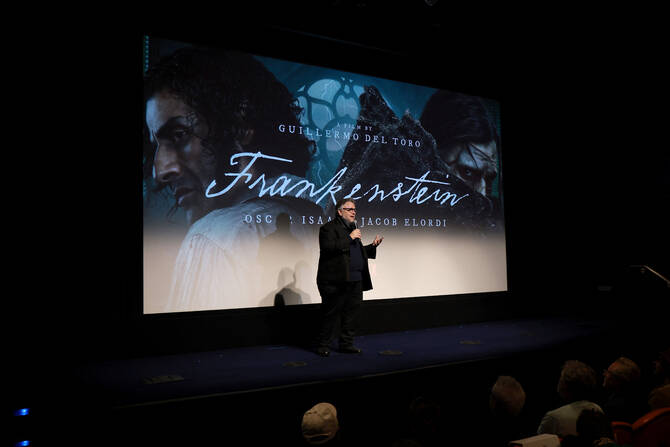
BATH: On a window of a Bath townhouse, one of the southwestern ​English city’s most famous residents looks out at passersby. Inside is Mary Shelley’s House of Frankenstein, a museum dedicated to the writer and her Gothic novel, published in 1818, which has inspired numerous screen adaptations, with the latest being Mexican filmmaker Guillermo del Toro’s Oscar contender.
“‘Frankenstein’ is regarded as one of the most important books in English literature ... It’s the world’s first science fiction novel,” said Chris Harris, co-founder and director of the immersive attraction.
“It’s a very modern story ... he’s trying to fit in, but he’s abandoned ... and rejected and ‌has prejudice thrown ‌toward him. And you think, well, from prejudice comes violence, ​which is ‌happening ⁠nowadays.”
‘FEAR ABOUT ​CHANGE’

Born ⁠Mary Wollstonecraft Godwin, Shelley came up with the idea for “Frankenstein; or, the Modern Prometheus” at 18 years old. She and her future husband, poet Percy Bysshe Shelley, were staying by Lake Geneva in 1816 with Lord Byron when the latter challenged their group to write a ghost story. She found inspiration there.
Back in England, she moved to Bath, where she penned key chapters before finishing the book — about the scientist Victor Frankenstein, who brings to life a creature ⁠assembled from body parts — in the town of Marlow.
“It plays on ‌people’s fears about change,” Harris said. “Now Frankenstein is a ‌metaphor for anything we’re scared of.”
The first “Frankenstein” adaptation was ​a musical, he said.
“The Creature in her ‌book is sensitive, he talks ... but in the play, he was rendered into a ‌monster. He didn’t talk, he was mute. He just went around killing people,” Harris said.
“So, right from the off, he’s been sort of invented in a slightly different way. And that’s happened all the way through the evolution of film and theater ... So it’s interesting to see del Toro’s ‌film; they’re exploring a different side of him.”
OSCAR AND BAFTA NOMINATIONS
That film, with nine Oscar nominations including best picture, shows actor ⁠Jacob Elordi’s Creature as ⁠gentle and hungry for knowledge but facing resentment. Elordi received Best Supporting Actor nods at the Oscars and Sunday’s BAFTA Film Awards, Britain’s top movie honors, where “Frankenstein” has eight nominations.
While del Toro’s movie differs from the book in several ways, including omitting the Creature’s murders, Harris said physically it was “a similar recreation” of Shelley’s description.
The museum has its own animatronic, standing in Victor Frankenstein’s recreated laboratory. Elsewhere, visitors learn about Shelley’s life, tragedies she faced and her interest in science.
Nearby, by Bath Abbey, is a 2018 plaque marking where Shelley lived in 1816-1817 and worked on the book. Bath is also associated with another female novelist, Jane Austen, who is celebrated annually with a festival. Harris, who opened his museum in 2021, says ​Shelley deserves more recognition.
“We just want ​people to understand that this is an extraordinary young woman who came up with one of the most enduring books ever written, that will never go out of fashion.”


Judge declares 4 men wrongly accused of 1991 Austin yogurt shop murders innocent

Updated 19 February 2026
Follow

Judge declares 4 men wrongly accused of 1991 Austin yogurt shop murders innocent

  • The declaration was aimed at closing a dark chapter for the men and their families
  • Investigators chased thousands of leads and several false confessions before the four men were arrested in late 1999

TEXAS, USA: A Texas judge on Thursday declared four men who were wrongfully accused of the 1991 Austin yogurt shop murders innocent, formally clearing their names in a courtroom for the first time since the killings of four teenage girls that haunted the city for decades.
“You are innocent,” state District Judge Dayna Blazey said during a hearing in a packed Austin courtroom.
The declaration was aimed at closing a dark chapter for the men and their families, and for a city that was shaken by the brutality of the crime and investigators’ inability to solve it for decades. Blazey called her order “an obligation to the rule of law and the obligation to the dignity of the individual.”
Cold case detectives announced last year that they had connected the killings to a suspect who died in a 1999 standoff with police in Missouri.
Two of the original four suspects, Michael Scott and Forrest Welborn, were in the packed courtroom with family members to hear prosecutors tell the judge that they are innocent. Robert Springsteen, who was initially convicted and spent several years on death row, did not attend. Maurice Pierce died in 2010.
“Over 25 years ago, the state prosecuted four innocent men ... (for) one of the worst crimes Austin has ever seen,” Travis County First Assistant District Attorney Trudy Strassburger said at the opening of the hearing. “We could not have been more wrong.”
A declaration of “actual innocence” would also be a key step for the men and their families to seek financial compensation for years they spent in jail or in prison.
“All four lived under the specter of the yogurt shop murders. These four never had the chance to live normal lives,” Strassburger said.
The murders shocked Austin and confounded investigators for years
Amy Ayers, 13; Eliza Thomas, 17; and sisters Jennifer and Sarah Harbison, ages 17 and 15, were bound, gagged and shot in the head at the “I Can’t Believe It’s Yogurt” store where two of them worked. The building was set on fire.
Investigators chased thousands of leads and several false confessions before the four men were arrested in late 1999.
Springsteen and Scott were convicted based largely on confessions they insisted were coerced by police. Both convictions were overturned in the mid-2000s.
Welborn was charged but never tried after two grand juries refused to indict him. Pierce spent three years in jail before the charges were dismissed and he was released.
Prosecutors wanted to try Springsteen and Scott again, but a judge ordered the charges dismissed in 2009 when new DNA tests that were unavailable in 1991 had revealed another male suspect.
“Let us not forgot that Robert Springsteen could be dead right now, executed at the hands of the state of Texas,” Springsteen attorney Amber Farrelly said at the hearing.
Connection to a new suspect revealed
The case effectively went cold until 2025. It got new public attention when an HBO documentary series explored the unsolved crime.
Investigators announced in September that new evidence and reviews of old evidence pointed to Robert Eugene Brashers as the killer.
Since 2018, authorities had used advanced DNA evidence to link Brashers to the strangulation death of a South Carolina woman in 1990, the 1997 rape of a 14-year-old girl in Tennessee and the shooting of a mother and daughter in Missouri in 1998.
The link to the Austin case came when a DNA sample taken from under Ayers’ fingernail came back as a match to Brashers from the 1990 murder in South Carolina.
Austin investigators also found that Brashers had been arrested at a border checkpoint near El Paso two days after the yogurt shop killings. In his stolen car was a pistol that matched the same caliber used to kill one of the girls in Austin.
Police also noted similarities in the yogurt shop case to Brashers’ other crimes: The victims were tied up with their own clothing, sexually assaulted and some crime scenes were set on fire.
Brashers died in 1999 when he shot himself during an hourslong standoff with police at a motel in Kennett, Missouri.