

Arab and Muslim candidates win 18 of 36 elections in Chicago suburbs

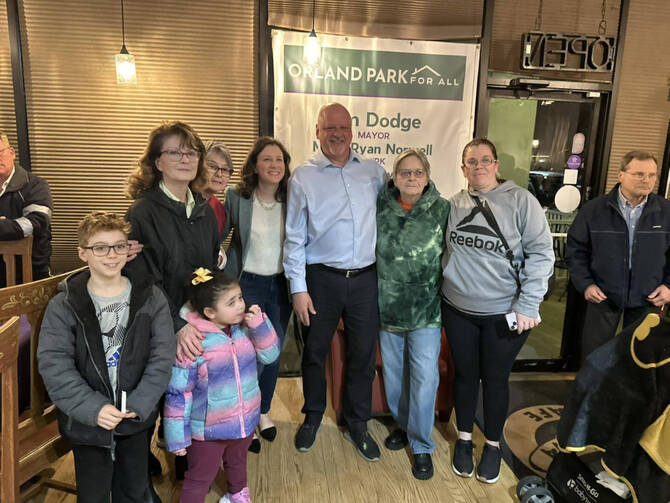
Orland Park Mayor Keith Pekau lost his re-election by a landslide to former trustee Jim Dodge, who is shown in this picture with his family. (Facebook: Orland Park for All)
Short Url
Updated 03 April 2025
Follow

Arab and Muslim candidates win 18 of 36 elections in Chicago suburbs

  • They were running for municipal and school board seats in areas with fast-growing Arab and Muslim populations
  • Keith Pekau, a mayor who last year told residents who asked local authorities to support a ceasefire in Gaza to ‘go to another country,’ loses his bid for reelection

CHICAGO: Arab and Muslim candidates won 18 of 36 seats they contested in suburban Chicago elections on April 1, a result participants and observers said reflected the growing influence of the community on the city’s politics.

The 36 hopefuls were running for municipal and school board seats in areas with fast-growing Arab and Muslim populations. Of the 18 who won, 12 of the races were uncontested. Of the 24 candidates who faced challengers, 18 lost but said they were not discouraged.

Two key races took place in Orland Township and the village of Orland Park, which has a population of 60,000 and is a part of the township.

First-time candidate Lena Matariyeh, a local real estate agent, received the most votes in a crowded field of 12 candidates to win a trustee seat on the board of Orland Township, a governing body that provides services for about 98,000 residents.

“When I came out on top, it was definitely something. It was amazing,” she told Arab News. “I always dreamed of doing something like this for myself to serve the community.

“For me, running for office was for personal and professional reasons. I’m always helping people move and relocate to our area, and to understand why people are leaving and why people want to move here.

“Orland has so much to offer and there’s always room for growth. So just to be involved on a first-hand basis with how we could improve and make this community work for all walks of life is what I dream for it to be.”

Matariyeh, a mother-of-four whose family has lived in Orland Park for 15 years, said she was motivated to run, in part, after the local mayor, Keith Pekau, told residents during a meeting in February 2024 they should “go to another country” when they asked the board to adopt a resolution supporting a ceasefire in Gaza.

“I would say that is what encouraged a lot of Arab Americans to run for office,” she added. “It might be something that encouraged me without me realizing it. I ran for many reasons but if people are telling us that we’re not part of the process, or we’re not following things a certain way, we have to show up and prove to ourselves that we do belong.

“This is everyone’s home. My family is the same as others whose ancestors came to this country. We all immigrated to his country. My background being Palestinian American, being born and raised here, I don’t think anyone should have to fight to be recognized or to receive the same rights as someone else who looks a certain way. My goal is for this to be a world of inclusion. We all should be respected.”

After the meeting last year during which Pekau made his comment, local Arab Americans rallied and registered to vote in large numbers. On Tuesday, the mayor lost his reelection bid to challenger Jim Dodge, who during his campaign promised to be more inclusive of the Arab and Muslim communities and “all residents regardless of their race, religion or ethnicity.”

Dodge did not, however, include any Arabs or Muslims on his ticket as his choices for the post of clerk and three available trustee spots. Mohammed Jaber, who in April 2023 became the first Arab American elected to serve on the High School District 230 Board of Education, which encompasses the bulk of Arab American families living in Chicago’s southwestern suburbs, told Arab News that Dodge had declined requests to include an Arab on his ticket, possibly because he was not sure how this might affect the outcome of the election.

However, the effect of the Arab Americans on this week’s elections was clear, Jaber said, noting that voter turnout among the community had doubled following Pekau’s disrespectful comments.

“The huge surge in Arab and Muslim candidates in this past election shows that there is growing community awareness that they need to be involved,” he added,

“Although only half of the 35 candidates were able to win office, it is a huge achievement. It also reflects on the hesitancy of some mainstream politicians to run with Arab running mates.

“The success of the Arab candidates shows that Jim Dodge, who won the race for Orland Park mayor, should have slated an Arab American candidate on his ticket. He did not, as many non-Arab activists and candidates didn’t have faith in the strength and dedication of the Arab and Muslim community to engage in the election process as we did on Tuesday, energetically and with pride.”

Egyptian American Mary Alexander Basta was reelected on Tuesday for a second term as mayor of Bolingbrook, a village in the western suburbs of DuPage County with a population of 74,000.

“I extend my deepest gratitude to the Arab community that has supported me throughout my journey,” Basta told Arab News. “Your dedication to uplifting our communities, fostering unity and advocating for meaningful representation has been truly invaluable.

“The Arab community plays a vital role in the fabric of our society, and it is essential that we remain engaged, active and involved in shaping our collective future. Our voices matter and our contributions enrich every aspect of civic life.

“I encourage more Arab Americans to step forward, whether by voting, serving in leadership roles or running for office. Representation is not just about presence, it’s about influence, advocacy and ensuring that our diverse perspectives are heard at every level of government.”

Basta, who studied communications at the American University in Cairo, added: “Together, we can continue to build a stronger, more inclusive community where everyone has a seat at the table. Thank you for your unwavering support and commitment to making a difference.”

Basta and her family moved to Bolingbrook in 2003 and she became involved in local education, serving as president of the Parent Teachers Association for schools her children attended.

She was named “Citizen of the Year” in 2018 for her community activism, and two years later was elected to the post of village trustee. In Dec. 2020, she was appointed acting mayor and won the election to the office in April 2021.

The other successful Arab American and Muslim American candidates in suburban Cook, DuPage and Will counties were: Rasha Atallah, elected trustee in North Palos School District 117; Nour Akhras, in Niles Township High School District 2189; Aisha Zayyad, in Orland School District 135; Fida Khalil, in Ridgeland School District 122; Sakina Kadakia, in West Northfield 31 School District; and Diane Shaar, elected trustee of Moraine Valley Community College.

Jackie Haddad Tamer was elected clerk of the city in Elmhurst; Mohammed Siddiqi as a trustee in Glendale Heights; Tasneem Abuzir as a trustee in Palos Township; Ranya El-Khatib as clerk of the village of Lombard; Ashfaq Syed as a council member in the village of Naperville; and Samia Wahab as a member of the West Chicago Library Board.

Zahawa Saleh was elected trustee in Marquardt School District in Addison; Nagla Fetouh in Willowbrook School District 62; Nader Najjar in Burr Ridge School District 180; and Denyana Masood in Rockdale School District 84.


Women fleeing Mali’s conflict say they were sexually assaulted but silence hides many more

Updated 2 sec ago
Follow

Women fleeing Mali’s conflict say they were sexually assaulted but silence hides many more

DOUANKARA: The girl lay in a makeshift health clinic, her eyes glazed over and her mouth open, flies resting on her lips. Her chest barely moved. Drops of fevered sweat trickled down her forehead as medical workers hurried around her, attaching an IV drip.
It was the last moment to save her life, said Bethsabee Djoman Elidje, the women’s health manager, who led the clinic’s effort as the heart monitor beeped rapidly. The girl had an infection after a sexual assault, Elidje said, and had been in shock, untreated, for days.
Her family said the 14-year-old had been raped by Russian fighters who burst into their tent in Mali two weeks earlier. The Russians were members of Africa Corps, a new military unit under Russia’s defense ministry that replaced the Wagner mercenary group six months ago.
Men, women and children have been sexually assaulted by all sides during Mali’s decade-long conflict, the UN and aid workers say, with reports of gang rape and sexual slavery. But the real toll is hidden by a veil of shame that makes it difficult for women from conservative, patriarchal societies to seek help.
The silence that nearly killed the 14-year-old also hurts efforts to hold perpetrators accountable.
The AP learned of the alleged rape and four other alleged cases of sexual violence blamed on Africa Corps fighters, commonly described by Malians as the “white men,” while interviewing dozens of refugees at the border about other abuses such as beheadings and abductions.
Other combatants in Mali have been blamed for sexual assaults. The head of a women’s health clinic in the Mopti area told the AP it had treated 28 women in the last six months who said they had been assaulted by militants with the Al-Qaeda affiliated JNIM, the most powerful armed group in Mali.
The silence among Malian refugees has been striking.
In eastern Congo, which for decades has faced violence from dozens of armed groups, “we didn’t have to look for people,” said Mirjam Molenaar, the medical team leader in the border area for Doctors Without Borders, or MSF, who was stationed there last year. The women “came in huge numbers.”
It’s different here, she said: “People undergo these things and they live with it, and it shows in post-traumatic stress.”
Speechless after an assault
The aunt of the 14-year-old girl said the Africa Corps fighters marched everyone outside at gunpoint. The family couldn’t understand what they wanted. The men made them watch as they tied up the girl’s uncle and cut off his head.
Then two of the men took the 14-year-old into the tent as she tried to defend herself, and raped her. The family waited outside, unable to move.
“We were so scared that we were not even able to scream anymore,” the aunt recalled, as her mother sobbed quietly next to her. She, like other women, spoke on condition of anonymity for fear of retaliation, and the AP does not name victims of rape unless they agree to be named.
The girl emerged over a half-hour later, looking terrified. Then she saw her uncle’s body and screamed. She fainted. When she woke up, she had the eyes of someone “who was no longer there,” the aunt said.
The next morning, JNIM militants came and ordered the family to leave. They piled onto a donkey cart and set off toward the border. At any sound, they hid in the bushes, holding their breath.
The girl’s condition deteriorated during the three-day journey. When they arrived in Mauritania, she collapsed.
The AP came across her lying on the ground in the courtyard of a local family. Her family said they had not taken her to a clinic because they had no money.
“If you have nothing, how can you bring someone to a doctor?” the girl’s grandmother said between sobs. The AP took the family to a free clinic run by MSF. A doctor said the girl had signs of being raped.
The clinic had been functioning for barely a month and had seen three survivors of sexual violence, manager Elidje said.
“We are convinced that there are many cases like this,” she said. “But so far, very few patients come forward to seek treatment because it’s still a taboo subject here. It really takes time and patience for these women to open up and confide in someone so they can receive care. They only come when things have already become complicated, like the case we saw today.”
As Elidje tried to save the girl’s life, she asked the family to describe the incident. She did not speak Arabic and asked the local nurse to find out how many men carried out the assault. But the nurse was too ashamed to ask.
Scratch marks are part of story she could not tell
Thousands of new refugees from Mali, mostly women and children, have settled just inside Mauritania in recent weeks, in shelters made of fabric and branches. The nearest refugee camp is full, complicating efforts to treat and report sexual assaults.
Two recently arrived women discreetly pulled AP journalists aside, adjusting scarves over their faces. They said they had arrived a week ago after armed white men came to their village.
“They took everything from us. They burned our houses. They killed our husbands,” one said. “But that’s not all they did. They tried to rape us.”
The men entered the house where she was by herself and undressed her, she said, adding that she defended herself “by the grace of Allah.”
As she spoke, the second woman started crying and trembling. She had scratch marks on her neck. She was not capable of telling her story.
“We are still terrified by what we went through,” she said.
Separately, a third woman said that what the white men did to her in Mali last month when she was alone at home “stays between God and me.”
A fourth said she watched several armed white men drag her 18-year-old daughter into their house. She fled and has not seen her daughter again.
The women declined the suggestion to speak with aid workers, some of whom are locals. They said they were not ready to talk about it with anyone else.
Russia’s Defense Ministry did not respond to questions, but an information agency that the US State Department has called part of the “Kremlin’s disinformation campaign” called the AP’s investigation into Africa Corps fake news.
Wagner has a legacy of sexual abuse
Allegations of rapes and other sexual assaults were already occurring before Wagner transformed into Africa Corps.
One refugee told the AP she witnessed a mass rape in her village in March 2024.
“The Wagner group burned seven men alive in front of us with gasoline.” she said. Then they gathered the women and raped them, she said, including her 70-year-old mother.
“After my mother was raped, she couldn’t bear to live,” she said. Her mother died a month later.
In the worst-known case of sexual assault involving Russian fighters in Africa, the UN in a 2023 report said at least 58 women and girls had been raped or sexually assaulted in an attack on Moura village by Malian troops and others that witnesses described as “armed white men.”
In response, Mali’s government expelled the UN peacekeeping mission. Since then, gathering accurate data on the ground about conflict-related sexual violence has become nearly impossible.
The AP interviewed five of the women from Moura, who now stay in a displacement camp. They said they had been blindfolded and raped for hours by several men.
Three of the women said they hadn’t spoken about it to anyone apart from aid workers. The other two dared to tell their husbands, months later.
“I kept silent with my family for fear of being rejected or looked at differently. It’s shameful,” one said.
The 14-year-old whose family fled to Mauritania is recovering. She said she cannot remember anything since the attack. Her family and MSF said she is speaking to a psychiatrist — one of just six working in the country.
Aid workers are worried about others who never say a thing.
“It seems that conflict over the years gets worse and worse and worse. There is less regard for human life, whether it’s men, women or children,” said MSF’s Molenaar, and broke into tears. “It’s a battle.”