ISLAMABAD: Pakistan saw the highest number of militant attacks during the Muslim holy month of Ramadan in a decade, a think tank reported Monday.
Some militant groups previously paused hostilities for Ramadan, but the country has seen an overall increase in violence in recent years.
The Pak Institute for Peace Studies reported at least 84 attacks during Ramadan, which ended Sunday in Pakistan. It reported 26 attacks during last year’s Ramadan.
The Pakistani Taliban unilaterally ended a ceasefire with the government in November 2022, while the Baloch Liberation Army has developed its capabilities to stage elaborate attacks. Both have contributed to the rise in violence.
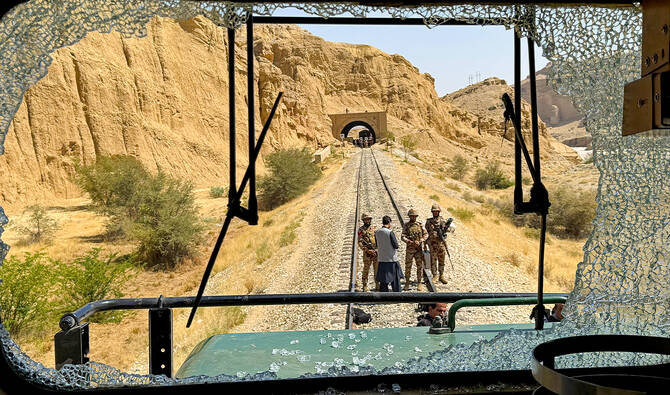
The outlawed BLA was behind a train hijacking on March 11 in the southwest province of Balochistan that killed at least 25 people.
Another think tank, the Pakistan Institute for Conflict and Security Studies, recorded 61 attacks in the first three weeks of Ramadan. There were 60 total attacks in the previous Ramadan, it said.
It also said this was the deadliest Ramadan in a decade for security personnel, with 56 killed between March 2 and March 20.
Abdullah Khan, managing director of the Pakistan Institute for Conflict and Security Studies, cited an overall escalation in militant activity.
“There has been a unification of different groups,” Khan said. “Baloch factions are joining hands. In some areas (of the northwest), the Hafiz Gul Bahadur faction is more lethal than the Pakistani Taliban, it is competing with them.”
He said there was also a revival of banned organizations like Lashkar-e-Islam, which operates from the northwest province of Khyber Pakhtunkhwa.
Pakistan accuses the Taliban government in neighboring Afghanistan of giving haven to such groups, saying militants have thrived since the Taliban returned to power in 2021. Kabul rejects that.
Khan also pointed to intelligence failures, including those that led to the train hijack in Balochistan, and the widening trust gap between the state and the population: “It’s important to get back public support. The public is the first line of defense.”

Pakistan saw highest number of militant attacks during Ramadan in a decade
https://arab.news/5sfbn
Pakistan saw highest number of militant attacks during Ramadan in a decade
- The Pak Institute for Peace Studies reported at least 84 attacks during Ramadan, which ended Sunday in Pakistan
- Some militant groups previously paused hostilities for Ramadan, but overall violence has increased in recent years
Pakistan launches cashless Ramadan market in Islamabad to promote digital payments
- Pilot market allows shoppers to buy subsidized food using digital payments
- Initiative aims to improve transparency and public relief during Ramadan
KARACHI: Pakistan has launched a cashless subsidized Ramadan food market in the capital Islamabad, the interior ministry said on Wednesday, introducing digital payments for essential goods as authorities try to improve transparency and affordability during the Muslim holy month.
The facility in the G-6 Aabpara area allows citizens to purchase vegetables, fruit and staple food items at regulated prices without cash, part of a broader push toward digitizing subsidy delivery.
Ramadan bazaars, which are temporary and often state-supported markets, are set up across Pakistan each year to limit price spikes as demand rises during fasting hours and evening meals.
Ramadan is likely to start on Feb. 19 in Pakistan.
“The objective is to provide the public affordable and quality items. No negligence in public relief will be tolerated,” the interior ministry said in a statement.
Officials said the market will operate daily from 9 a.m. to 4 p.m. and includes private vendors under monitoring mechanisms to ensure goods are sold according to wholesale market rates.
Authorities also instructed administrators to strengthen cleanliness, security and complaint-handling systems and ensure price lists are prominently displayed.
Pakistan last year launched its first-ever cashless weekly market in Islamabad, but slow Internet speeds and patchy phone connectivity have hampered adoption among vendors and shoppers.
The government plans to turn Islamabad into Pakistan’s first fully cashless city, using QR-code payments to formalize retail transactions, reduce tax evasion and improve documentation in one of South Asia’s most informally run economies.
Pakistan relies heavily on cash, enabling widespread tax evasion and limiting financial transparency. Economists say expanding digital payments can raise government revenues, curb corruption, and make marketplaces safer for customers and traders.
Pakistan has increasingly experimented with targeted subsidies and digital systems to manage food affordability during Ramadan, when consumption rises sharply and lower-income households face pressure after years of high inflation.
Last week, Prime Minister Shehbaz Sharif launched a Rs38 billion ($136 million) Ramadan relief package, pledging direct digital cash transfers of Rs13,000 ($47) each to 12.1 million low-income families across Pakistan.
The government will distribute the relief package through bank accounts and regulated mobile wallet platforms, fully replacing the previous utility store-based subsidy model with a digital payment mechanism overseen by the State Bank of Pakistan.


