

Medical supplies shortage hampering Myanmar quake response: UN

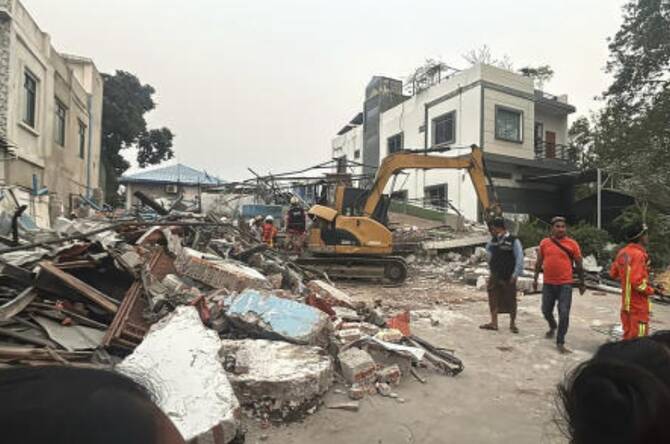
Volunteers work at an earthquake affected area in Mandalay, central Myanmar, Mar. 29, 2026, (AP)
Short Url
Updated 29 March 2025
Follow

Medical supplies shortage hampering Myanmar quake response: UN

  • “As the full scale of the disaster unfolds, urgent humanitarian assistance is needed to support those affected,” the UN humanitarian agency OCHA said
  • WHO said it had rushed nearly three tons of medical supplies, including trauma kits and multi-purpose tents

GENEVA: A severe lack of medical supplies is hampering efforts to respond to the deadly earthquake in Myanmar, the United Nations said Saturday, adding that those affected needed urgent humanitarian aid.
The UN said it was mobilizing emergency response efforts, alongside humanitarian partner organizations, following the huge earthquake that struck on Friday leaving more than 1,600 people dead in Myanmar and neighboring Thailand.
“As the full scale of the disaster unfolds, urgent humanitarian assistance is needed to support those affected,” the UN humanitarian agency OCHA said in a statement.
It said the response was being hindered by a lack of medical supplies, along with damaged roads and communications infrastructure.
“A severe shortage of medical supplies is hampering response efforts, including trauma kits, blood bags, anaesthetics, assistive devices, essential medicines, and tents for health workers,” OCHA said.
The agency said hospitals and health facilities had sustained extensive damage or had been destroyed.
“Telecommunications and Internet disruptions continue to hinder humanitarian communications and operations. Damaged roads and debris are obstructing humanitarian access and complicating needs assessments,” it added.
OCHA said coordination efforts were under way to conduct rapid needs assessments and scale up the emergency response.
“The earthquake caused widespread destruction of homes and severe damage to critical infrastructure,” it said.
“Thousands of people are spending the nights on the streets or open spaces due to the damage and destruction to homes, or fearing further quakes.”
In central and northwestern Myanmar, hospitals in Mandalay, Magway and the capital Naypyidaw “are struggling to cope with the influx of people injured.”
In the southern part of Shan state, multiple townships have been affected, with clothing, blankets, emergency shelters and food assistance needed immediately, OCHA said.
The agency said a convoy of 17 cargo trucks from neighboring China carrying shelters and medical supplies was expected to arrive on Sunday.
Meanwhile the World Health Organization said it had rushed nearly three tons of medical supplies, including trauma kits and multi-purpose tents, from its emergency stockpile in Yangon to hospitals in Mandalay and Naypyidaw treating thousands of people injured in the quake.

“Immediate support is critical to save lives,” its South-East Asia branch said on X.
Jagan Chapagain, secretary general of the International Federation of Red Cross and Red Crescent Societies (IFRC) — the world’s largest humanitarian network — said Red Cross teams in Myanmar were “racing against time” to rescue survivors, provide pre-hospital care and distribute emergency shelter materials.
In a video from Yangon, Marie Manrique, the IFRC’s acting head of delegation in Myanmar, said the numbers of fatalities and injuries were continually increasing.
“We do have some uplifting stories of actually finding people... however, the sad stories will continue to be coming in,” she said.
Besides infrastructure, many houses have collapsed, “and we really need to start thinking of what is going to happen to these people and their long-term housing needs,” she added.



Winter storm packing snow and strong winds to descend on Great Lakes, Northeast

Updated 5 sec ago
Follow

Winter storm packing snow and strong winds to descend on Great Lakes, Northeast

  • The fierce winds on Lake Erie sent water surging toward the basin’s eastern end near Buffalo, New York, while lowering water on the western side in Michigan to expose normally submerged lakebed — even the wreck of a car and a snowmobile

NEW YORK: A wild winter storm was expected to bring strong winds, heavy snow and frigid temperatures to the Great Lakes and Northeast on Tuesday, a day after a bomb cyclone barreled across the northern US and left tens of thousands of customers without power.
The storm that hit parts of the Plains and Great Lakes on Monday brought sharply colder air, strong winds and a mix of snow, ice and rain, leading to treacherous travel. Forecasters said it intensified quickly enough to meet the criteria of a bomb cyclone, a system that strengthens rapidly as pressure drops.
Nationwide, more than 127,000 customers were without power Tuesday morning, more than a third of them in Michigan, according to Poweroutage.us.

BACKGROUND

The storm that hit parts of the Plains and Great Lakes on Monday brought sharply colder air, strong winds and a mix of snow, ice and rain, leading to treacherous travel.

As the storm moved into Canada, the National Weather Service predicted more inclement weather conditions for the Eastern US, including quick bursts of heavy snow and gusty winds known as snow squalls. Blustery winds were expected to add to the arctic chill, with low temperatures dipping below freezing as far south as the Florida panhandle, the agency said.
New York Gov. Kathy Hochul warned that whiteout conditions were expected Tuesday in parts of the state, including the Syracuse metro area.
“If you’re in an impacted area, please avoid all unnecessary travel,” she said in a post on the social platform X.
Snow piled up quickly in Michigan’s Upper Peninsula on Monday, where as much as 2 feet (60 centimeters) fell in some areas, according to the National Weather Service. Meteorologist Ryan Metzger said additional snow was expected in the coming days, although totals would be far lighter.
Waves on Lake Superior that were expected to reach 20 feet (6 meters) on Monday sent all but one cargo ship into harbors for shelter, according to MarineTraffic.com.
The fierce winds on Lake Erie sent water surging toward the basin’s eastern end near Buffalo, New York, while lowering water on the western side in Michigan to expose normally submerged lakebed — even the wreck of a car and a snowmobile.
Kevin Aldrich, 33, a maintenance worker from Monroe, Michigan, said he has never seen the lake recede so much and was surprised on Monday to spot remnants of piers dating back to the 1830s. He posted photos on social media of wooden pilings sticking up several feet from the muck.
“Where those are at would typically be probably 12 feet deep,” he said. “We can usually drive our boat over them.”
Dangerous wind chills plunged as low as minus 30 F (minus 34 C) across parts of North Dakota and Minnesota on Monday. And in northeast West Virginia, rare, nearly hurricane-force winds were recorded on a mountain near Dolly Sods, according to the National Weather Service.
In Iowa, after blizzard conditions eased by Monday morning, high winds continued blowing snow across roadways, keeping more than 200 miles (320 kilometers) of Interstate 35 closed. State troopers reported dozens of crashes during the storm, including one that killed a person.
On the West Coast, the National Weather Service warned that moderate to strong Santa Ana winds were expected in parts of Southern California through Tuesday, raising concerns about downed trees in areas where recent storms had saturated the soil. Two more storms were forecast later this week, with rain on New Year’s Day potentially soaking the Rose Parade in Pasadena for the first time in about two decades.