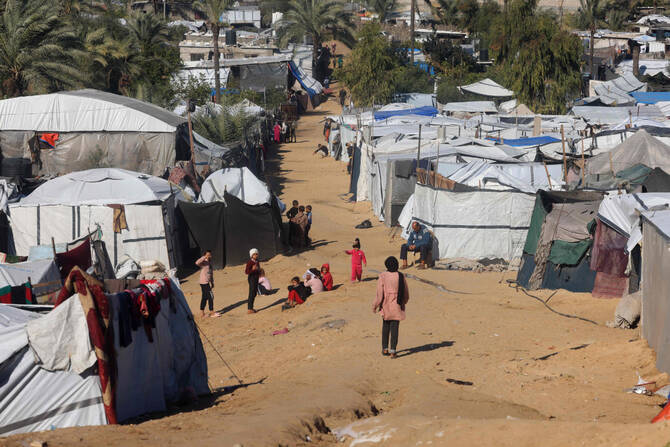


DEIR AL-BALAH, Gaza Strip: Barefoot children played on chilly sand as Gaza ‘s thousands of displaced people prepared threadbare tents on Saturday for another round of winter rain.
Some families in the central town of Deir Al-Balah said they had been living in tents for about two years, or for most of the war between Israel and Hamas that has devastated the territory.
Fathers braced fraying tents with old pieces of wood or inspected the ragged edges of holes torn in tarps. Inside the dim homes, daylight through tiny holes shone like stars.
Mothers battled the damp, slinging clothing over poles or cord to dry in the wind between the downpours that turn paths into puddles. One mother pulled a tiny child away from a mildewing patch of carpet.
“We have been living in this tent for two years. Every time it rains and the tent collapses over our heads, we try to put up new pieces of wood,” said Shaima Wadi, a mother of four children who was displaced from Jabaliya in the north. “With how expensive everything has become, and without any income, we can barely afford clothes for our children or mattresses for them to sleep on.”
Gaza’s Health Ministry, part of the Hamas-run government, has said dozens of people, including a two-week-old infant, have died from hypothermia or after weather-related collapses of war-damaged homes. Aid organizations have called for more shelters and other humanitarian aid to be allowed into the territory.

A displaced Palestinian child drags a trolley with a water containers in the Khan Yunis refugee camp in the southern Gaza Strip on December 27, 2025. With many displaced living in tent camps, the coming winter is raising serious concerns. (AFP)
Emergency workers have warned people not to stay in damaged buildings. But with so much of the territory reduced to rubble, there are few places to escape the rain.
“I collect nylon, cardboard and plastic from the streets to keep them warm,” said Ahmad Wadi, who burns the materials or uses them as a kind of blanket for loved ones. “They don’t have proper covers. It is freezing, the humidity is high, and water seeps in from everywhere. I don’t know what to do.”
Ceasefire talks
Israel Prime Minister Benjamin Netanyahu is expected to visit Washington in the coming days as negotiators and others discuss the second stage of the ceasefire that took effect on Oct. 10.
Though the agreement has mostly held, its progress has slowed. The remains of the final hostage taken during the Hamas-led attack on Oct. 7, 2023, that sparked the war are still in Gaza. Challenges in the next phase of the ceasefire include the deployment of an international stabilization force, a technocratic governing body for Gaza, the disarmament of Hamas and further Israeli troop withdrawals from the territory.
Both Israel and Hamas have accused each other of truce violations.
Gaza’s Health Ministry said that since the ceasefire went into effect, 414 Palestinians have been killed and 1,142 wounded. It said the bodies of 679 people were pulled from the rubble during the same period as the truce makes it safer to search for the remains of people killed earlier.
The ministry on Saturday said 29 bodies, including 25 that were recovered from under the rubble, had been brought to local hospitals over the past 48 hours.
The overall Palestinian death toll from the Israel-Hamas war has risen to at least 71,266, the ministry said, and another 171,219 have been wounded.
The ministry, which does not distinguish between militants and civilians in its count, is staffed by medical professionals and maintains detailed records viewed as generally reliable by the international community.
West Bank operation
Israel’s defense minister, Israel Katz, said in a statement Saturday that a military operation continued in a town in the Israeli-occupied West Bank a day after police said a Palestinian attacker rammed his car into a man and then stabbed a young woman in northern Israel on Friday afternoon, killing both.
The statement said the army had surrounded the town of Qabatiya, where Katz said the attacker was from, and was operating “forcefully” there. Authorities on Friday said the attacker was shot and injured in Afula. He was taken to a hospital.
It’s common practice for Israel to launch raids in the West Bank towns that attackers come from or demolish homes belonging to the assailants’ families. Israel says that it helps to locate militant infrastructure and prevents future attacks. Rights watchdogs describe such actions as collective punishment.
AP video on Saturday showed Israeli bulldozers entering the town and soldiers patrolling.
“They announced a strict curfew,” resident Bilal Hanash said, as he and others described main roads being closed with dirt barriers, a practice that has grown during the war in Gaza. “So basically, they’re punishing 30,000 people.”