


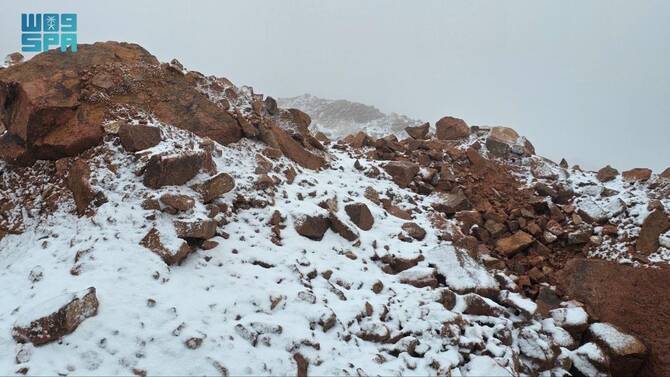

RIYADH: Snow blanketed several regions across Saudi Arabia on Wednesday and Thursday, transforming the desert-framed mountains into a striking winter wonderland as inclement weather made its presence felt.
Snow affected parts of northern Saudi Arabia on Wednesday, with cold weather and heavy rain hitting several cities and other parts of the Kingdom.
Trojena, a mountain destination for hiking and skiing that is located on Jebel Al-Lawz in Tabuk Province and reaches up to 2,600 m, was covered in snow and experienced some light rainfall.
Light to moderate rain was experienced in Bir Bin Hermas, Al-Ayinah, Ammar, AlUla Governorate and Shaqra and its suburbs, while several other regions, including Riyadh, experienced moderate to heavy rainfall.
The Saudi capital experienced its downfalls from the early hours on Thursday, with thick cloud cover remaining over the city throughout the day. All schools in Riyadh were switched to remote learning amid the continuing inclement weather which has prevailed since Monday.
The Qassim Region, including the city of Buraidah, experienced moderate to heavy rainfall while Tabuk Region experienced light to moderate rainfall on Thursday, the Saudi Press Agency reported.
Parts of Hail Region also witnessed snowfall on Wednesday evening in areas surrounding the city of Hail, while light to moderate rainfall was reported across the region and several of its governorates.
The National Center for Meteorology anticipated more snow in the northern parts of the Riyadh Region and the governorates of Al-Majmaah and Al-Ghat, north of Riyadh, witnessed snowfall on Thursday morning, which led to accumulations over high land and open areas, the SPA reported.
Hussein Al-Qahtani, the NCM’s official spokesperson, explained that the weather conditions affecting the north of the Riyadh Region were the result of a cold mass of air advancing into the area, accompanied by rain-bearing clouds.
This contributed to temperatures dropping below zero Celsius in some locations, creating the conditions for snowfall during the early-morning hours.
Al-Qahtani noted that the center had issued early warnings regarding the weather conditions, adding that specialized teams continued to monitor developments.
He expected temperatures to remain low over the coming hours, with a chance of frost in several areas of the Kingdom’s northern and central regions.
He urged citizens and residents to exercise caution, particularly while driving on exposed roads, due to the potential formation of ice, and stressed the importance of following official weather updates issued by the center through its official channels, while adhering to preventive guidelines and avoiding open areas during peak cold periods to ensure public safety.
Many people gathered to witness the snowfall in Al-Majmaah and Al-Ghat. Thamr Alotaibi, a Riyadh resident, told Arab News: “This is unprecedented, so we are excited to see it. Me and my friends are going to experience this winter wonder which is going to be an amazing experience.”
According to the NCM, gusty winds are expected, and moderate to heavy rain and hail may fall in parts of the Eastern Region, Riyadh, and Qassim.
Light to moderate rain may also fall in parts of the Northern Borders, Jouf, and Hail, as well as the southwestern parts of the Kingdom. Fog may form in parts of these regions.
Gusty and dust-stirring winds will blow in most regions of the Kingdom, accompanied by cold weather in the northwest.
Winds over the Red Sea will be northwesterly to northeasterly at speeds of 25-50 kph.
In the Arabian Gulf, winds will be northwesterly to westerly at speeds of 25-60 kph.
The General Directorate of Civil Defense has called for caution and adherence to guidelines in light of the inclement weather conditions.
It has advised residents to avoid going to valleys during this spell of weather.
Riyadh resident Abdul Hammed told Arab News: “We had an outing planned for a family get-together at a banquet on the city’s outskirts but the prevailing weather has forced us to change the plan, and we have decided to remain indoors instead.”
* We can use this SPA video link: https://x.com/SPAqualitylife/status/2001385003935043998?s=20


