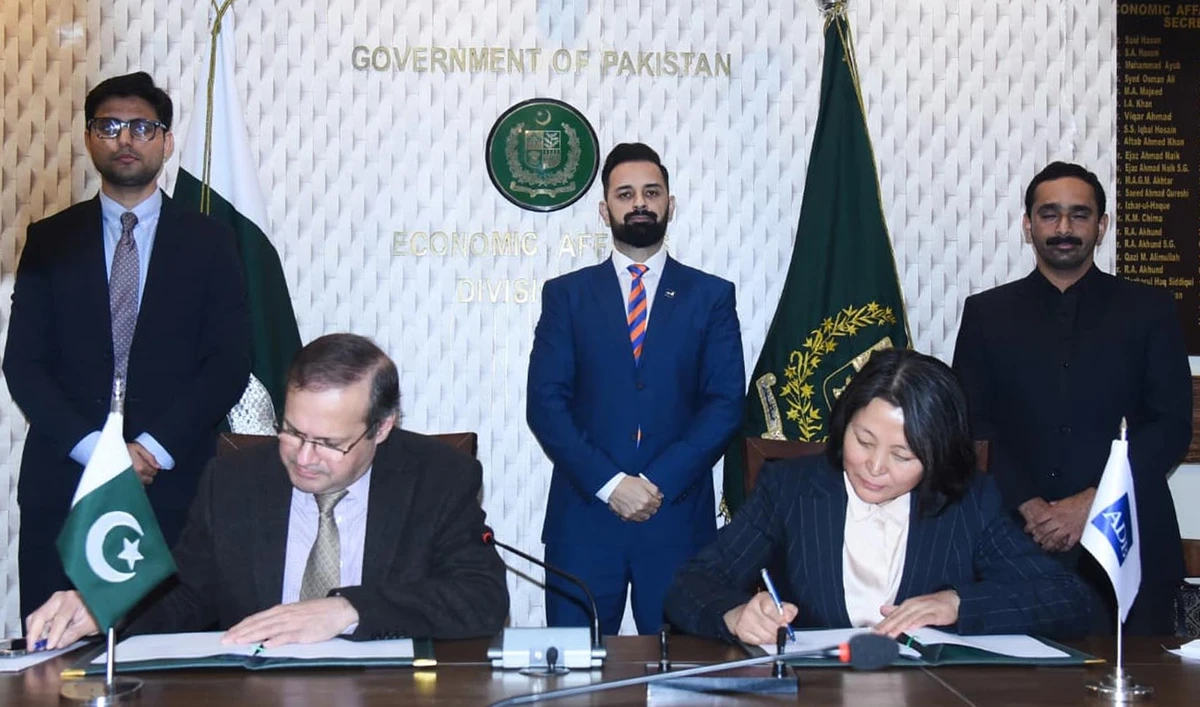
ADB, Pakistan sign over $300 million agreements to undertake climate resilience initiatives

Secretary Economic Affairs Division, Muhammad Humair Karim (sitting left), and Country Director of Asian Development Bank, Emma Fan (sitting right), sign an agreement in Islamabad, Pakistan, on December 30, 2025. (PID)
Short Url
Updated 30 December 2025
Follow

ADB, Pakistan sign over $300 million agreements to undertake climate resilience initiatives

  • Pakistan ranks among nations most vulnerable to climate change and has seen erratic changes in weather patterns
  • The projects in Sindh and Punjab will restore nature-based coastal defenses and enhance agricultural productivity

ISLAMABAD: The Pakistani government and the Asian Development Bank (ADB) have signed more than $300 million agreements to undertake two major climate resilience initiatives, Pakistan’s Press Information Department (PID) said on Tuesday.

The projects include the Sindh Coastal Resilience Sector Project (SCRP), valued at Rs50.5 billion ($180.5 million), and the Punjab Climate-Resilient and Low-Carbon Agriculture Mechanization Project (PCRLCAMP), totaling Rs34.7 billion ($124 million).

Pakistan ranks among nations most vulnerable to climate change and has seen erratic changes in its weather patterns. In 2022, monsoon floods killed over 1,700 people, displaced another 33 million and caused over $30 billion losses, while another 1,037 people were killed in floods this year.

The South Asian country is ramping up climate resilience efforts, with support from the ADB and World Bank, and investing in climate-resilient infrastructure, particularly in vulnerable areas.

“Both sides expressed their commitment to effectively utilize the financing for successful and timely completion of the two initiatives,” the PID said in a statement.

The Sindh Coastal Resilience Project (SCRP) will promote integrated water resources and flood risk management, restore nature-based coastal defenses, and strengthen institutional and community capacity for strategic action planning, directly benefiting over 3.8 million people in Thatta, Sujawal, and Badin districts, according to ADB.

The Punjab project will enhance agricultural productivity and climate resilience across 30 districts, improving small farmers’ access to climate-smart machinery, introducing circular agriculture practices to reduce residue burning, establishing testing and training facilities, and empowering 15,000 women through skills development and livelihood diversification.

Earlier this month, the ADB also approved $381 million in financing for Pakistan’s Punjab province to modernize agriculture and strengthen education and health services, including concessional loans and grants for farm mechanization, Science, Technology, Engineering and Mathematics (STEM) education, and nursing sector reforms.


Pakistan, UK discuss regional security, cross-border attacks as senior official visits Islamabad

Updated 20 January 2026
Follow

Pakistan, UK discuss regional security, cross-border attacks as senior official visits Islamabad

  • British envoy for Afghanistan Richard Lindsay’s visit comes at a time of a surge in militancy in Pakistan’s border regions
  • Pakistani diplomat says both sides reviewed broader security challenges, emphasized coordination to address ‘shared concerns’

ISLAMABAD: Pakistani and British officials have discussed regional security challenges and cross-border attacks during talks in Islamabad, a Pakistani diplomat said on Tuesday, during a visit of the United Kingdom’s Afghanistan envoy, Richard Lindsay, to the Pakistani capital.

Pakistan and the UK regularly cooperate on counterterrorism and security, with a focus on intelligence-sharing to combat militant activity. Lindsay’s visit comes at a time of a rise in militancy in Pakistan’s western provinces, which border Afghanistan.

Mohammad Sadiq, Pakistan’s special representative for Afghanistan, said the discussions in Islamabad focused on the regional security situation, particularly the urgent challenge posed by cross-border attacks.

“We also exchanged views on the latest regional security developments and broader security challenges,” he said on X. “We emphasized the importance of continued cooperation and coordination to address shared concerns and promote regional stability.”

Islamabad frequently accuses Afghanistan of allowing its soil and India of backing militant groups, such as the Tehreek-e-Taliban Pakistan (TTP) and the Balochistan Liberation Army (BLA), for attacks against Pakistan. Kabul and New Delhi deny this.

In recent years, Pakistan and the UK have engaged with each other on counterterrorism and cross-border crimes as part of bilateral cooperation.

Both sides held the second round of the Pakistan-UK Counter Terrorism Dialogue in London in February last year, reviewing global and regional threats and exchanging best practices. Over the years, armed forces of both countries have also maintained close cooperation, particularly in counterterrorism efforts and professional military training.