

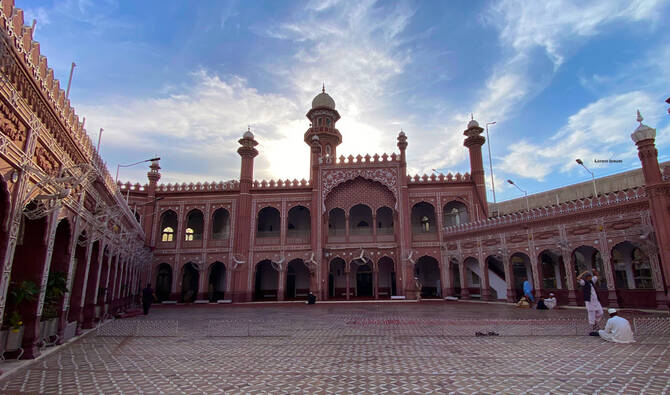
Peshawar’s iconic Sunehri Mosque sees surge of devotees in Ramadan

Worshippers pray during Ramadan at the Sunehri Mosque in Peshawar, Pakistan, on March 22, 2025. (AN Photo)
Short Url
Updated 28 March 2025
Follow

Peshawar’s iconic Sunehri Mosque sees surge of devotees in Ramadan

  • Foundation stone for mosque laid in 1946, Sunehri Masjid is famous for its gold domes, tall minarets and Mughal architecture
  • Worshippers frequent Sunehri Masjid, with capacity for 6,000 people, during Ramadan to offer prayers, recite Qur’an, attend large congregations

Peshawar: The 39-meter tall minaret is the first thing that comes into view when one arrives close to the street in Peshawar’s main Saddar Bazaar where the majestic Sunehri Masjid is located. 

Known for its considerable size, built over an impressive 1,670 sq. meters, and Mughal-style architecture, the Sunehri, or Golden, Mosque in the capital of the northwestern Khyber Pakhtunkhwa, is one of the most iconic masjids in the region.

The mosque can accommodate at least 6,000 worshippers, making it ideal for the month of Ramadan when believers flock to mosques for Tarawih — special, voluntary prayers performed typically after the Isha (night) prayer, and considered a highly recommended Sunnah, or practice of the Prophet Muhammad.

The foundation stone of the mosque was laid by Habib Ur Rehman, a Peshawar resident, in 1946 but construction work was hit by delays due unavailability of funds and security issues, and was completed in 1992, primarily funded by public donations. 

Rehman modeled the mosque after Lahore’s iconic Badshahi Mosque, built by Mughal emperor Aurangzeb, the prayer leader at Sunehri Masjid, Maulana Muhammad Ismail, told Arab News. 

“The foundation stone of our mosque was laid in 1946, but the situation deteriorated in Pakistan due to the wars (of 1965 and 1971), so work was stopped for a little time,” he said. 

Explaining the architecture, Ismail said that the central minaret, a hallmark of the mosque, was built at 39 meters (128 feet) so it could be seen from far-flung areas in Peshawar at a time when there were few tall buildings in the city.

“The need for the construction of the 128-feet-high minaret at that time was that our organizers thought that the azaan (call to prayer) of the Sunehri Masjid should reach far-flung areas,” Ismail said.

The mosque is built with red bricks and famed for its signature gold domes and intricate Mughal-style architecture that features arches, domes and pointed cupolas atop the minarets.

In Ramadan, more worshippers than usual throng to the Sunehri Masjid, filling up its halls and prayer rooms as they seek to deepen their connection with Allah, earn rewards, and ask for forgiveness from sins.

Imran Khan, 38, is one such devotee who has been offering prayers at the mosque for the past 12 years.

“This is a beautiful mosque, I come here every Ramadan to worship and recite (the Qur’an),” Khan told Arab News. “I especially visit a lot in Ramadan when I get the chance.”

Khawar Rehman, a Peshawar resident who had come for Asr prayers at the mosque, said that he frequented the place as he liked worshiping in a “known mosque” like the Sunehri Masjid. 

“This mosque has larger congregations and better rewards,” he said, “so I like to come here.”


Ice-cool Rybakina beats Sabalenka in tense Australian Open final

Updated 5 sec ago
Follow

Ice-cool Rybakina beats Sabalenka in tense Australian Open final

  • The big-serving Kazakh fifth seed held her nerve to pull through 6-4, 4-6, 6-4
  • Rybakina who was born in Moscow, adds her Melbourne triumph to her Wimbledon win in 2022
MELBOURNE: Elena Rybakina took revenge over world number one Aryna Sabalenka to win a nail-biting Australian Open final on Saturday and clinch her second Grand Slam title.
The big-serving Kazakh fifth seed held her nerve to pull through 6-4, 4-6, 6-4 at Rod Laver Arena in Melbourne in 2hrs 18mins.
It was payback after the Belarusian Sabalenka won the 2023 final between two of the hardest hitters in women’s tennis.
The ice-cool Rybakina, 26, who was born in Moscow, adds her Melbourne triumph to her Wimbledon win in 2022.
“Hard to find the words now,” said Rybakina, and then addressed her beaten opponent to add: “I know it is tough, but I hope we play many more finals together.”
Turning to some Kazakh fans in the crowd, she said: “Thank you so much to Kazakhstan. I felt the support from that corner a lot.”
It was more disappointment in a major final for Sabalenka, who won the US Open last year for the second time but lost the French Open and Melbourne title deciders.
She was into her fourth Australian Open final in a row and had been imperious until now, with tears in her eyes at the end.
“Let’s hope maybe next year will be a better year for me,” Sabalenka said ruefully.
Rybakina fights back
With the roof on because of drizzle in Melbourne, Rybakina immediately broke serve and then comfortably held for 2-0.
Rybakina faced two break points at 4-3, but found her range with her serve to send down an ace and dig herself out of trouble, leaving Sabalenka visibly frustrated.
Rybakina looked in the zone and wrapped up the set in 37 minutes on her first set point when Sabalenka fired long.
Incredibly, it was the first set Sabalenka had dropped in 2026.
The second game of the second set was tense, Rybakina saving three break points in a 10-minute arm-wrestle.
They went with serve and the seventh game was another tussle, Sabalenka holding for 4-3 after the best rally of a cagey affair.
The tension ratcheted up and the top seed quickly forged three set points at 5-4 on the Kazakh’s serve, ruthlessly levelling the match at the first chance to force a deciding set.
Sabalenka was now in the ascendancy and smacked a scorching backhand to break for a 2-0 lead, then holding for 3-0.
Rybakina, who also had not dropped a set in reaching the final, looked unusually rattled.
She reset to hold, then wrestled back the break, allowing herself the merest of smiles.
At 3-3 the title threatened to swing either way.
But a surging Rybakina won a fourth game in a row to break for 4-3, then held to put a thrilling victory within sight.
Rybakina sealed the championship with her sixth ace of the match.
The finalists were familiar foes having met 14 times previously, with Sabalenka winning eight of them.
Sabalenka came into the final as favorite but Rybakina has been one of the form players on the women’s tour in recent months.
She also defeated Sabalenka in the decider at the season-ending WTA Finals.
Rybakina beat second seed Iga Swiatek in the quarter-finals and sixth seed Jessica Pegula in the last four in Melbourne.
Rybakina switched to play under the Kazakh flag in 2018 when she was a little-known 19-year-old, citing financial reasons.