

Gunmen kill five commuters traveling to Karachi in Pakistan’s volatile southwest

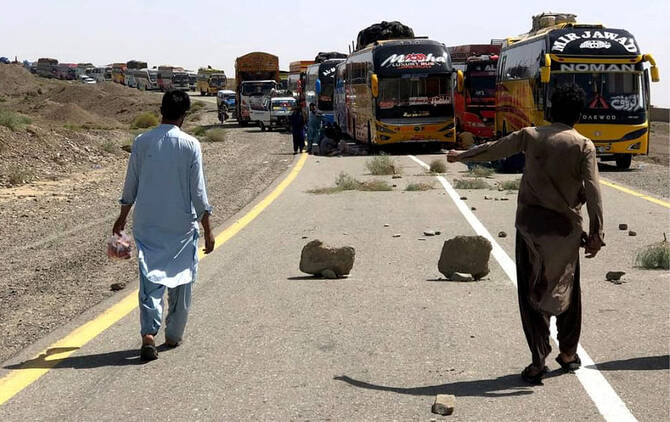
People walk past parked supply trucks alongside a road, after traffic was halted following an attack on a highway in Pakistan's restive province of Balochistan on August 26, 2024. (REUTERS/File)
Short Url
Updated 27 March 2025
Follow

Gunmen kill five commuters traveling to Karachi in Pakistan’s volatile southwest

  • The incident happened near Pasni, Balochistan, where armed men offboarded Punjabi passengers on a highway
  • No group has immediately claimed responsibility for the attack, though BLA usually launches such attacks

QUETTA: At least five passengers belonging to Pakistan’s eastern Punjab province were forcibly offboarded from passenger buses heading to Karachi from Gwadar on Wednesday after gunmen checked their identity cards and killed them near Pakistan’s coastal town of Pasni, a senior government official confirmed.

This is not the first time commuters from Punjab have been targeted in Pakistan’s restive southwestern Balochistan province, which shares porous borders with Iran and Afghanistan and has experienced a low-scale insurgency by Baloch separatist groups against the Pakistani state.

Baloch nationalists have long accused the Pakistani government and the country’s most prosperous Punjab province of monopolizing profits from Balochistan’s abundant natural resources, saying it has led to their political marginalization and economic exploitation.

Pakistani administrations have denied these allegations, however, citing several development initiatives launched in the province to improve local living conditions.

“Armed men stopped buses at the coastal highway near Kalmat, Pasni, and forcibly removed six passengers after checking their ID cards,” Moheem Khan Gichki, Assistant Commissioner Pasni, told Arab News over the phone.

“Five Punjab-based travelers who were traveling to Karachi from Gwadar were killed in the attack and one sustained injuries,” he continued. “The attackers also set one trawler and one vehicle on fire before escaping from the area.”

The coastal town of Gwadar, located on the shore of the Arabian Sea, is the heart of Pakistan and China’s multibillion-dollar development project called the China-Pakistan Economic Corridor (CPEC).

No group has claimed responsibility for the latest killings of the Punjab-based commuters, though suspicion is likely to fall on the outlawed Baloch separatist group Baloch Liberation Army, which has previously launched similar attacks on passenger buses on different highways of the volatile province.

In February, seven Punjab-based passengers were killed after the ethnic separatist group stopped Punjab-bound passenger buses in Barkhan district.

Prime Minister Shehbaz Sharif expressed sorrow in a statement issued by his office over the death of the commuters in the attack.

“Subversive elements are enemies of peace and development in Balochistan,” he said. “Cowardly attacks by such elements on innocent people clearly reflect their barbarity.”

Sharif also applauded the actions of the security forces and law enforcement agencies against anti-state groups while ordering an investigation into the incident to identify the perpetrators of the attack and bring them to justice.


Pakistan, ADB sign $730 loan agreements to boost SOE reforms, energy infrastructure

Updated 25 December 2025
Follow

Pakistan, ADB sign $730 loan agreements to boost SOE reforms, energy infrastructure

  • Both sign $330 million Power Transmission Strengthening Project and $400 million SOE Transformation Program loan agreements
  • Economic Affairs Division official says Transmission Project will secure Pakistan’s energy future by strengthening national grid’s backbone

KARACHI: Pakistan and the Asian Development Bank (ADB) on Thursday signed two loan agreements totaling $730 million to boost reforms in state-owned enterprises (SOEs) and energy infrastructure in the country, the bank said.

The first of the two agreements pertains to the SOE Transformation Program worth $400 million while the second loan, worth $330 million, is for a Power Transmission Strengthening Project, the lender said. 

The agreements were signed by ADB Country Director for Pakistan Emma Fan and Pakistan’s Secretary of Economic Affairs Division Humair Karim. 

“The agreements demonstrate ADB’s enduring commitment to supporting sustainable and inclusive economic growth in Pakistan,” the ADB said. 

Pakistan’s SOEs have incurred losses worth billions of dollars over the years due to financial mismanagement and corruption. These entities, including the country’s national airline Pakistan International Airlines, which was sold to a private group this week, have relied on subsequent government bailouts over the years to operate.

The ADB approved the $400 million loan for SOE reforms on Dec. 12. It said the program seeks to improve governance and optimize the performance of Pakistan’s commercial SOEs. 

Karim highlighted that the Power Transmission Strengthening Project will enable reliable evacuation of 2,300 MW from Pakistan’s upcoming hydropower projects, relieve overloading of existing transmission lines and enhance resilience under contingency conditions, the Press Information Department (PID) said. 

“The Secretary emphasized that both initiatives are transformative in nature as the Transmission Project will secure Pakistan’s energy future by strengthening the backbone of the national grid whereas the SOE Program will enhance transparency, efficiency and sustainability of state-owned enterprises nationwide,” the PID said. 

The ADB has supported reforms by Pakistan to strengthen its public finance and social protection systems. It has also undertaken programs in the country to help with post-flood reconstruction, improve food security and social and human capital. 

To date, ADB says it has committed 764 public sector loans, grants and technical assistance totaling $43.4 billion to Pakistan.