

Medical team inspects ex-PM Imran Khan’s eye condition at Rawalpindi prison — official

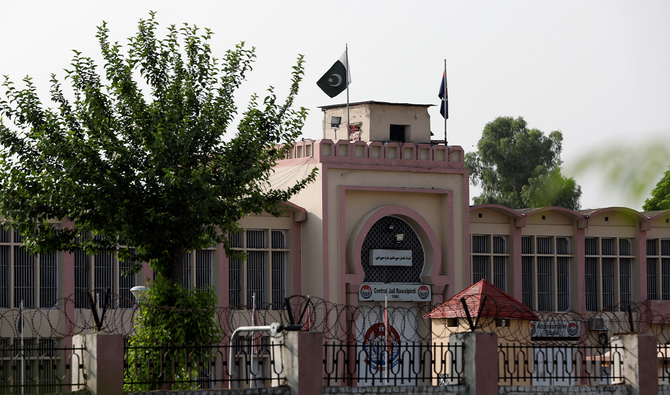
A general view of the Adiala jail, where according to media, ousted Pakistani Prime Minister Nawaz Sharif and his daughter Maryam were brought after their arrest from Lahore, in Rawalpindi, Pakistan July 14, 2018. (REUTERS)
Short Url
Updated 16 February 2026
Follow

Medical team inspects ex-PM Imran Khan’s eye condition at Rawalpindi prison — official

  • Khan has suffered severe vision loss in his right eye due to central retinal vein occlusion, a court-appointed lawyer said this week
  • The ex-premier's party has rejected his medical examination 'behind closed doors, without the presence of personal physicians or family'

ISLAMABAD: A team of doctors was inspecting jailed former prime minister Imran Khan’s eye condition at Rawalpindi’s Adiala prison, the jail superintendent said on Sunday, after a court-appointed lawyer reported a significant loss of sight in his right eye.

The development followed a report submitted to the Supreme Court by a lawyer appointed as amicus curiae who was asked to visit Khan at Rawalpindi’s Adiala jail earlier this month. The report said the 73-year-old had suffered severe vision loss in his right eye due to central retinal vein occlusion, leaving him with only 15 percent sight in the affected eye.

The findings triggered a sit-in by an opposition alliance, including members of Khan’s Pakistan Tehreek-e-Insaf (PTI) party, demanding his immediate transfer to Islamabad’s Al-Shifa Hospital. Khan was also allowed to speak to his sons for about 20 minutes, according to his family, despite the former premier’s limited interactions with family and legal team in recent months due to restrictions that the PTI has challenged in court.

In a statement issued on Sunday evening, the Adiala Jail superintendent said a team of expert doctors from various hospitals had arrived at the prison with necessary medical equipment and medicines and was conducting a detailed examination of the ex-premier’s eye.

“Detailed eye check-up is underway under the supervision of the Medical Board,” the statement read. “Medical examination is being conducted under strict security arrangements. The report of the medical team is likely to be compiled soon.”

The development comes a day after Pakistan’s government said on Saturday it has decided to transfer jailed former prime minister Imran Khan to a hospital and form a medical board for his eye treatment.

“Imran Khan has been provided the facility to speak with his sons on the phone and, in view of his health, it has also been decided to transfer him to hospital and constitute a medical board,” Parliamentary Affairs Minister Tariq Fazal Chaudhry said on X. “The government gives priority to humanitarian considerations and legal requirements.”

But Khan’s PTI party rejected his medical examination “behind closed doors, without the presence of his personal physicians or even a family representative.”

“A medical assessment carried out in secrecy does not restore public confidence; it deepens suspicion,” Sayed Zulfiqar Bukhari, a PTI spokesman, said in a statement on Sunday evening.

“Access to independent medical professionals and family oversight is not a privilege, it is a fundamental right of any detainee. Denying that access undermines due process and fuels legitimate fears about the credibility of the findings.”

Meanwhile, the opposition alliance continued its protest sit-in at parliament for a third consecutive day on Sunday to move the ex-premier to the hospital.

The former cricket star-turned-politician has been in prison since 2023 after being convicted in a graft case. He was removed from office in a parliamentary no-confidence vote in April 2022.


Islamabad dismisses claims about paying up to 8 percent interest on foreign loans as ‘misleading’

Updated 22 February 2026
Follow

Islamabad dismisses claims about paying up to 8 percent interest on foreign loans as ‘misleading’

  • Pakistan has long relied on external loans to help bridge persistent gaps in public finances and foreign exchange reserves
  • Pakistan’s total external debt, liabilities stand at $138 billion at an overall average cost of around 4 percent, ministry says

KARACHI: Pakistan’s finance ministry on Sunday dismissed as “misleading” claims that the country is paying up to 8 percent interest on external loans, saying the overall average cost of external public debt is approximately 4 percent.

Pakistan has long relied on external loans to help bridge persistent gaps in public finances and foreign exchange reserves, driven largely by a narrow tax base, chronic trade deficits, rising debt-servicing costs and repeated balance-of-payments pressures.

Over the decades, successive governments have turned to multilateral and bilateral lenders, including the International Monetary Fund, the World Bank and the Asian Development Bank, to support budgetary needs and shore up foreign exchange reserves.

The finance ministry on Sunday issued a clarification in response to a “recent press commentary” regarding the country’s external debt position and associated interest payments, and said the figures required contextual explanation to ensure accurate understanding of Pakistan’s external debt profile.

“Pakistan’s total external debt and liabilities currently stand at $138 billion. This figure, however, encompasses a broad range of obligations, including public and publicly guaranteed debt, debt of Public Sector Enterprises (both guaranteed and non-guaranteed), bank borrowings, private-sector external debt, and intercompany liabilities to direct investors. It is therefore important to distinguish this aggregate figure from External Public (Government) Debt, which amounts to approximately $92 billion,” it said.

“Of the total External Public Debt, nearly 75 percent comprises concessional and long-term financing obtained from multilateral institutions (excluding the IMF) and bilateral development partners. Only about 7 percent of this debt consists of commercial loans, while another 7 percent relates to long-term Eurobonds. In light of this composition, the claim that Pakistan is paying interest on external loans ‘up to 8 percent’ is misleading.

The overall average cost of External Public Debt is approximately 4 percent, reflecting the predominantly concessional nature of the borrowing portfolio.”

With respect to interest payments, public external debt interest outflows increased from $1.99 billion in Fiscal Year (FY) 2022 to $3.59 billion in FY2025, representing an increase of 80.4 percent, not 84 percent as reported. In absolute terms, interest payments rose by $1.60 billion over this period, not $1.67 billion, it said.

According to the State Bank of Pakistan’s records, Pakistan’s total debt servicing payments to specific creditors during the period under reference were as follows: the IMF received $1.50 billion, of which $580 million constituted interest; Naya Pakistan Certificates payments totaled $1.56 billion, including $94 million in interest; the Asian Development Bank received $1.54 billion, including $615 million in interest; the World Bank received $1.25 billion, including $419 million in interest; and external commercial loans amounted to nearly $3 billion, of which $327 million represented interest payments.

“While interest payments have increased in absolute terms, this rise cannot be attributed solely to an expansion in the debt stock,” the ministry said. “Although the overall debt stock has increased slightly since FY2022, the additional inflows have primarily originated from concessional multilateral sources and the IMF’s Extended Fund Facility (EFF) under the ongoing IMF-supported program.”

Pakistan secured a $7 billion IMF bailout in Sept. 2024 as part of Prime Minister Shehbaz Sharif’s efforts to stabilize the South Asian economy that narrowly averted a default in 2023. The government has since been making efforts to boost trade and bring in foreign investment to consolidate recovery.

“It is also important to note that the increase in interest payments reflects prevailing global interest rate dynamics. In response to the inflation surge of 2021–22, the US Federal Reserve raised the federal funds rate from 0.75-1.00 percent in May 2022 to 5.25–5.50 percent by July 2023. Although rates have since moderated to around 3.75 percent, they remain significantly higher than 2022 levels,” the finance ministry said.

“The government remains committed to prudent debt management, transparency, and the continued strengthening of Pakistan’s macroeconomic stability,” it added.