

Medical team inspects ex-PM Imran Khan’s eye condition at Rawalpindi prison — official

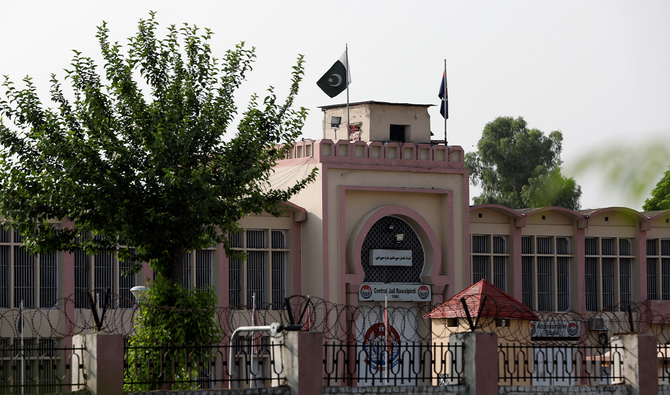
A general view of the Adiala jail, where according to media, ousted Pakistani Prime Minister Nawaz Sharif and his daughter Maryam were brought after their arrest from Lahore, in Rawalpindi, Pakistan July 14, 2018. (REUTERS)
Short Url
Updated 16 February 2026
Follow

Medical team inspects ex-PM Imran Khan’s eye condition at Rawalpindi prison — official

  • Khan has suffered severe vision loss in his right eye due to central retinal vein occlusion, a court-appointed lawyer said this week
  • The ex-premier's party has rejected his medical examination 'behind closed doors, without the presence of personal physicians or family'

ISLAMABAD: A team of doctors was inspecting jailed former prime minister Imran Khan’s eye condition at Rawalpindi’s Adiala prison, the jail superintendent said on Sunday, after a court-appointed lawyer reported a significant loss of sight in his right eye.

The development followed a report submitted to the Supreme Court by a lawyer appointed as amicus curiae who was asked to visit Khan at Rawalpindi’s Adiala jail earlier this month. The report said the 73-year-old had suffered severe vision loss in his right eye due to central retinal vein occlusion, leaving him with only 15 percent sight in the affected eye.

The findings triggered a sit-in by an opposition alliance, including members of Khan’s Pakistan Tehreek-e-Insaf (PTI) party, demanding his immediate transfer to Islamabad’s Al-Shifa Hospital. Khan was also allowed to speak to his sons for about 20 minutes, according to his family, despite the former premier’s limited interactions with family and legal team in recent months due to restrictions that the PTI has challenged in court.

In a statement issued on Sunday evening, the Adiala Jail superintendent said a team of expert doctors from various hospitals had arrived at the prison with necessary medical equipment and medicines and was conducting a detailed examination of the ex-premier’s eye.

“Detailed eye check-up is underway under the supervision of the Medical Board,” the statement read. “Medical examination is being conducted under strict security arrangements. The report of the medical team is likely to be compiled soon.”

The development comes a day after Pakistan’s government said on Saturday it has decided to transfer jailed former prime minister Imran Khan to a hospital and form a medical board for his eye treatment.

“Imran Khan has been provided the facility to speak with his sons on the phone and, in view of his health, it has also been decided to transfer him to hospital and constitute a medical board,” Parliamentary Affairs Minister Tariq Fazal Chaudhry said on X. “The government gives priority to humanitarian considerations and legal requirements.”

But Khan’s PTI party rejected his medical examination “behind closed doors, without the presence of his personal physicians or even a family representative.”

“A medical assessment carried out in secrecy does not restore public confidence; it deepens suspicion,” Sayed Zulfiqar Bukhari, a PTI spokesman, said in a statement on Sunday evening.

“Access to independent medical professionals and family oversight is not a privilege, it is a fundamental right of any detainee. Denying that access undermines due process and fuels legitimate fears about the credibility of the findings.”

Meanwhile, the opposition alliance continued its protest sit-in at parliament for a third consecutive day on Sunday to move the ex-premier to the hospital.

The former cricket star-turned-politician has been in prison since 2023 after being convicted in a graft case. He was removed from office in a parliamentary no-confidence vote in April 2022.


Sindh assembly passes resolution rejecting move to separate Karachi

Updated 21 February 2026
Follow

Sindh assembly passes resolution rejecting move to separate Karachi

  • Chief Minister Shah cites constitutional safeguards against altering provincial boundaries
  • Calls to separate Karachi intensified amid governance concerns after a mall fire last month

ISLAMABAD: The provincial assembly of Pakistan’s southern Sindh province on Saturday passed a resolution rejecting any move to separate Karachi, declaring its territorial integrity “non-negotiable” amid political calls to carve the city out as a separate administrative unit.

The resolution comes after fresh demands by the Muttahida Qaumi Movement (MQM) and other voices to grant Karachi provincial or federal status following governance challenges highlighted by the deadly Gul Plaza fire earlier this year that killed 80 people.

Karachi, Pakistan’s largest and most densely populated city, is the country’s main commercial hub and contributes a significant share to the national economy.

Chief Minister Syed Murad Ali Shah tabled the resolution in the assembly, condemning what he described as “divisive statements” about breaking up Sindh or detaching Karachi.

“The province that played a foundational role in the creation of Pakistan cannot allow the fragmentation of its own historic homeland,” Shah told lawmakers, adding that any attempt to divide Sindh or separate Karachi was contrary to the constitution and democratic norms.

Citing Article 239 of Pakistan’s 1973 Constitution, which requires the consent of not less than two-thirds of a provincial assembly to alter provincial boundaries, Shah said any such move could not proceed without the assembly’s approval.

“If any such move is attempted, it is this Assembly — by a two-thirds majority — that will decide,” he said.

The resolution reaffirmed that Karachi would “forever remain” an integral part of Sindh and directed the provincial government to forward the motion to the president, prime minister and parliamentary leadership for record.

Shah said the resolution was not aimed at anyone but referred to the shifting stance of MQM in the debate while warning that opposing the resolution would amount to supporting the division of Sindh.

The party has been a major political force in Karachi with a significant vote bank in the city and has frequently criticized Shah’s provincial administration over its governance of Pakistan’s largest metropolis.

Taha Ahmed Khan, a senior MQM leader, acknowledged that his party had “presented its demand openly on television channels with clear and logical arguments” to separate Karachi from Sindh.

“It is a purely constitutional debate,” he told Arab News by phone. “We are aware that the Pakistan Peoples Party, which rules the province, holds a two-thirds majority and that a new province cannot be created at this stage. But that does not mean new provinces can never be formed.”

Calls to alter Karachi’s status have periodically surfaced amid longstanding complaints over governance, infrastructure and administrative control in the megacity, though no formal proposal to redraw provincial boundaries has been introduced at the federal level.