
RYLSK, Russia: In the Russian region of Kursk, where Ukraine has been fighting for more than seven months, people say they want peace but fear there will be more war.
Ukraine’s incursion into Russian territory was launched in August — more than two years into a major war triggered by Moscow’s invasion of its neighbor — shocking a border region that hadn’t seen conflict since World War Two.
Now, with Russia close to expelling the last Ukrainian troops, Kursk’s populace is counting the cost.
For some residents like Leonid Boyarintsev, a veteran of the Sino-Soviet border conflict of 1969, the surprise enemy offensive served as justification for Russia to double down on its military activities in Ukraine.
“When we are victorious there will be peace because no one will dare to come crawling in again,” the 83-year-old told Reuters in the town of Rylsk, adding that he blamed the West for stoking the conflict in Ukraine. “They will be too afraid to.”
The damage that has been unleashed on towns and cities in the Russian region has brought home the horrors of war long suffered by Ukrainians.
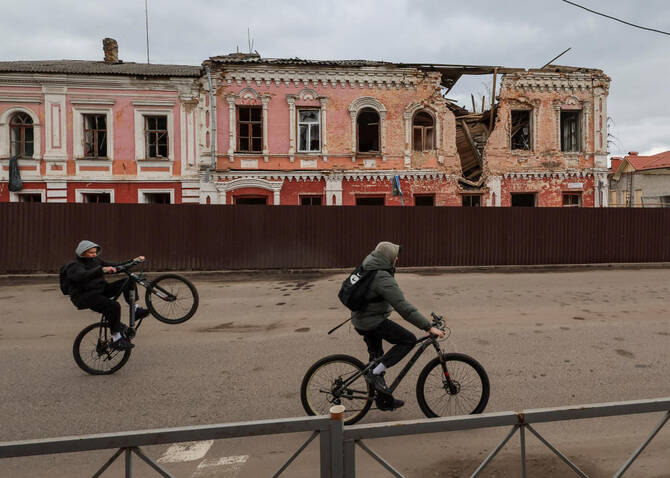
In ancient Rylsk, 26 km (16 miles) from the border, the scars are everywhere — from the smashed merchant buildings from Tsarist Russia to the families still struggling with children living apart in evacuation.
“We want peace but it is very important that the peace is long term and durable,” town Mayor Sergei Kurnosov told Reuters in the ruins of a cultural center that was destroyed in a Dec. 20 Ukrainian attack.
Six people were killed and 12 injured in the attack, Russia said. Russia said the cultural center was destroyed by US-made HIMARS missiles. Abandoned music books lay beside silent pianos and a theater stage showing a shattered scene of rubble and glass.
Reuters is among the first international news outlets to gain access to the Kursk region since Russia began a lightning offensive to expel Ukrainian troops this month. While Russian officials did not check reporting material, the Reuters team was informed in advance that it could not report about the Russian military in the region or gather visuals of Russian forces.
Just like Ukrainians, many Kursk residents crave a return to normality
Here too, air-raid sirens have become the daily soundtrack of life. While Russia has now pushed out almost all Ukrainian forces from Kursk, the area has been heavily mined and drones continue to attack. Many civilian cars speeding along a road near the vast Kurchatov nuclear power plant had drone jamming devices strapped onto their roofs. Residents shopped for food and vapes as artillery boomed in the distance.
“It’s all very scary indeed,” said Rimma Erofeyeva, a music teacher in Rylsk who said people in the town wanted the fighting to stop though believed that God was protecting them. “The really scary thing is that people have got so used to this that they don’t even react to the sirens anymore.”
SWARMS OF DRONES
Ukrainian forces smashed into the Kursk region on August 6, supported by swarms of drones and heavy Western weaponry, and swiftly seize almost 1,400 sq km of territory, according to Russian generals. But within weeks the area under Ukraine’s control shrank as Russia piled in forces.
The latest battlefield map from Deep State, an authoritative Ukrainian site that charts the frontlines from open-source data, showed Ukraine controlled less than 81 sq km as of March 23.
By contrast, Russia controls about 113,000 sq km, or about 20 percent, of Ukraine.
The strategic fortunes of the Kursk incursion are disputed.
Ukraine said the incursion was aimed at bringing the war to Russia, diverting Russian troops from advances in eastern Ukraine, embarrassing President Vladimir Putin and gaining a bargaining chip in potential future talks on ending the war. The operation “achieved most of its goals,” the armed forces’ General Staff told Reuters this week.
The chief of Russia’s General Staff Valery Gerasimov told Putin, in a televised exchange during a trip by the president to a command post in the Kursk region on March 12, that Ukraine had lost tens of thousands of its best troops in a failed bid to distract Russian forces from the Donbas, in eastern Ukraine.
“The Kyiv regime aimed to create a so-called strategic foothold in the Kursk region for later use as a bargaining chip in possible negotiations with Russia,” Gerasimov said. “These plans of the enemy have completely failed.”
Russia’s defense ministry says Ukraine has lost 69,700 troops dead or injured in Kursk, along with 5,700 tanks, armored cars and many Western-supplied vehicles. Russia has not given its own casualty figures. Ukraine has given no casualty figures but dismisses Russian estimates as fake.
New US President Donald Trump has vowed to end the three-year war in Ukraine, yet many people in the Kursk region are skeptical of any lasting peace because of deep-seated geopolitical tensions and distrust between Russia and the West.
“I don’t think that there will be peace in our region in the near future,” said a resident of the city of Kursk who gave her name only as Yekaterina, citing resentment toward Russia from Ukraine and the West. “There will be some hostility toward our people, toward our land for a very long time.”