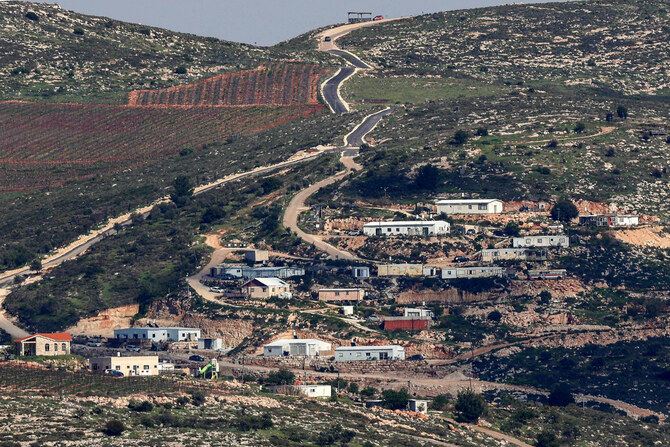


JERUSALEM/RAMALLAH: The Palestinian foreign ministry and an anti-settlement watchdog group on Sunday condemned an Israeli decision to recognize more than a dozen new settlements in the occupied West Bank, upgrading existing neighborhoods to independent settlement status.
Israel’s Finance Minister Bezalel Smotrich earlier announced that the security cabinet approved a plan to separate 13 Jewish settlements from their neighboring communities.

Israeli Prime Minister Benjamin Netanyahu (R) and Minister of Finance Bezalel Smotrich. (AFP file photo)
Smotrich, a far-right leader and settler who was behind the cabinet’s decision, hailed it as an “important step” for Israeli settlements in the West Bank.
Smotrich is a leading voice calling for Israel to formally annex the West Bank — as it did in 1967 after capturing east Jerusalem in a move not recognized by most of the international community.
The settlements will ultimately be recognized as independent, he posted on X about the move, which follows the approval of tens of thousands of housing units across the West Bank.
“We continue to lead a revolution of normalization and regulation in the settlements. Instead of hiding and apologizing – we raise the flag, build and settle. This is another important step on the path to actual sovereignty in Judea and Samaria,” Smotrich said, using Israel’s term for the West Bank.
Israel’s opposition to ceding control of the West Bank has been deepened by its fears of a repeat of the October 7, 2023, attack by Hamas-led militants. Its military says it is conducting counter-terrorism operations in the West Bank and targeting suspected militants.
A statement from the Palestinian Authority’s foreign ministry condemned the decision by Israel’s security cabinet as a show of “disregard for international legitimacy and its resolutions.”
The West Bank, occupied by Israel since 1967, is home to about three million Palestinians as well as nearly 500,000 Israelis living in settlements that are illegal under international law.
In its statement, the Palestinian foreign ministry also mentioned an ongoing major Israeli military operation in the northern West Bank, saying it was accompanied by “an unprecedented escalation in the confiscation of Palestinian lands.”
Peace Now, an anti-settlement watchdog group, said that aside from creating new settlements, the Security Cabinet made a decision that would lead to the expulsion of Palestinians from Gaza.
“The second decision, to recognize 13 settlements in the West Bank as independent settlements, exposes Israel’s long-standing lie that it does not establish new settlements, but only ’neighborhoods,’ of existing settlements,“ Peace Now wrote on the X platform.
This brings the number of settlements, considered illegal by the majority of the international community, to 140, said the watchdog group. They will now receive independent budgets from Israel and can elect their own local governments, it added.
The 13 settlement neighborhoods approved for development by the Israeli cabinet are located across the West Bank. Some of them are effectively part of the bigger settlements they belong to while others are practically separate.
Their recognition as separate communities under Israeli law is not yet final.
Hailing the “normalization” of settlement expansion, the Yesha Council, an umbrella organization for the municipal councils of West Bank settlements, thanked Smotrich for pushing for the cabinet decision.
According to EU figures, 2023 saw a 30-year record in settlement building permits issued by Israel.
(With AFP, AP & Reuters)