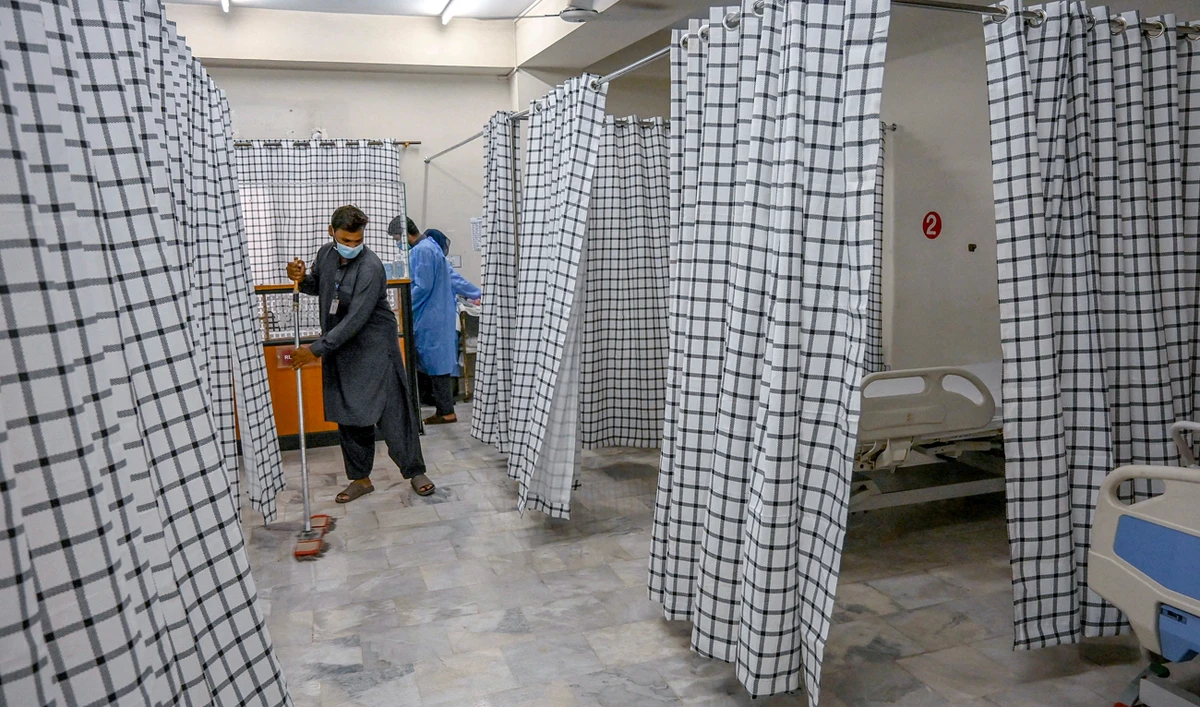
KARACHI: Pakistan’s southeastern province of Sindh on Saturday reported its first mpox case, with health authorities saying the patient, in his late 20s, had no recent travel history and was being kept in isolation at a local hospital.
Pakistan reported eight cases last year and five this year of mpox, which causes flu-like symptoms and pus-filled lesions. Children, pregnant women, and people with weakened immune systems face a higher risk of complications from the infection.
Mpox can spread through close contact with an infected person, such as skin-to-skin touching or cuts, sexual activity, mouth-to-mouth contact, or by breathing in infectious respiratory particles.
The Sindh health department’s announcement highlighting the lack of travel history raises suspicion of a locally transmitted case.
“Saturday 22nd March 2025, the lab confirmed the first case of Monkeypox in Sindh,” Meeran Yousuf, the provincial health department spokesperson, said in a brief statement.
“The 29-year-old male, resident of District Malir, has no recent travel history,” he continued. “His first symptom onset was on 15th March 2025. The patient is currently in isolation at a public hospital and contact tracing is currently being conducted by the health department.”
Last month, Pakistan reported two new mpox cases in the northwestern city of Peshawar, one of which was said to be the country’s first locally transmitted case.
The World Health Organization declared a global health emergency in 2024 over the spread of a new, more dangerous mutated strain of mpox, named clade I. The strain first emerged in the Democratic Republic of Congo and spread to several countries, prompting increased monitoring and preventive measures worldwide.
Pakistan has so far not reported any cases of the new mutation.

Health authorities confirm first mpox case in Pakistan’s Sindh
https://arab.news/bvvy7
Health authorities confirm first mpox case in Pakistan’s Sindh
- The 29-year-old patient has no recent travel history, raising suspicion of local transmission
- Provincial health official says the patient is kept in isolation, with contact tracing in progress
Pakistan urges UN Security Council to sanction separatist BLA group after recent attacks
- Separatist BLA launched attacks in multiple Balochistan cities last week, killing over 50 as per official figures
- Pakistan envoy says since Taliban assumed control of Afghanistan, BLA, other militant groups have a “new lease of life“
ISLAMABAD: Pakistan’s UN Ambassador Iftikhar Ahmed this week urged the Security Council to impose sanctions against the separatist Baloch Liberation Army (BLA) militant group and designate it as a “terrorist” group, after its recent coordinated attacks in southwestern Balochistan province.
Pakistan’s military said on Thursday it has concluded security operations in Balochistan against separatists that was launched since Jan. 29, killing 216 militants. The military launched counteroffensive operations in Balochistan after the BLA said it launched coordinated attacks in several parts of the province last Friday and Saturday.
The attacks killed 36 civilians and 22 law enforcement and security forces personnel, Pakistan’s military said. Pakistan’s government has accused India of being involved in the attacks, charges that New Delhi has dismissed.
“We hope the Council will act swiftly to designate BLA under the 1267 sanctions regime acceding to the listing request that is currently under consideration,” Iftikhar said on Wednesday during a UNSC briefing on the topic ‘Threats to International Peace and Security caused by Terrorist Acts.’
The 1267 sanctions regime is a UNSC program that seeks to impose sanctions on individuals and entities associated with “terrorism.”
The regime seeks to impose travel bans, freeze assets and impose an arms embargo on individuals and groups primarily associated with Al-Qaeda or the Taliban.
Ahmad said that after the Taliban takeover of Afghanistan in 2021, “externally sponsored and foreign-funded proxy terrorist groups” such as the Tehreek-e-Taliban Pakistan and the BLA have got a “new lease of life.”
“Operating with virtual impunity from Afghan soil and with the active support of our eastern neighbor, these groups are responsible for heinous terrorist attacks inside Pakistan,” he said.
The Pakistani envoy said it has become imperative to prevent billions of dollars of sophisticated weapons and equipment, which were left behind by foreign forces in Afghanistan, “from falling into the hands of terrorists.”
“There must be accountability of external destabilizing actors who support, finance and arm these groups, including their proxies in Afghanistan,” Ahmad said in a veiled reference to India.
Pakistan’s largest and poorest province, mineral-rich Balochistan borders Iran and Afghanistan and is home to China’s investment in the Gwadar deep-water port and other projects.
Balochistan has been the site of a decades-long insurgency led by ethnic Baloch separatists seeking greater autonomy and a larger share of its natural resources.
They accuse the state of denying locals a fair share of the province’s mineral wealth, charges that are denied by the Pakistani government.