NEW DELHI: The family of an Indian scholar at Georgetown University is calling for New Delhi’s intervention after US agents detained him for deportation earlier this week despite a court order against the move.
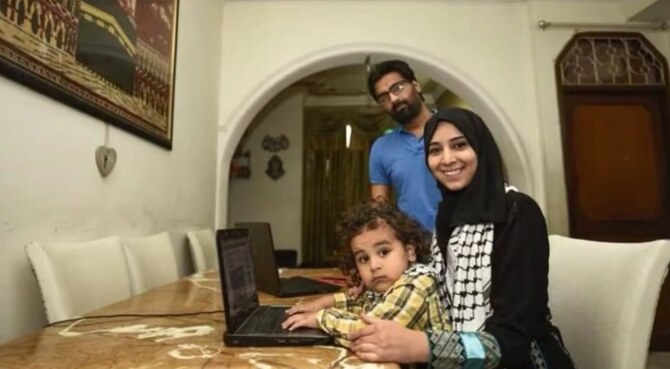
Badar Khan Suri is an Indian national and a postdoctoral fellow at Georgetown’s Prince Alwaleed bin Talal Center for Muslim-Christian Understanding in Washington, where he is studying and teaching on a student visa.
He was detained by Department of Homeland Security agents outside his home in northern Virginia on Monday.
A DHS assistant secretary said on X that Suri was “actively spreading Hamas propaganda and promoting antisemitism on social media,” had “close connections to a known or suspected terrorist who is a senior adviser to Hamas,” and that his presence in the US rendered him “deportable.”
Suri is married to a Gazan woman whose father was a political adviser to Palestine’s former prime minister.
“His wife is from Palestine and his father-in-law is a supporter of Gaza and the Palestinian cause. This is the allegation against my son, and for this he has been arrested,” Suri’s father, Shamshad Ali Khan, told Arab News.
“The Indian government should intervene and ensure justice for him. My son has not committed any crime ... Is it a crime to talk about Palestine or get married to a Palestinian?”
Suri’s legal team and Georgetown’s administration have repeatedly denied the DHS claims on mainstream international TV channels, and on Thursday a US district judge in Virginia blocked the US administration’s attempt to deport him.
As of Saturday, he was still in detention.
Suri completed his Ph.D. in peace and conflict studies from Nelson Mandela Center for Peace and Conflict Resolution at Jamia Millia Islamia in New Delhi, and was invited to become a fellow at Georgetown’s Alwaleed bin Talal Center, a part of the university’s School of Foreign Service.
“My son has not committed any crime if he has spoken out for the helpless people of Palestine ... As a researcher in peace and conflict studies, it is his duty to talk about it and provide insight,” Khan said.
“I am proud of my son because he is a lecturer at Georgetown University. He is a brilliant student and scholar ... At the university, people are protesting in favor of my son. The students at the university, the faculty of the university, and even the court are in favor of my son.”
Suri’s father is in contact with his daughter-in-law, who has been seeking assistance of the Indian Embassy in the US.
“My daughter-in-law informed me that she has reached out to the Indian Embassy,” he said.
“I request the Indian government to come forward to help him. The Indian embassy in Washington should come forward and help my son.”
But India’s Ministry of External Affairs spokesperson Randhir Jaiswal told reporters on Friday that knew about the detention only from the media and said that “when it comes to visa and immigration policy, it is something that lies within the sovereign functions of a country.”
However, top lawyers say that the government has a series of obligations it must fulfill.
“India is obliged, as all nations are, to protect its citizens anywhere in the world, so India must lodge a protest to the US, provide consular services to Mr. Suri and publicly mention that his detention is illegal,” Dushyant Dave, former Supreme Court Bar Association president and senior advocate, told Arab News.
According to another Supreme Court lawyer, Anas Tanveer, even if immigration policy is a sovereign function of the US, it is the duty of the embassy to act.
“The person there is not an illegal immigrant. He is on a scholarship, he is on a valid visa, and unless his conditions of admission and unemployment prohibit him (from expressing dissent) — and I don’t think it is possible in the US — he was very well within his rights,” he said.
“India must provide diplomatic access; India must provide legal help. The embassy must provide that. You can’t remain silent ... These are the principles of the Vienna Convention that every nation is a signatory to.”


Family seeks India’s help after scholar detained in US over alleged Gaza support
https://arab.news/9fvne
Family seeks India’s help after scholar detained in US over alleged Gaza support

- Badar Khan Suri is a fellow at Georgetown University, specializing in peace studies
- District court barred US administration from deporting him over political views


Tug of war: how US presidents battle Congress for military powers
- The last official declaration of war by Congress was as far back as World War II
WASHINGTON, United States: Donald Trump’s unleashing of operation “Epic Fury” against Iran has once more underscored the long and bitter struggle between US presidents and Congress over who has the power to decide on foreign military action.
In his video address announcing “major combat” with the Islamic republic, Trump didn’t once mention any authorization or consultation with the US House of Representatives or Senate.
In doing so he sidelined not only Democrats, who called for an urgent war powers vote, but also his own Republican party as he asserts his dominance over a largely cowed legislature.
A US official said Secretary of State Marco Rubio had called top congressional leaders known as the “Gang of Eight” to give them a heads up on the Iran attack — adding that one was unreachable.
Rubio also “laid out the situation” and consulted with the same leaders on Tuesday in an hour-long briefing, the US official said.
According to the US Constitution, only Congress can declare war.
But at the same time the founding document of the United States first signed in 1787 says that the president is the “commander in chief” of the military, a definition that US leaders have in recent years taken very broadly.
The last official declaration of war by Congress was as far back as World War II.
There was no such proclamation during the unpopular Vietnam War, and it was then that Congress sought to reassert its powers.
In 1973 it adopted the War Powers Resolution, passed over Richard Nixon’s veto, to become the only lasting limit on unilateral presidential military action abroad.
The act allows the president to carry out a limited military intervention to respond to an urgent situation created by an attack against the United States.
In his video address on Saturday, Trump evoked an “imminent” threat to justify strikes against Iran.
- Sixty days -
Yet under this law, the president must still inform Congress within 48 hours.
It also says that if the president deploys US troops for a military action for more than 60 days, the head of state must then obtain the authorization of Congress for continued action.
That falls short of an official declaration of war.
The US Congress notably authorized the use of force in such a way after the September 11, 2011 attacks on the United States by Al-Qaeda. Presidents have used it over the past two decades for not only the 2001 invasion of Afghanistan but a series of operations in several countries linked to the “War on Terror.”
Trump is far from the first US president to launch military operations without going through Congress.
Democrat Bill Clinton launched US air strikes against Kosovo in 1999 as part of a NATO campaign, despite the lack of a green light from skeptical lawmakers.
Barack Obama did the same for airstrikes in Libya in 2011.
Trump followed their example in his first term in 2018 when he launched airstrikes in Syria along with Britain and France.
But since his return to power the 79-year-old has sought to push presidential power to its limits, and that includes in the military sphere.
Trump has ordered strikes on alleged drug trafficking boats in Latin America without consulting Congress, and in June 2025 struck Iran’s nuclear facilities.
Perhaps the most controversial act was when he ordered the capture of Venezuelan president Nicolas Maduro in a lightning military raid on January 3.
Republicans however managed to knock down moves by Democrats for a rare war powers resolution that would have curbed his authority over Venezuela operations.
Trump has meanwhile sought to extend his powers over the home front. Democrats have slammed the Republican for deploying the National Guard in several US cities in what he calls a crackdown on crime and immigration.