

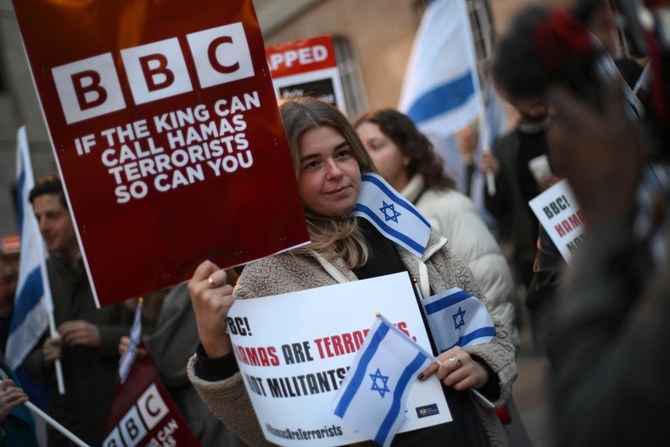
Israel threatens ban of BBC for its refusal to call Hamas terrorists

Karhi called the network “a propaganda mouthpiece” for Hamas and accused it of exposing Israeli soldiers to potential attack from Gaza. (AFP/File)
Short Url
Updated 20 October 2023
Follow

Israel threatens ban of BBC for its refusal to call Hamas terrorists

  • Israeli president calls BBC reporting ‘atrocious’ and accuses broadcaster of double standards

LONDON: The Israeli government has issued a stern warning to the BBC, suggesting that the network may be prohibited from reporting in the country due to its refusal to classify Hamas as a terrorist organization.

A senior Israeli official voiced the government’s concerns, emphasizing that the BBC might face repercussions if it continued to operate in a manner “inconsistent with our legal framework.”

In an interview with the Daily Mail on Thursday, Israeli President Isaac Herzog called the BBC’s stance “atrocious.”

“The fact that it does not recognize Hamas as a terror organization requires a complete legal battle and public battle,” Herzog said. “What other type of torture do they want before they decide it (is) a terrorist organization?”

Herzog also highlighted what he claimed was a double standard in the way the BBC has characterized similar acts of violence in the past, citing the London Bridge, Westminster, and Paris attacks as examples of events the BBC has reported as terrorist acts. 

Another Israeli official, discussing potential measures against broadcasters, told The Telegraph, “We’re a democratic country and we will use all the tools a democratic state has. If any broadcast channel uses terminology we think is crossing the line in accordance with our laws, we will (take action).”

Earlier this week, Israeli media reported that Shlomo Karhi, the communications minister, had been given the green light by the attorney general to set up regulations aimed at curbing Al Jazeera’s reporting on the ground in Israel.

Karhi called the network “a propaganda mouthpiece” for Hamas and accused it of exposing Israeli soldiers to potential attack from Gaza.

The reports triggered an international reaction, with media and press-freedom organizations urging Israel not to block the Qatari broadcaster, citing the importance of a “plurality of media voices.” Any move to ban the BBC from Israel is expected to further raise concerns about press freedom.

Since the beginning of the conflict, the BBC has faced numerous criticisms over its reporting. On Thursday, Israeli officials criticized the British broadcaster for its coverage of the explosion at Al-Ahli Arab Hospital in Gaza, describing suggestions it made in the immediate aftermath of the blast that Israel might have been responsible as a “modern blood libel.”

On Saturday, during a pro-Palestine march in London, activists splattered the BBC’s New Broadcasting House in Oxford Circus with red paint to protest what they called the network’s “biased” reporting of events in Israel and Gaza.


Israel says ban on Gaza media access should stay: court document

Updated 05 January 2026
Follow

Israel says ban on Gaza media access should stay: court document

  • Israeli authorities have told the Supreme Court that a ban on international media access to Gaza should remain in place, arguing it is necessary for security reasons

JERUSALEM: Israeli authorities have told the Supreme Court that a ban on international media access to Gaza should remain in place, arguing it is necessary for security reasons, according to a government submission filed by the public prosecutor.
Since the outbreak of the Gaza war in October 2023, Israeli authorities have barred foreign journalists from independently entering the devastated territory.
Instead, Israel has allowed only a limited number of reporters to enter Gaza on a case-by-case basis, embedded with its military forces inside the blockaded territory.
The Foreign Press Association (FPA), which represents hundreds of foreign journalists working in Israel and the Palestinian territories, filed a petition with the Supreme Court in 2024 seeking immediate and unrestricted access for international media to the Gaza Strip.
Since then the court has given several extensions to the Israeli authorities to come up with a plan, but at a hearing last month it set January 4 as a final deadline.
Late on Sunday, the Israeli authorities filed their response with the court, a copy of which was obtained by AFP.
In the submission, the government said the ban on media access to Gaza should continue, citing security risks in the territory.
“Even at this time, entry of journalists into the Gaza Strip without escort, as requested in the petition, should not be permitted,” said the government submission.
“This is for security reasons, based on the position of the defense establishment, which maintains that a security risk associated with such entry still exists.”
The Israeli authorities said the ceasefire in Gaza, which came into effect on October 10, continues to face regular threats.
At least 420 Palestinians have been killed in Gaza by Israeli forces since the ceasefire took effect, according to Gaza’s health ministry.
The Israeli military said three of its soldiers have also been killed by militants during the same period.
The Israeli authorities said in their submission that the search for the remains of the last hostage held in Gaza is ongoing, suggesting that allowing journalists into the territory at this stage could hinder the operation.
The remains of Ran Gvili, whose body was taken to Gaza after he was killed during the Hamas attack on October 7, 2023, have still not been recovered despite the ceasefire.
All other 250 hostages seized on that day — both the living and the deceased — have been returned to Israel.
The Supreme Court is expected to issue a ruling on the matter, though it is unclear when a decision will be handed down.
An AFP journalist sits on the board of the FPA.