Pakistani journalist faces court over ‘anti-state’ posts

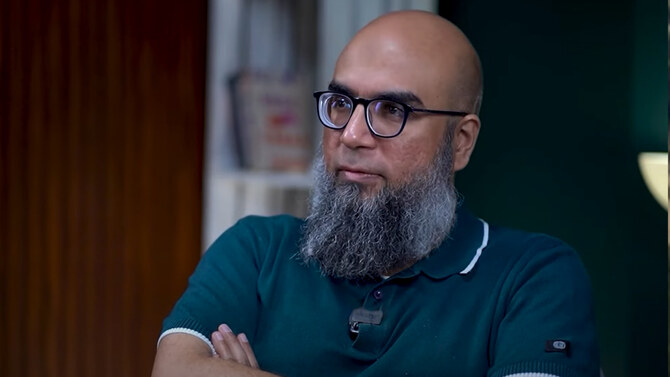
The screengrab taken from a video shows founder of a Pakistani Internet media channel, Farhan Malik, speaks in a podcast interview, uploaded on March 17, 2025. (Screengrab/YouTube/@raftartv)
Short Url
Updated 21 March 2025
Follow

Pakistani journalist faces court over ‘anti-state’ posts

  • Farhan Mallick, head of the Raftar channel, was remanded in custody for three days, his media outlet reported on X
  • He was detained under a law targeting people ‘intentionally disseminating’ information that is ‘fake or likely to spread fear’

ISLAMABAD: The founder of a Pakistani Internet media channel appeared in court on Friday on charges of “anti-state posts and fake news” under toughened legislation targeting online content.
Farhan Mallick, head of the Raftar channel, was remanded in custody for three days, his media outlet reported on social media platform X.
The charge sheet seen by AFP shows he was detained under a revised law targeting people “intentionally disseminating” information that is “fake or likely to spread fear.”
The revised legislation carries a prison term of up to three years and prompted journalist protests when it was approved in January.
“At this stage, no concrete evidence has been presented to substantiate the anti-state allegations against Mr.Mallick or Raftar,” read an online statement by the channel, which primarily publishes podcasts and analyzes of current affairs.
Several of Raftar’s videos have amassed more than a million views in recent years and examine the role of Pakistan’s powerful military, which analysts say is deeply involved in the country’s politics and economy.
Mallick was arrested by the Federal Investigation Agency, which deals with cybercrime, on Thursday.
The independent Human Rights Commission of Pakistan subsequently called on authorities to “check the overreach of agencies... and uphold the right to freedom of expression.”
The criminalization of online disinformation has spread fear in Pakistan, with journalists among those worried about the potentially wide reach of the law.
“Amendments are being brought in specifically to quell dissent, to abduct, arrest, and detain journalists, and to silence journalism, silence dissent, and silence all criticism of the state,” human rights lawyer Imaan Mazari told AFP.
Pakistan is ranked 152 out of 180 countries in a press freedom index compiled by Reporters Without Borders.
Islamabad has long been criticized by watchdogs for restricting Internet access, including temporary bans on YouTube and TikTok, while X is officially blocked.


Pakistan PM approves framework for National Energy Plan aimed at cutting power costs

Updated 4 sec ago
Follow

Pakistan PM approves framework for National Energy Plan aimed at cutting power costs

  • Electricity costs in Pakistan have been a major concern for both industries and domestic consumers
  • PM Shehbaz Sharif instructs authorities to expedite privatization of power distribution companies

ISLAMABAD: Prime Minister Shehbaz Sharif on Wednesday approved the framework for a National Energy Plan aimed at ensuring low electricity costs for industries and facilitating domestic consumers, Pakistani state broadcaster reported. 

The development took place during a meeting of the Cabinet Committee on Energy in Islamabad presided over by Sharif. The Pakistani prime minister directed all ministries and provincial governments to present a “workable and coordinated” strategy under the proposed plan.

Electricity costs in Pakistan have been a major concern for both industries and domestic consumers. Industrial users often face high tariffs that increase production cost while residential consumers struggle with rising bills that impact household budgets. 

“Prime Minister Shehbaz Sharif has given in-principle approval for the formulation of a comprehensive National Energy Plan in consultation with relevant ministries and provincial governments,” Radio Pakistan said in a report.

“He emphasized that the government’s top priorities include ensuring electricity supply to industries at the lowest possible cost and providing facilitation for domestic consumers.”

Sharif also approved the establishment of a dedicated secretariat for the National Energy Plan and gave approval to the framework guidelines for auctioning wheeling charges, it added.

Wheeling charges are fees paid for using another company’s power grid to transmit electricity from a generator to a consumer, covering the cost of transporting electricity over someone else’s network.

The report said Sharif instructed authorities to include the recommendations of the climate change, finance, industries and petroleum ministries into the plan. 

Sharif also gave instructions to expedite the privatization of power distribution companies (DISCOs) and urged competitive tariffs for industries to boost production capacity.

Fluctuations in fuel prices, inefficiencies in the power sector, and reliance on imported energy have contributed to high electricity costs in Pakistan in recent years, making energy affordability and stability a key focus for government policies and reforms.

Pakistan has pushed energy sector reforms to tackle long-standing issues like circular debt, power theft, and transmission losses, which have caused blackouts and high electricity costs. 

In February, Pakistan developed a new energy policy that it says will help the country attract $5 billion in investment through public-private partnerships.