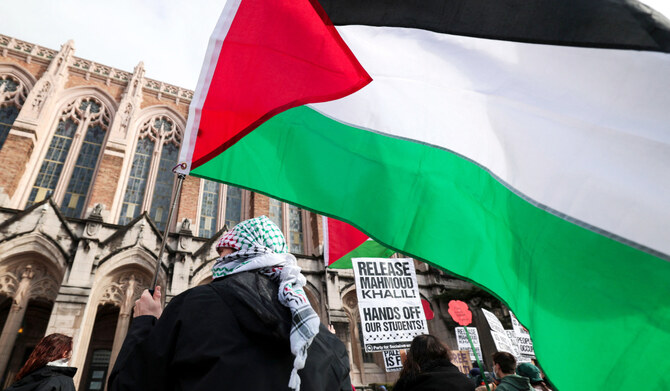
NEW YORK: A Columbia University student arrested and threatened with deportation for his role in campus protests against Israel gave his first public statement Tuesday, saying that his detention is indicative of “anti-Palestinian racism” demonstrated by both the Trump and Biden administrations.
In a letter dictated from a Louisiana immigration lockup and released by his attorney, the student, Mahmoud Khalil, said he is being targeted as part of a larger effort to repress Palestinian voices.
“My unjust detention is indicative of the anti-Palestinian racism that both the Biden and Trump administrations have demonstrated over the past 16 months as the US has continued to supply Israel with weapons to kill Palestinians and prevented international intervention,” he said.
“For decades, anti-Palestinian racism has driven efforts to expand US laws and practices that are used to violently repress Palestinians, Arab Americans, and other communities. That is precisely why I am being targeted.”
Khalil and the federal government have been sparring in court over the Trump administration’s move to ship him halfway across the country to the lockup in Louisiana.
The government says he could not be detained at an immigration facility near where he was originally arrested in part because of a bedbug infestation, so they sent him to Louisiana. Khalil says there was no such discussion of bedbugs and he feared he was being immediately deported.
Khalil said in a declaration filed in Manhattan federal court Monday that while he was held overnight at a detention center in Elizabeth, New Jersey, “I did not hear anyone mention bedbugs.”
In court papers over the weekend, lawyers for the Justice Department also blamed his move on overcrowded facilities in the Northeast.
Khalil made the statement about bedbugs in an exhibit attached to court papers in which his lawyers asked that he be freed on bail while the courts decide whether his arrest violated the First Amendment.
The lawyers have also asked a judge to widen the effect of any order to stop the US government from “arresting, detaining, and removing noncitizens who engage in constitutionally protected expressive activity in the United States in support of Palestinian rights or critical of Israel.”
Khalil said in court records that he was put in a van when he was taken away from the Elizabeth facility and he asked if he was being returned to FBI headquarters in Manhattan, where he was taken immediately after his arrest.
“I was told, ‘no, we are going to JFK Airport.’ I was afraid they were trying to deport me,” he recalled.
Of his time spent at the Elizabeth facility, he wrote: “I was in a waiting room with about ten other people. We slept on the ground. Even though it was cold inside the room, there were no beds, mattresses, or blankets.”
Khalil, in the letter released by his attorney on Tuesday, said “I see in my circumstances similarities to Israel’s use of administrative detention – imprisonment without trial or charge – to strip Palestinians of their rights.”
“For Palestinians, imprisonment without due process is commonplace,” he said.
In the weekend court papers, lawyers for the Justice Department gave a detailed description of Khalil’s March 8 arrest and his transport from Manhattan to Elizabeth and then to Kennedy International Airport in New York the next day for his transfer to Louisiana, where he has been held since.
“Khalil could not be housed at Elizabeth Detention Facility long-term due to a bedbug issue, so he remained there until his flight to Louisiana,” the lawyers wrote. They said he was at the facility from 2:20 a.m. until 11:30 a.m. on March 9.
The lawyers have asked that legal issues be addressed by federal judges in New Jersey or Louisiana rather than New York. A Manhattan federal judge has not yet ruled on the request.
Khalil’s lawyers, who oppose transferring the case, wrote in a submission Monday that the transfer to Louisiana was “predetermined and carried out for improper motives” rather than because of a bedbug infestation.
Despite the bedbug claim, the Elizabeth Detention accepted at least four individuals for detention from March 6 through last Thursday and Khalil himself saw men being processed for detention while he was there, they wrote.
Khalil, in the letter released by his attorney on Tuesday, also referenced a wave of Israeli strikes across Gaza — ending the ceasefire on Monday night — and called it a “moral imperative” to continue push for freedom for Palestinians.
“With January’s ceasefire now broken, parents in Gaza are once again cradling too-small shrouds, and families are forced to weigh starvation and displacement against bombs,” he said. “It is our moral imperative to persist in the struggle for their complete freedom.”

Columbia University student says his detention is indicative of anti-Palestinian racism in US
Short Url
https://arab.news/8uktq
Columbia University student says his detention is indicative of anti-Palestinian racism in US
- Khalil, in the letter released by his attorney on Tuesday, said “I see in my circumstances similarities to Israel’s use of administrative detention – imprisonment without trial or charge – to strip Palestinians of their rights”
- Khalil and the federal government have been sparring in court over the Trump administration’s move to ship him halfway across the country to the lockup in Louisiana
El Paso flights resume after US anti-drone system prompts sudden shutdown
- Aviation officials lifts restrictions after sudden overnight halt
- FAA, US Army in dispute over laser anti-drone system
WASHINGTON: A secret military laser-based anti-drone system prompted the Trump administration to ban air traffic for more than seven hours in and out of the Texas border city of El Paso after US aviation officials raised drastic concerns about the safety of commercial air traffic.
The sudden closure of the nation’s 71st busiest airport by the Federal Aviation Administration stranded air travelers and disrupted medical evacuation flights overnight. The FAA initially said the closure would last 10 days for “special security reasons,” in what would have been an unprecedented action involving a single airport. Government and airline officials, speaking on condition of anonymity, said the FAA closed the airspace due to concerns that an Army laser-based counter-drone system could pose risks to air traffic. The two agencies had planned to discuss the issue at a February 20 meeting but the Army opted to proceed without FAA approval, sources said, which prompted the FAA to halt flights.
The Army’s laser was a direct-energy weapon called LOCUST and is manufactured by AeroVironment, a Virginia-based drone and counter-drone defense firm, two people briefed on the matter said. The company and the Pentagon did not immediately respond to requests for comment.
The FAA lifted its restrictions after the Army agreed to more safety tests before using the system, which is housed at Fort Bliss, next to El Paso International Airport.
The White House was surprised by the El Paso airspace closure, according to two sources speaking on condition of anonymity, touching off a scramble among law enforcement agencies to figure out what happened.
The FAA lifted the restrictions shortly after the situation was discussed in the office of White House chief of staff Susie Wiles, the sources said. US Transportation Secretary Sean Duffy, who oversees the FAA, said the closure had been prompted by a drone incursion by a Mexican drug cartel. However, a drone sighting near an airport would typically lead to a brief pause on traffic, not an extended closure, and the Pentagon says there are more than 1,000 such incidents each month along the US-Mexico border.
FAA Administrator Bryan Bedford met senators on Wednesday and told them there could have been better coordination about the move but did not answer detailed questions about why the agency initially planned a 10-day halt to flights, lawmakers said. Senate Commerce Committee chair Ted Cruz, a Texas Republican, and Senator Ben Ray Lujan, a New Mexico Democrat, both called for a classified briefing to get more answers. “The details of what exactly occurred over El Paso are unclear,” Cruz said.
The move had stranded numerous aircraft from Southwest Airlines, United Airlines and American Airlines at the airport, which handles about 4 million passengers annually.
El Paso Mayor Renard Johnson said the FAA did not reach out to the airport, the police chief or other local officials before shutting down the airspace.
“I want to be very, very clear that this should have never happened,” he said at a news conference.
The US official in charge of airport security, Transportation Security Administration Acting Administrator Ha Nguyen McNeill, also told Congress that she had not been notified.
“That’s a problem,” said Republican Representative Tony Gonzales of Texas, who said there are daily drone incursions along the US-Mexico border.
Airlines caught off guard
Airlines were also caught off-guard by the early Wednesday announcement. Southwest Airlines said the effects should be minimal for its 23 daily departures scheduled.
“FAA has not exactly acquitted itself credibly, objectively, or professionally,” said Bob Mann, an airline industry consultant. “The question should be, do we get an explanation?”
Trump has repeatedly threatened to deploy US military force against Mexican drug cartels, which have used drones to carry out surveillance and attacks on civilian and government infrastructure, according to US and Mexican security sources.
Mexican President Claudia Sheinbaum said at her daily news conference that her administration would try to find out what exactly happened but had no information about drone traffic along the border.
Tensions between the US and regional leaders have ramped up since the Trump administration mounted a large-scale military buildup in the southern Caribbean, attacked Venezuela and seized its president, Nicolas Maduro, in a military operation. The FAA curbed flights throughout the Caribbean after the attack, forcing the cancelation of hundreds of flights.
The sudden closure of the nation’s 71st busiest airport by the Federal Aviation Administration stranded air travelers and disrupted medical evacuation flights overnight. The FAA initially said the closure would last 10 days for “special security reasons,” in what would have been an unprecedented action involving a single airport. Government and airline officials, speaking on condition of anonymity, said the FAA closed the airspace due to concerns that an Army laser-based counter-drone system could pose risks to air traffic. The two agencies had planned to discuss the issue at a February 20 meeting but the Army opted to proceed without FAA approval, sources said, which prompted the FAA to halt flights.
The Army’s laser was a direct-energy weapon called LOCUST and is manufactured by AeroVironment, a Virginia-based drone and counter-drone defense firm, two people briefed on the matter said. The company and the Pentagon did not immediately respond to requests for comment.
The FAA lifted its restrictions after the Army agreed to more safety tests before using the system, which is housed at Fort Bliss, next to El Paso International Airport.
The White House was surprised by the El Paso airspace closure, according to two sources speaking on condition of anonymity, touching off a scramble among law enforcement agencies to figure out what happened.
The FAA lifted the restrictions shortly after the situation was discussed in the office of White House chief of staff Susie Wiles, the sources said. US Transportation Secretary Sean Duffy, who oversees the FAA, said the closure had been prompted by a drone incursion by a Mexican drug cartel. However, a drone sighting near an airport would typically lead to a brief pause on traffic, not an extended closure, and the Pentagon says there are more than 1,000 such incidents each month along the US-Mexico border.
FAA Administrator Bryan Bedford met senators on Wednesday and told them there could have been better coordination about the move but did not answer detailed questions about why the agency initially planned a 10-day halt to flights, lawmakers said. Senate Commerce Committee chair Ted Cruz, a Texas Republican, and Senator Ben Ray Lujan, a New Mexico Democrat, both called for a classified briefing to get more answers. “The details of what exactly occurred over El Paso are unclear,” Cruz said.
The move had stranded numerous aircraft from Southwest Airlines, United Airlines and American Airlines at the airport, which handles about 4 million passengers annually.
El Paso Mayor Renard Johnson said the FAA did not reach out to the airport, the police chief or other local officials before shutting down the airspace.
“I want to be very, very clear that this should have never happened,” he said at a news conference.
The US official in charge of airport security, Transportation Security Administration Acting Administrator Ha Nguyen McNeill, also told Congress that she had not been notified.
“That’s a problem,” said Republican Representative Tony Gonzales of Texas, who said there are daily drone incursions along the US-Mexico border.
Airlines caught off guard
Airlines were also caught off-guard by the early Wednesday announcement. Southwest Airlines said the effects should be minimal for its 23 daily departures scheduled.
“FAA has not exactly acquitted itself credibly, objectively, or professionally,” said Bob Mann, an airline industry consultant. “The question should be, do we get an explanation?”
Trump has repeatedly threatened to deploy US military force against Mexican drug cartels, which have used drones to carry out surveillance and attacks on civilian and government infrastructure, according to US and Mexican security sources.
Mexican President Claudia Sheinbaum said at her daily news conference that her administration would try to find out what exactly happened but had no information about drone traffic along the border.
Tensions between the US and regional leaders have ramped up since the Trump administration mounted a large-scale military buildup in the southern Caribbean, attacked Venezuela and seized its president, Nicolas Maduro, in a military operation. The FAA curbed flights throughout the Caribbean after the attack, forcing the cancelation of hundreds of flights.
© 2026 SAUDI RESEARCH & PUBLISHING COMPANY, All Rights Reserved And subject to Terms of Use Agreement.


