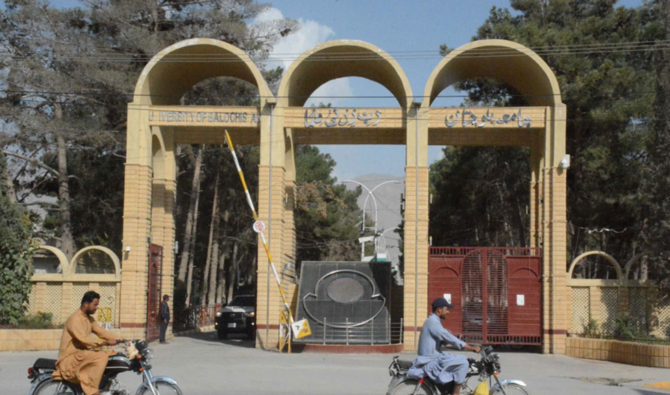
QUETTA: Pakistan’s volatile Balochistan province has ordered the closure of three universities in recent weeks due to “security concerns,” an official told AFP on Tuesday, as separatist attacks surge in the region.
Two universities in the provincial capital of Quetta were ordered to close for an “indefinite period” last week, while on Tuesday, a third was instructed to switch to virtual learning, a provincial administration official told AFP on condition of anonymity as he was not authorized to speak to the media.
“The decision was made after reviewing the overall security situation,” the official said
“It was decided to switch to virtual learning until further notice due to security concerns.”
The decision to reopen the campuses, which will impact thousands of students, will be made after the Muslim festival of Eid, just two weeks away, the official said.
Security across the provincial capital has been heightened, with an increased number of security forces on the streets and additional checkpoints set up throughout the city following the recent surge in separatist violence.
Last week, ethnic Baloch separatists attacked a train with 450 passengers on board, sparking a two-day siege during which dozens of people were killed.
And on Sunday, at least five paramilitaries were killed in a vehicle-borne suicide attack.
The assaults were claimed by the Baloch Liberation Army (BLA), one of a number of separatist groups that accuse outsiders of plundering natural resources in Balochistan near the borders with Afghanistan and Iran.

Pakistan shuts universities in southwest province over ‘security concerns’
https://arab.news/5nvx7
Pakistan shuts universities in southwest province over ‘security concerns’
- Security across the provincial capital has been heightened, with an increased number of security forces on the streets
- The decision to reopen the campuses will be made after the Muslim festival of Eid, just two weeks away, an official says
Pakistan army chief assumes role as first Chief of Defense Forces, signaling unified command
- New role is held simultaneously with Gen Asim Munir’s existing position as Chief of Army Staff
- It is designed to centralize operational planning, war-fighting doctrine, modernization across services
ISLAMABAD: Pakistan’s most senior military officer, Field Marshal Syed Asim Munir, formally took charge as the country’s first Chief of Defense Forces (CDF) on Monday, marking a structural change in Pakistan’s defense command and placing the army, navy and air force under a single integrated leadership for the first time.
The new role, held simultaneously with Munir’s existing position as Chief of Army Staff, is designed to centralize operational planning, war-fighting doctrine and modernization across the services. It reflects a trend seen in several advanced militaries where a unified command oversees land, air, maritime, cyber and space domains, rather than service-level silos.
Pakistan has also established a Chief of Defense Forces Headquarters, which Munir described as a “historic” step toward joint command integration.
In remarks to officers from all three forces after receiving a tri-services Guard of Honor at the General Headquarters (GHQ) in Rawalpindi, Munir said the military must adapt to new theaters of conflict that extend far beyond traditional ground warfare.
He stressed the need for “a formalized arrangement for tri-services integration and synergy,” adding that future war will involve emerging technologies including cyber operations, the electromagnetic spectrum, outer-space platforms, information warfare, artificial intelligence and quantum computing.
“He termed the newly instituted CDF Headquarters as historic, which will afford requisite integration, coherence and coordination to meet the dynamics of future threat spectrum under a tri-services umbrella,” the military quoted Munir as saying in a statement.
The ceremony also included gallantry awards for Pakistan Navy and Air Force personnel who fought in Marka-e-Haq, the brief May 2025 conflict between Pakistan and India, which Pakistan’s military calls a model for integrated land, air, maritime, cyber and electronic combat. During his speech, Munir paid tribute to the personnel who served in the conflict, calling their sacrifice central to Pakistan’s defense narrative.
The restructuring places Pakistan closer to command models used by the United States, United Kingdom and other nuclear-armed states where a unified chief directs inter-service readiness and long-range war planning. It also comes at a time when militaries worldwide are re-engineering doctrine to counter threats spanning satellites, data networks, information space and unmanned strike capabilities.


