

Saudi Arabia’s top body reviews economic performance, global outlook

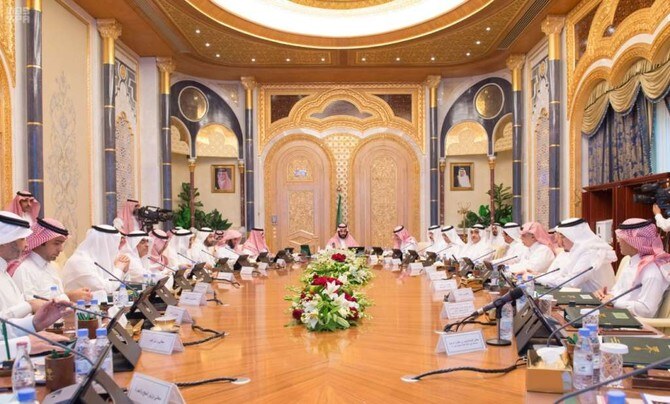
Held on March 15, the meeting covered a range of reports and topics, including the quarterly economic report from the Ministry of Economy and Planning. File photo - SPA
Short Url
Updated 16 March 2025
Follow

Saudi Arabia’s top body reviews economic performance, global outlook

JEDDAH: Saudi Arabia’s Council of Economic and Development Affairs hosted a virtual meeting to discuss financial performance and global developments, focusing on improving public sector contributions. 

Operating under the Council of Ministers, CEDA oversees the governance framework, mechanisms, and policies essential to achieving Saudi Vision 2030. It addresses key domestic sectors, including health, labor, education, and Islamic affairs. 

Held on March 15, the meeting covered a range of reports and topics, including the quarterly economic report from the Ministry of Economy and Planning. 

According to the Saudi Press Agency, the report is “an in-depth analysis of the drivers and challenges affecting national economic growth across various sectors, along with proposed solutions.” It also highlighted Saudi Arabia’s strong economic performance in the third and fourth quarters of 2024, supported by projections from both local and international institutions.  

CEDA also reviewed the Ministry of Finance’s fourth-quarter budget performance report for the 2024 fiscal year. The report noted that total expenditures reached SR1.37 trillion ($365.3 billion), reflecting a 6 percent annual rise, while the budget deficit widened to SR115.63 billion — a 43 percent increase from 2023, in line with previous forecasts. 

The report outlined revenue, expenditure, and public debt indicators, noting a “21 percent increase in non-oil revenues, reaching SR132 billion, compared to SR109 billion during the same period of the previous year,” SPA said.  

It credited government reforms and diversification efforts for driving growth, aligning with Saudi Vision 2030’s aim to expand non-oil sectors. 

The report also underscored the Kingdom’s “continued support for development and service projects, as well as its commitment to enhancing social welfare and protection systems,” according to SPA. 

The meeting further discussed Saudi Arabia’s upcoming participation in the 2025 World Economic Forum in Davos, emphasizing the Kingdom’s rising role among the world’s leading economies. 

CEDA reviewed additional presentations on policies and administrative frameworks, including the Supreme National Investment Committee’s guiding principles for green investments and the Ministry of Media’s organizational structure and regulations. 

The council also examined data from the General Authority for Statistics, covering import substitution indicators, the Consumer Price Index, and the Wholesale Price Index. It further reviewed the 2024 Monthly Foreign Trade Report. 

The meeting concluded with CEDA issuing decisions and recommendations on the discussed matters.


Saudi POS spending jumps 28% in final week of Jan: SAMA

Updated 06 February 2026
Follow

Saudi POS spending jumps 28% in final week of Jan: SAMA

RIYADH: Saudi Arabia’s point-of-sale spending climbed sharply in the final week of January, rising nearly 28 percent from the previous week as consumer outlays increased across almost all sectors. 

POS transactions reached SR16 billion ($4.27 billion) in the week ending Jan. 31, up 27.8 percent week on week, according to the Saudi Central Bank. Transaction volumes rose 16.5 percent to 248.8 million, reflecting stronger retail and service activity. 

Spending on jewelry saw the biggest uptick at 55.5 percent to SR613.69 million, followed by laundry services which saw a 44.4 percent increase to SR62.83 million. 

Expenditure on personal care rose 29.1 percent, while outlays on books and stationery increased 5.1 percent. Hotel spending climbed 7.4 percent to SR377.1 million. 

Further gains were recorded across other categories. Spending in pharmacies and medical supplies rose 33.4 percent to SR259.19 million, while medical services increased 13.7 percent to SR515.44 million. 

Food and beverage spending surged 38.6 percent to SR2.6 billion, accounting for the largest share of total POS value. Restaurants and cafes followed with a 20.4 percent increase to SR1.81 billion. Apparel and clothing spending rose 35.4 percent to SR1.33 billion, representing the third-largest share during the week. 

The Kingdom’s key urban centers mirrored the national surge. Riyadh, which accounted for the largest share of total POS spending, saw a 22 percent rise to SR5.44 billion from SR4.46 billion the previous week. The number of transactions in the capital reached 78.6 million, up 13.8 percent week on week. 

In Jeddah, transaction values increased 23.7 percent to SR2.16 billion, while Dammam reported a 22.2 percent rise to SR783.06 million. 

POS data, tracked weekly by SAMA, provides an indicator of consumer spending trends and the ongoing growth of digital payments in Saudi Arabia.  

The data also highlights the expanding reach of POS infrastructure, extending beyond major retail hubs to smaller cities and service sectors, supporting broader digital inclusion initiatives.  

The growth of digital payment technologies aligns with Saudi Arabia’s Vision 2030 objectives, promoting electronic transactions and contributing to the Kingdom’s broader digital economy.