

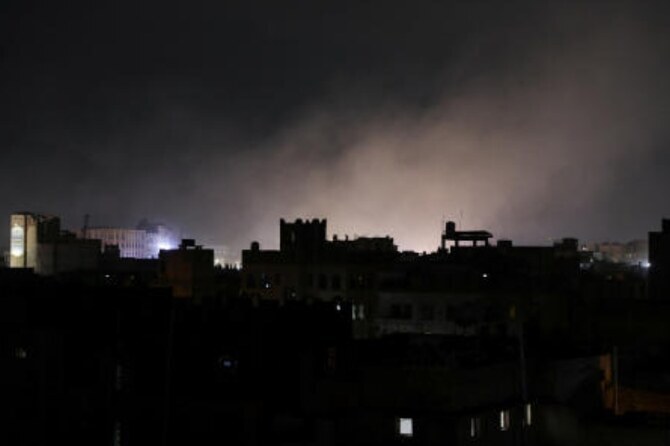

WASHINGTON/ADEN: US President Donald Trump launched large-scale military strikes against Yemen’s Iran-aligned Houthis on Saturday over the group’s attacks against Red Sea shipping, killing at least 24 people at the start of a campaign expected to last many days.
Trump also warned Iran, the Houthis’ main backer, that it needed to immediately halt support for the group. He said if Iran threatened the United States, “America will hold you fully accountable and, we won’t be nice about it!”
The unfolding strikes — which one US official told Reuters might continue for weeks — represent the biggest US military operation in the Middle East since Trump took office in January. It came as the United States ramps up sanctions pressure on Tehran while trying to bring it to the negotiating table over its nuclear program.
“To all Houthi terrorists, YOUR TIME IS UP, AND YOUR ATTACKS MUST STOP, STARTING TODAY. IF THEY DON’T, HELL WILL RAIN DOWN UPON YOU LIKE NOTHING YOU HAVE EVER SEEN BEFORE!” Trump posted on his Truth Social platform.
At least 13 civilians were killed and nine injured in US strikes on Yemen’s capital Sanaa, according to the Houthi-run health ministry.
At least 11 others, including four children and one woman, were killed and 14 were injured in a US strike on the northern province of Saada, the Houthi-run Al-Masirah TV reported.
The Houthis’ political bureau described the attacks as a “war crime.”
“Our Yemeni armed forces are fully prepared to respond to escalation with escalation,” it said in a statement.
Residents in Sanaa said the strikes hit a building in a Houthi stronghold.
“The explosions were violent and shook the neighborhood like an earthquake. They terrified our women and children,” one of the residents, who gave his name as Abdullah Yahia, told Reuters.
Another strike on a power station in the town of Dahyan in Saada led to a power cut, Al-Masirah TV reported early on Sunday. Dahyan is where Abdul Malik Al-Houthi, the enigmatic leader of the Houthis, often meets his visitors.
The Houthis, an armed movement that took control of most of Yemen over the past decade, have launched scores of attacks on ships off its coast since November 2023, disrupting global commerce and setting the US military on a costly campaign to intercept missiles and drones that have burned through stocks of US air defenses.
A Pentagon spokesperson said the Houthis have attacked US warships 174 times and commercial vessels 145 times since 2023. The Houthis say the attacks are in solidarity with Palestinians over Israel’s war in Gaza with Hamas militants.
Iran’s other allies, Hamas and Hezbollah in Lebanon, have been severely weakened by Israel since the start of the Gaza conflict. Syria’s Bashar Assad, who was closely aligned with Tehran, was overthrown by rebels in December.
But throughout, Yemen’s Houthis have remained resilient and often on the offensive, sinking two vessels, seizing another and killing at least four seafarers in an offensive that disrupted global shipping, forcing firms to reroute to longer and more expensive journeys around southern Africa.
The US administration of then-President Joe Biden had sought to degrade the Houthis’ ability to attack vessels off its coast but limited the US actions.
US officials, speaking on condition of anonymity, say Trump has authorized a more aggressive approach.
Strikes across Yemen
The strikes on Saturday were carried out in part by fighter aircraft from the Harry S. Truman aircraft carrier, which is in the Red Sea, officials said.
The US military’s Central Command, which oversees troops in the Middle East, described Saturday’s strikes as the start of a large-scale operation across Yemen.
“Houthi attacks on American ships & aircraft (and our troops!) will not be tolerated; and Iran, their benefactor, is on notice,” Defense Secretary Pete Hegseth wrote on X. “Freedom of Navigation will be restored.”
Trump held out the prospect of far more devastating military action against Yemen.
“The Houthi attack on American vessels will not be tolerated. We will use overwhelming lethal force until we have achieved our objective,” Trump wrote.
Iran’s Foreign Minister Abbas Araqchi said the US government had “no authority, or business, dictating Iranian foreign policy.”
“End support for Israeli genocide and terrorism. Stop killing of Yemeni people,” he said in an X post on early Sunday.
Iran’s mission to the United Nations did not immediately respond to a request for comment.
On Tuesday, the Houthis said they would resume attacks on Israeli ships passing through the Red Sea and Arabian Sea, the Bab Al-Mandab Strait and the Gulf of Aden, ending a period of relative calm starting in January with the Gaza ceasefire.
The US attacks came just days after a letter to Iran’s Supreme Leader Ayatollah Ali Khamenei from Trump was delivered, seeking talks over Iran’s nuclear program.
Khamenei on Wednesday rejected holding negotiations with the United States.
Still, Tehran is increasingly concerned that mounting public anger over economic hardships could erupt into mass protests, four Iranian officials told Reuters.
Last year, Israeli strikes on Iranian facilities, including missile factories and air defenses, in retaliation for Iranian missile and drone attacks, reduced Tehran’s conventional military capabilities, according to US officials.
Iran has denied wanting to develop a nuclear weapon. However, it is dramatically accelerating enrichment of uranium to up to 60 percent purity, close to the roughly 90 percent weapons-grade level, the UN nuclear watchdog — the International Atomic Energy Agency — has warned.
Western states say there is no need to enrich uranium to such a high level under any civilian program and that no other country has done so without producing nuclear bombs. Iran says its nuclear program is peaceful.
In an apparent sign of US efforts to improve ties with Russia, Secretary of State Marco Rubio spoke on Saturday with Russian Foreign Minister Sergei Lavrov to inform him about the US strikes in Yemen, the State Department said.
Russia has relied on Iranian-provided weaponry in its war in Ukraine, including missiles and drones, US and Ukrainian officials say.


