

Why is Ethiopia’s Tigray again on the brink of conflict?

A damaged tank stands on a road north of Mekele, the capital of Tigray region in northern Ethiopia, where infighting between rival factions has raised the specter of a fresh war between Ethiopia and neighboring Eritrea. (AFP file photo)
Short Url
Updated 16 March 2025
Follow

Why is Ethiopia’s Tigray again on the brink of conflict?

  • Power struggle within the once-dominant Tigray People’s Liberation Front (TPLF) party has sparked fears of renewed conflict
  • There is concern in Addis Ababa that Eritrea, its historic rival that gained independence from Ethiopia in 1993, will exploit the unrest

ADDIS ABABA: More than two years after a peace deal ended the devastating war in Ethiopia’s Tigray region, a power struggle within the once-dominant TPLF party has sparked fears of renewed conflict.
Could these rising tensions lead to violence so soon after one of the century’s deadliest conflicts that killed an estimated 600,000 people?

The Tigray People’s Liberation Front (TPLF) ran the whole of Ethiopia for nearly three decades until Prime Minister Abiy Ahmed, a non-Tigrayan, took power in 2018.
His takeover led to months of tension with the TPLF leadership, eventually leading Abiy to send troops to Tigray in November 2020, accusing their forces of attacking federal army camps.

This triggered two years of horrific war between Tigrayan rebels and government forces backed by militias and Eritrean troops. It finally ended with a November 2022 peace treaty, known as the Pretoria Agreement.
A new interim administration was created in Tigray with TPLF veteran Getachew Reda in charge, though overseen by the federal government.
But divisions have emerged in recent months between Getachew and the TPLF’s leader, Debretsion Gebremichael.

Getachew faces criticism over delays in implementing the peace deal — particularly the failure to expel Eritrean forces who supported the federal government against the Tigrayans, and return the million people displaced by the war.
The Tigray Defense Forces (TDF) had previously stayed neutral in the Getachew-Debretsion dispute.
But in January, a dissident group within the TDF accused Getachew’s administration of undermining “the Tigrayan people’s national interest and engaging in treason.”
One foreign expert, who did not want to be named, estimated around 200 commanders supported the letter.
Getachew described it as declaring “a coup d’etat.”

In early March, he attempted to suspend three TDF generals and accused Debretsion’s faction of trying to “take over the whole of Tigray.”
This week, Debretsion’s forces took control of the municipalities in state capital Mekele and second city Adigrat, putting their own mayors in place.
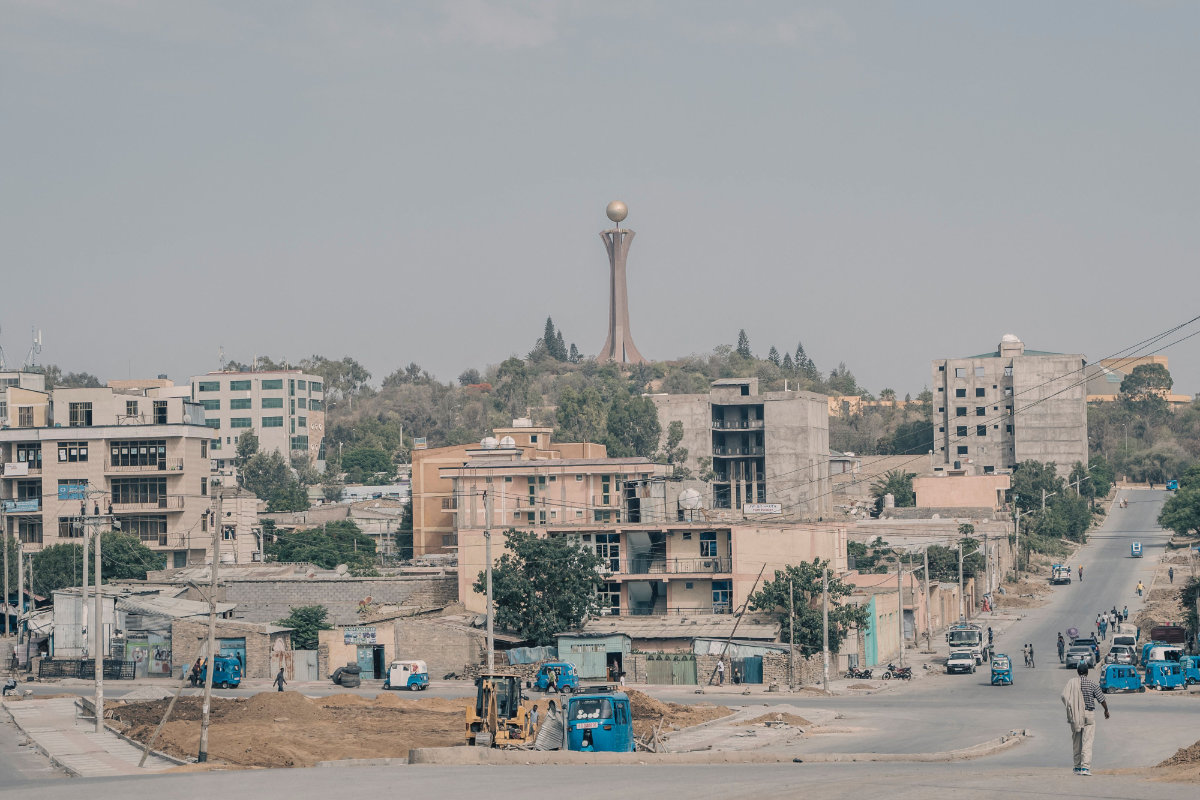


General view of Mekele, the capital city of the Tigray region in northern Ethiopia. (AFP)

Many residents, already deeply weary of war, are panicking over the threat of renewed conflict with reports of bank runs and sold-out flights.
Getachew has asked for assistance from the federal government in Addis Ababa, though he said this should not be military in nature.
The federal government has not responded publicly.

There is concern in Addis Ababa that Eritrea, its historic rival that gained independence from Ethiopia in 1993, will exploit the unrest.
Eritrea’s rhetoric has been increasingly bellicose. Last month, its information minister accused Ethiopia of “waging an intense and unacceptable campaign against Eritrea” and committing “malicious provocations.”
A security source told AFP on condition of anonymity that armed Ethiopian convoys were heading toward the region of Afar, which borders Eritrea, in recent days.
Eritrean President Isaias Afwerki’s dissatisfaction with the 2022 peace agreement, Ethiopian Prime Minister Abiy Ahmed’s ambitions for a Red Sea port and geopolitical interest from the Middle East have fueled the deteriorating tensions, said Kjetil Tronvoll, Oslo University professor specializing in the region.
That has left the “two countries inching closer to a new war,” he said.


US bombers join Japanese jets in show of force after China–Russia drills

Updated 8 sec ago
Follow

US bombers join Japanese jets in show of force after China–Russia drills

  • Japan says US B-52 bombers flew with Japanese F-35s and F-15s
  • South Korea and Japan have scrambled jets during Chinese and Russian drills

TOKYO: US nuclear-capable bombers flew over the Sea of Japan alongside Japanese fighter jets on Wednesday, Tokyo said, in a show of force following Chinese and Russian drills in the skies and seas around Japan and South Korea.
Japan and the US “reaffirmed their strong resolve to prevent any unilateral attempt to change the status quo by force and confirmed the readiness posture of both the Self-Defense Forces (SDF) and US forces,” Japan’s defense ministry said in a press release on Thursday.
The flight of two US B-52 strategic bombers with three Japanese F-35 stealth fighters and three F-15 air-superiority jets was the first time the US had asserted its military presence since China began military exercises in the region last week.
The display follows a joint flight of Chinese and Russian strategic bombers in the East China Sea and western Pacific on Tuesday and separate Chinese aircraft carrier drills that prompted Japan to scramble jets that Tokyo said were targeted by radar beams.

A Russian Tu-95 nuclear-capable strategic bomber which flew from the Sea of Japan to the East China Sea to rendezvous with two Chinese H-6 bombers before heading into the Western Pacific on December 9, 2025. (Japan Self Defense Forces/Handout via REUTERS)

The encounter drew criticism from Washington, which said the incident was “not conducive to regional peace and stability” and reaffirmed that its alliance with Japan was “unwavering.”
Both Japan and South Korea host US forces, with Japan home to the biggest concentration of American military power overseas, including an aircraft carrier strike group and a US Marine expeditionary force.
China denied Tokyo’s accusation, saying Japanese jets flying near the carrier had endangered its air operations south of Japan.

South Korea’s military said it also scrambled fighter jets when the Chinese and Russian aircraft entered its air defense identification zone on Tuesday, an area that extends beyond its airspace and is used for early warning.
 

Chinese H6 nuclear-capable strategic bomber flies from the East China Sea over the Miyako Strait into the Western Pacific on December 9, 2025. (Japan Self Defense Forces/Handout via REUTERS)

Regional tensions have risen since Japanese Prime Minister Sanae Takaichi triggered a dispute with Beijing last month with her remarks on how Tokyo might react to a hypothetical Chinese attack on Taiwan.
China claims democratically governed Taiwan and has not ruled out using force to take control of the island, which sits just over 100 km (62 miles) from Japanese territory and is surrounded by sea lanes on which Tokyo relies.