

Terrified Tigrayans seek to flee renewed tensions in north Ethiopia

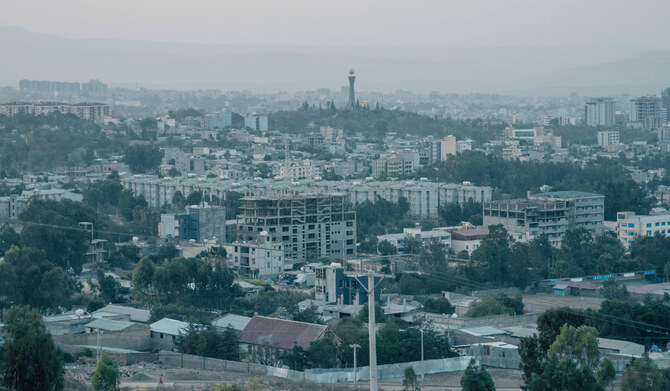
This photograh taken on May 24, 2024 shows a general view of the city of Mekele, capital of Ethiopia's region of Tigray. (AFP)
Short Url
Updated 16 March 2025
Follow

Terrified Tigrayans seek to flee renewed tensions in north Ethiopia

  • “A war between Ethiopia and Eritrea could break out at any moment,” said General Tsadkan Gebretensae, senior strategist for the Tigray forces in Getachew’s administration, in remarks published this week

ADDIS ABABA: Residents sought to flee mounting tensions in the Tigray region of Ethiopia as a political faction confirmed they had seized control of the town hall in the state capital Mekele.
Ethiopia’s most northerly state, which borders Eritrea, saw a devastating conflict between Tigrayan rebels and the federal government in 2020-22, which claimed up to 600,000 lives, according to some estimates.
The tensions come from an internal power struggle within Tigray between Getachew Reda, head of the state’s regional administration, and Debretsion Gebremichael, head of the dominant local party, the Tigray People’s Liberation Front.
“People are in terror that if armed conflict breaks out, it will be worse than the war they endured,” said Solomon Hagos, a university lecturer in Mekele, who asked for one of his names to be changed for security reasons.
Another resident said people were trying to flee.
“We were trapped in Mekele during the previous war, we do not want that to happen again,” said Mihret, 27, who only gave one name.
“We are trying to leave the region, and we went to the airport, but all the flights are full. We are looking for ways to leave the region; we are afraid,” he added.
Debretsion’s faction seized control of Mekele’s town hall on Thursday to reinstate its chosen mayor and the local radio station.
A spokesman for Debretsion said: “The previous elected mayor was fired by Getachew, which was not legal. So now the previous one has been put back in place.”
Armed supporters of Debretsion also took over the municipality in Adigrat, Tigray’s second-largest town near the Eritrean border, ousting the mayor appointed by Getachew.
“We are afraid of a new siege, of a civil war between Tigrayans,” said Mehari Gebremariam, a civil servant in Adigrat.
The tensions threaten to draw in Eritrea, which has a history of war with Ethiopia, adding another layer of fear among locals.
A war between Ethiopia and Eritrea in 1998-2000 resulted in tens of thousands of deaths.
Ethiopia’s Prime Minister Abiy Ahmed was lauded for finally reaching a peace agreement with Eritrea when he came to power in 2018 and won the Nobel Peace Prize.
But relations have soured since the end of the Tigray conflict in 2022.
Eritrea claimed in February that Ethiopia was waging an “intense campaign” against it.
A security source told AFP on condition of anonymity that armed Ethiopian convoys were heading toward the region of Afar, which borders Eritrea, in recent days.
“A war between Ethiopia and Eritrea could break out at any moment,” said General Tsadkan Gebretensae, senior strategist for the Tigray forces in Getachew’s administration, in remarks published this week.
The tensions have led to panic in Mekele.
“People are currently rushing to withdraw from banks because they fear the political tensions could lead to a suspension of basic services,” Hagos told AFP, adding that he had stocked up on food for fear of coming inflation.
He said locals could not cope with the idea of another war.
“Our people are exhausted. Our economy is devastated,” he said.


Prabowo, Trump expected to sign Indonesia-US tariff deal in January 2026

Updated 23 December 2025
Follow

Prabowo, Trump expected to sign Indonesia-US tariff deal in January 2026

  • Deal will mean US tariffs on Indonesian products are cut from a threatened 32 percent to 19 percent
  • Jakarta committed to scrap tariffs on more than 99 percent of US goods

JAKARTA: Indonesia expects to sign a tariff deal with the US in early 2026 after reaching an agreement on “all substantive issues,” Jakarta's chief negotiator said on Tuesday.

Indonesia’s Coordinating Minister for Economic Affairs Airlangga Hartarto met with US trade representative Jamieson Greer in Washington this week to finalize an Indonesia-US trade deal, following a series of discussions that took place after the two countries agreed on a framework for negotiations in July.

“All substantive issues laid out in the Agreement on Reciprocal Trade have been agreed upon by the two sides, including both the main and technical issues,” Hartarto said in an online briefing.

Officials from both countries are now working to set up a meeting between Indonesian President Prabowo Subianto and US President Donald Trump. 

It will take place after Indonesian and US technical teams meet in the second week of January for a legal scrubbing, or a final clean-up of an agreement text.

“We are expecting that the upcoming technical process will wrap up in time as scheduled, so that at the end of January 2026 President Prabowo and President Trump can sign the Agreement on Reciprocal Trade,” Hartarto said.  

Indonesian trade negotiators have been in “intensive” talks with their Washington counterparts since Trump threatened to levy a 32 percent duty on Indonesian exports. 

Under the July framework, US tariffs on Indonesian imports were lowered to 19 percent, with Jakarta committing to measures to balance trade with Washington, including removing tariffs on more than 99 percent of American imports and scrapping all non-tariff barriers facing American companies. 

Jakarta also pledged to import $15 billion worth of energy products and $4.5 billion worth of agricultural products such as soybeans, wheat and cotton, from the US. 

“Indonesia will also get tariff exemptions on top Indonesian goods, such as palm oil, coffee, cocoa,” Hartarto said. 

“This is certainly good news, especially for Indonesian industries directly impacted by the tariff policy, especially labor-intensive sectors that employ around 5 million workers.” 

In the past decade, Indonesia has consistently posted trade surpluses with the US, its second-largest export market after China. 

From January to October, data from the Indonesian trade ministry showed two-way trade valued at nearly $36.2 billion, with Jakarta posting a $14.9 billion surplus.