

‘Stranded’ astronauts closer to coming home after next ISS launch

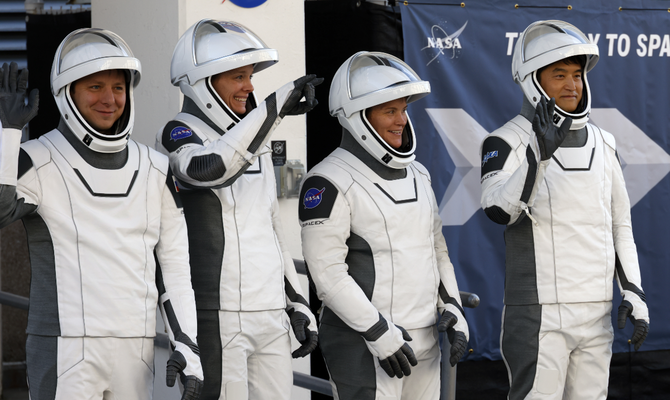
Crew 10, from left, cosmonaut Kirill Peskov, astronaut Nichole Ayers, astronaut Anne McClain and JAXA astronaut Takuya Onishi leave the Operations and Checkout building before heading to Launch Pad 39-A at the Kennedy Space Center in Cape Canaveral, Fla., for a mission to the International Space Station, Wednesday, March 12, 2025. (AP)
Short Url
Updated 13 March 2025
Follow

‘Stranded’ astronauts closer to coming home after next ISS launch

  • “All systems are looking good and weather is a go,” SpaceX wrote Wednesday on X

WASHINGTON: A routine crew rotation at the International Space Station has taken on unusual significance: It paves the way for a pair of astronauts stranded for more than nine months to finally come home.
The NASA-SpaceX Crew-10 mission is set to launch from Florida’s Kennedy Space Center on Wednesday at 7:48 p.m. (2348 GMT), bound for the ISS.
“All systems are looking good and weather is a go,” SpaceX wrote Wednesday on X, as the team of two US astronauts, one Japanese astronaut and a Russian cosmonaut said their goodbyes to relatives and drove to the launch pad.
All eyes however will be on Butch Wilmore and Suni Williams, the NASA duo who have been stuck aboard the ISS since June after their Boeing Starliner spacecraft developed propulsion issues and was deemed unfit for their return.
Wilmore and Williams were initially slated for an eight-day mission but were reassigned to Crew-9 after its astronauts arrived in September aboard a SpaceX Dragon. The spacecraft carried only two crew members instead of the usual four to make room for Wilmore and Williams.
Crew-9 can only return to Earth after Crew-10 arrives.
“We came up prepared to stay long, even though we plan to stay short,” Wilmore said in a recent news conference. “That’s what your nation’s human space flight program is all about, planning for unknown, unexpected contingencies.”
Crew-10 is expected to dock early Thursday, followed by a brief handover before Crew-9 departs on March 16 for an ocean splashdown off the Florida coast, weather permitting.
Along with Wilmore and Williams, NASA astronaut Nick Hague and Russian cosmonaut Aleksandr Gorbunov will also be aboard the returning Dragon capsule.
Space remains an area of cooperation between the United States and Russia despite the Ukraine conflict, with cosmonauts traveling to the ISS aboard SpaceX Crew Dragons and astronauts doing the same via Soyuz capsules launched from Kazakhstan.

Wilmore and Williams’s prolonged stay has recently become a political flashpoint, as President Donald Trump and his close adviser Elon Musk have accused ex-president Joe Biden’s administration of abandoning the pair.
SpaceX boss Musk has suggested, without providing specifics, that he had offered Biden a “rescue” mission outside of the routine crew rotations.
However, with Trump now in office for nearly two months, the astronauts are still set to return as originally planned.
The issue recently sparked a heated online exchange between Musk and Danish astronaut Andreas Mogensen, whom Musk called a slur for mentally disabled people. Several retired astronauts quickly came to Mogensen’s defense.
One astronaut who backed Musk however was Wilmore, who offered contradictory statements in last week’s press conference.
“I can only say that Mr. Musk, what he says is absolutely factual,” he said, seemingly endorsing the SpaceX founder’s version of events, before adding “politics is not playing into this at all.”
The Crew-10 team consists of NASA astronauts Anne McClain and Nichole Ayers, Japan’s Takuya Onishi, and Russia’s Kirill Peskov.
McClain, the mission’s commander, will be making her second trip to space.
“I’m looking forward to breaking bread with those guys, talking to them, giving them big hugs,” she said of Wilmore and Williams.
During their mission, the new crew will conduct a range of scientific experiments, including flammability tests for future spacecraft designs and research into the effects of space on the human body.



India’s top court denies bail to 2 Muslim activists after 5 years in jail without trial

Umar Khalid (L) and Sharjeel Imam. (Supplied)
Updated 06 January 2026
Follow

India’s top court denies bail to 2 Muslim activists after 5 years in jail without trial

  • The two student activists were a leading voice in nationwide protests against the citizenship law, which marked one of the most significant challenges to Prime Minister Narendra Modi’s Hindu nationalist government
  • Amnesty International in a statement last year said Khalid’s “imprisonment without trial exemplifies derailment of justice” and is “emblematic of a broader pattern of repression faced by those who dare to exercise their rights to freedom of expression”

NEW DELHI: India’s Supreme Court on Monday denied bail to two Muslim student activists who have spent years in detention without trial over a conspiracy case linked to one of the country’s deadliest outbreaks of religious violence.
Umar Khalid and Sharjeel Imam were arrested five years ago under India’s harsh state security law and accused of conspiring to incite the communal violence that swept parts of Delhi in February 2020. The riots left 53 people dead, most of them Muslims, and took place amid massive months-long protests against a controversial 2019 citizenship law that critics said discriminated against Muslims.
While bail was granted to the other five accused in the same case, the court noted that Khalid and Imam had a “central role in the conspiracy.” It also said that the delay in their trial was not a sufficient ground for granting them bail.
“Umar Khalid and Sharjeel Imam stand on a qualitatively different footing as compared to other accused,” the Supreme Court said in its verdict, according to Bar and Bench, a legal news website.
The two student activists were a leading voice in nationwide protests against the citizenship law, which marked one of the most significant challenges to Prime Minister Narendra Modi’s Hindu nationalist government. Their detention has been widely seen as emblematic of a broader crackdown on dissent under Modi, drawing criticism from rights groups over the use of anti-terror laws against activists and student leaders.
In the months following the riots, police charged several activists and organizers, including Khalid and Imam, under the Unlawful Activities (Prevention) Act, that in the past was used only to quell violent insurgencies but under Modi has been largely used to silence political opposition. Activists and other dissenters targeted under the law can be held in pretrial detention almost indefinitely, often resulting in years of detention until the completion of trial.
Prosecutors representing the Delhi police had strongly opposed Khalid and Imam’s bail request, arguing that the violence was not a spontaneous outbreak but a deliberate plot intended to tarnish India’s global image, and that they made provocative speeches and instigated violence. Khalid and Imam’s lawyers argue that there is no evidence linking them to the violence and deny the charges against them.
Dozens of other Muslims were also charged in similar cases related to the riots and held under prolonged detention. Some of those cases later unraveled because police were unable to provide evidence linking many detainees to the riots.
Last week, eight US lawmakers wrote to India’s ambassador in Washington expressing concern over Khalid’s prolonged pretrial detention. They urged Indian authorities to grant him a fair and timely trial.
International human rights groups have also repeatedly urged Khalid and Imam’s release, saying their detention suppresses dissent and breaches fundamental legal protections.
Amnesty International in a statement last year said Khalid’s “imprisonment without trial exemplifies derailment of justice” and is “emblematic of a broader pattern of repression faced by those who dare to exercise their rights to freedom of expression.”