4 astronauts return to Earth after being delayed by Boeing’s capsule trouble

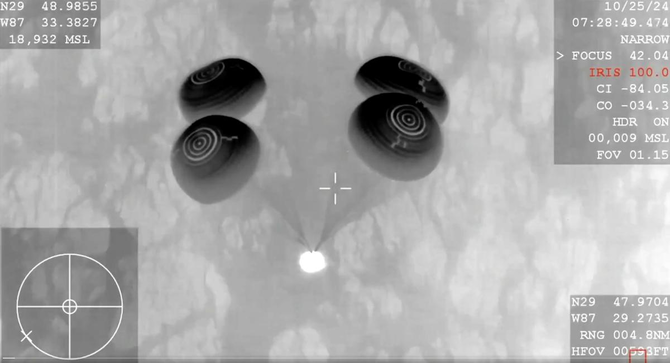
A SpaceX capsule carrying the crew parachuted before dawn into the Gulf of Mexico just off the Florida coast after undocking from the International Space Station mid-week. (X: @SpaceX)
Short Url
Updated 25 October 2024
Follow

4 astronauts return to Earth after being delayed by Boeing’s capsule trouble

  • A SpaceX capsule carrying the crew parachutes before dawn into the Gulf of Mexico just off the Florida coast

CAPE CANAVERAL, Florida: Four astronauts returned to Earth on Friday after a nearly eight-month space station stay extended by Boeing’s capsule trouble and Hurricane Milton.
A SpaceX capsule carrying the crew parachuted before dawn into the Gulf of Mexico just off the Florida coast after undocking from the International Space Station mid-week.
The three Americans and one Russian should have been back two months ago. But their homecoming was stalled by problems with Boeing’s new Starliner astronaut capsule, which came back empty in September because of safety concerns. Then Hurricane Milton interfered, followed by another two weeks of high wind and rough seas.
SpaceX launched the four — NASA’s Matthew Dominick, Michael Barratt and Jeanette Epps, and Russia’s Alexander Grebenkin — in March. Barratt, the only space veteran going into the mission, acknowledged the support teams back home that had “to replan, retool and kind of redo everything right along with us ... and helped us to roll with all those punches.”
Their replacements are the two Starliner test pilots Butch Wilmore and Suni Williams, whose own mission went from eight days to eight months, and two astronauts launched by SpaceX four weeks ago. Those four will remain up there until February.
The space station is now back to its normal crew size of seven — four Americans and three Russians — after months of overflow.


Prabowo, Trump expected to sign Indonesia-US tariff deal in January 2026

Updated 9 sec ago
Follow

Prabowo, Trump expected to sign Indonesia-US tariff deal in January 2026

  • Deal will mean US tariffs on Indonesian products are cut from a threatened 32 percent to 19 percent
  • Jakarta committed to scrap tariffs on more than 99 percent of US goods

JAKARTA: Indonesia expects to sign a tariff deal with the US in early 2026 after reaching an agreement on “all substantive issues,” Jakarta's chief negotiator said on Tuesday.

Indonesia’s Coordinating Minister for Economic Affairs Airlangga Hartarto met with US trade representative Jamieson Greer in Washington this week to finalize an Indonesia-US trade deal, following a series of discussions that took place after the two countries agreed on a framework for negotiations in July.

“All substantive issues laid out in the Agreement on Reciprocal Trade have been agreed upon by the two sides, including both the main and technical issues,” Hartarto said in an online briefing.

Officials from both countries are now working to set up a meeting between Indonesian President Prabowo Subianto and US President Donald Trump. 

It will take place after Indonesian and US technical teams meet in the second week of January for a legal scrubbing, or a final clean-up of an agreement text.

“We are expecting that the upcoming technical process will wrap up in time as scheduled, so that at the end of January 2026 President Prabowo and President Trump can sign the Agreement on Reciprocal Trade,” Hartarto said.  

Indonesian trade negotiators have been in “intensive” talks with their Washington counterparts since Trump threatened to levy a 32 percent duty on Indonesian exports. 

Under the July framework, US tariffs on Indonesian imports were lowered to 19 percent, with Jakarta committing to measures to balance trade with Washington, including removing tariffs on more than 99 percent of American imports and scrapping all non-tariff barriers facing American companies. 

Jakarta also pledged to import $15 billion worth of energy products and $4.5 billion worth of agricultural products such as soybeans, wheat and cotton, from the US. 

“Indonesia will also get tariff exemptions on top Indonesian goods, such as palm oil, coffee, cocoa,” Hartarto said. 

“This is certainly good news, especially for Indonesian industries directly impacted by the tariff policy, especially labor-intensive sectors that employ around 5 million workers.” 

In the past decade, Indonesia has consistently posted trade surpluses with the US, its second-largest export market after China. 

From January to October, data from the Indonesian trade ministry showed two-way trade valued at nearly $36.2 billion, with Jakarta posting a $14.9 billion surplus.