

How separatist militants hijacked a train in Pakistan

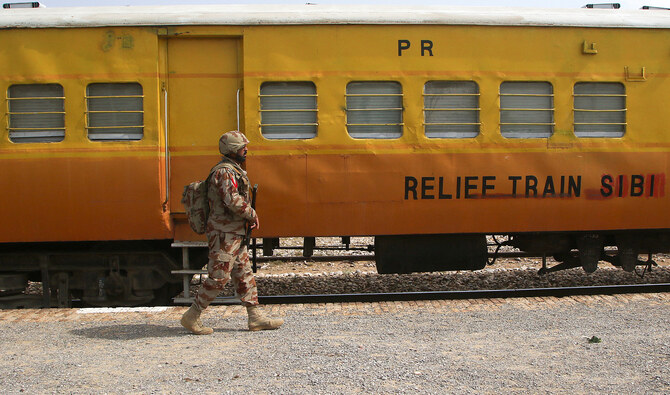
A Pakistan Army soldier walks next to a rescue train, after the attack on a train by separatist militants in Bolan, at the railway station in Mushkaf, Balochistan, Pakistan, on March 12, 2025. (REUTERS)
Short Url
Updated 12 March 2025
Follow

How separatist militants hijacked a train in Pakistan

  • Jaffar Express was heading to Peshawar city from Quetta with 425 people on board
  • Militants blew up railway tracks, fired at train and trapped locomotive inside tunnel

Pakistani security forces are carrying out a rescue operation to free dozens of passengers taken hostage by separatist militants who hijacked their train in the southwest of the country on Tuesday.

Here is a look at what happened, and the current situation.

THE TRAIN
The Jaffar Express was heading to the city of Peshawar in Khyber Pakhtunkhwa province from Quetta, the capital of Balochistan province, with 425 people on board when it was attacked.

The passengers included personnel from the Pakistani army and other security forces who were traveling on leave.

THE ATTACK
Militants blew up the railway tracks and opened fire on the train, killing the driver and trapping the locomotive inside a tunnel before taking control of it.

Some of those rescued said they crouched low when the firing started, while others spoke of passengers who had been injured or killed.

RESCUE OPERATION
Security forces have launched a massive operation to free the hostages, deploying special forces and helicopters, and 155 passengers have been rescued so far.

Some 27 militants have also been killed, sources say.

However, attackers wearing suicide bombs, who have been seated next to some of the hostages, have made the rescue efforts tougher.

THE DEMANDS
Ethnic armed group Baloch Liberation Army (BLA), which has claimed responsibility for the attack, has demanded the release of Baloch political prisoners, activists, and missing persons who it says were abducted by the military, within 48 hours.

It has threatened to start executing the hostages if the government does not fulfil the demand.

GOVERNMENT RESPONSE
Pakistan’s prime minister, Shehbaz Sharif, has condemned the attack and said security officials are “repelling” the militants.

Interior Minister Mohsin Naqvi has called the attackers “enemies” of Pakistan and vowed to foil their conspiracy to destabilize the nation.


Power minister defends solar net-metering overhaul after Pakistan PM orders review

Updated 6 sec ago
Follow

Power minister defends solar net-metering overhaul after Pakistan PM orders review

  • Leghari says 466,000 net-meter users earn up to 50% returns while 35.5 million consumers bear higher costs
  • NEPRA’s new rules require full grid tariffs for usage and lower, market-linked rates for excess solar exports

ISLAMABAD: Pakistan’s power minister on Thursday defended controversial changes to rooftop solar net-metering rules, arguing that generous returns for a small number of users were unfairly burdening millions of other electricity consumers, as Prime Minister Shehbaz Sharif ordered a review a day earlier.

The dispute centers on changes to the net-metering regime, under which households and businesses with rooftop solar panels can sell excess electricity to the national grid. The National Electric Power Regulatory Authority's (NEPRA) new compensation rules require consumers to pay full tariffs for electricity drawn from the grid while receiving a lower, market-linked rate for excess power they export.

Critics have called the revisions “anti-solar” and warned they would undermine renewable energy adoption and hurt household finances.

Power Minister Sardar Owais Ahmed Khan Leghari told the National Assembly that only 6,000-7,000 megawatts of Pakistan’s estimated 22,000 megawatts of installed solar capacity fall under net-metering, covering around 466,000 consumers out of 35.5 million nationwide electricity users.

“If a net-metering consumer earns a 50% return on his investment because of the savings he gets as a meter user, while IPPs [independent power producers] get 17% and bank deposits earn 8%, isn’t a 50% return a good rate,” he asked.

“I generate electricity at Rs. 5 and send it to the grid at Rs. 27,” he continued. “The average price at which we buy electricity from the rest of the grid is Rs. 8.31. Is buying at Rs. 27 justified?”

Leghari said under the revised framework, returns for net-meter users would fall to around 37%, adding that even at that level, rooftop solar power generation remains financially attractive.

He said the changes were aimed at ensuring “fair pricing” and reducing cross-subsidies borne by the broader consumer base.

“Besides them, there are 35.5 million other consumers who do not even use net-metering,” he said, adding that if electricity costs for the wider public fell by up to Rs. 1.50 per unit, the adjustment would be justified.

Leghari's statement follows the prime minister's instructions to file a review in response to the new NEPRA rules, as he directed his administration to protect existing consumer contracts while ensuring the policy does not shift the financial burden onto non-solar electricity users.
