

Power minister defends solar net-metering overhaul after Pakistan PM orders review

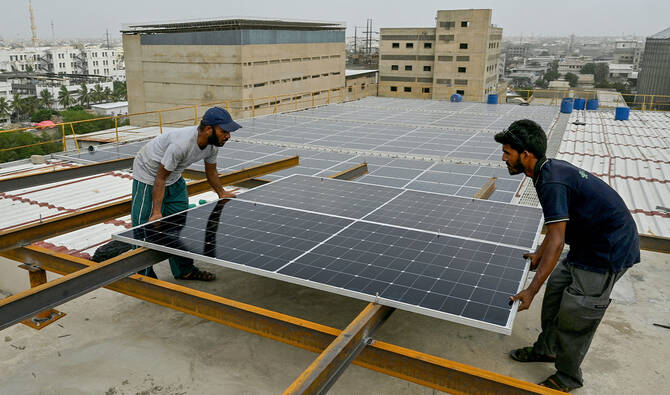
In this photograph taken on July 2, 2025, technicians install solar panels on the rooftop of a factory in Pakistan's port city of Karachi. (AFP/File)
Short Url
Updated 12 February 2026
Follow

Power minister defends solar net-metering overhaul after Pakistan PM orders review

  • Leghari says 466,000 net-meter users earn up to 50% returns while 35.5 million consumers bear higher costs
  • NEPRA’s new rules require full grid tariffs for usage and lower, market-linked rates for excess solar exports

ISLAMABAD: Pakistan’s power minister on Thursday defended controversial changes to rooftop solar net-metering rules, arguing that generous returns for a small number of users were unfairly burdening millions of other electricity consumers, as Prime Minister Shehbaz Sharif ordered a review a day earlier.

The dispute centers on changes to the net-metering regime, under which households and businesses with rooftop solar panels can sell excess electricity to the national grid. The National Electric Power Regulatory Authority's (NEPRA) new compensation rules require consumers to pay full tariffs for electricity drawn from the grid while receiving a lower, market-linked rate for excess power they export.

Critics have called the revisions “anti-solar” and warned they would undermine renewable energy adoption and hurt household finances.

Power Minister Sardar Owais Ahmed Khan Leghari told the National Assembly that only 6,000-7,000 megawatts of Pakistan’s estimated 22,000 megawatts of installed solar capacity fall under net-metering, covering around 466,000 consumers out of 35.5 million nationwide electricity users.


“If a net-metering consumer earns a 50% return on his investment because of the savings he gets as a meter user, while IPPs [independent power producers] get 17% and bank deposits earn 8%, isn’t a 50% return a good rate,” he asked.

“I generate electricity at Rs. 5 and send it to the grid at Rs. 27,” he continued. “The average price at which we buy electricity from the rest of the grid is Rs. 8.31. Is buying at Rs. 27 justified?”

Leghari said under the revised framework, returns for net-meter users would fall to around 37%, adding that even at that level, rooftop solar power generation remains financially attractive.

He said the changes were aimed at ensuring “fair pricing” and reducing cross-subsidies borne by the broader consumer base.

“Besides them, there are 35.5 million other consumers who do not even use net-metering,” he said, adding that if electricity costs for the wider public fell by up to Rs. 1.50 per unit, the adjustment would be justified.

Leghari's statement follows the prime minister's instructions to file a review in response to the new NEPRA rules, as he directed his administration to protect existing consumer contracts while ensuring the policy does not shift the financial burden onto non-solar electricity users.


Pakistan reviews austerity measures amid Middle East crisis, urges strict nationwide implementation

Updated 11 March 2026
Follow

Pakistan reviews austerity measures amid Middle East crisis, urges strict nationwide implementation

  • Deputy Prime Minister Ishaq Dar chairs review meeting of austerity steps
  • Officials briefed on salary cuts, school closures, four‑day week, petrol conservation

ISLAMABAD: Pakistan’s government on Wednesday assessed progress on a sweeping set of austerity measures introduced to mitigate the country’s economic strain from sharply rising global oil prices and supply disruptions linked to the ongoing war in the Middle East.

Prime Minister Shehbaz Sharif this week announced a series of austerity steps, including a four‑day work week for government offices, requiring 50  percent of staff to work from home, cutting fuel allowances for official vehicles by half, grounding up to 60  percent of the government fleet and closing all schools for two weeks to conserve fuel amid the global oil crisis.

The measures were unveiled in response to global oil market volatility triggered by the conflict involving the United States, Israel and Iran, which has disrupted supply routes such as the Strait of Hormuz and pushed crude prices sharply higher, straining Pakistan’s heavily import‑dependent energy sector.

“The meeting stressed the importance of strict and transparent adherence to the austerity measures, promoting fiscal responsibility and prudent use of public resources,” Deputy Prime Minister and Foreign Minister Senator Mohammad Ishaq Dar said in a statement.

He was chairing a meeting of the Committee for Monitoring and Implementation of Conservation and Additional Austerity Measures, constituted under the directions of the PM, bringing together federal and provincial officials to review execution of the broad cost‑cutting plan. 

Dar emphasized the government’s commitment to enforcing the PM’s austerity steps nationwide. The committee’s review also covered reductions in departmental expenditure, deductions from salaries of senior officials earning over Rs. 300,000 ($1,120), and coordination with provincial administrations to ensure uniform implementation of the plan.

Participants at the meeting reiterated that all ministries and divisions must continue strict monitoring and reporting, with transparent oversight mechanisms, as Pakistan navigates the economic pressures from the prolonged Middle East crisis and its fallout on global energy and trade markets.