

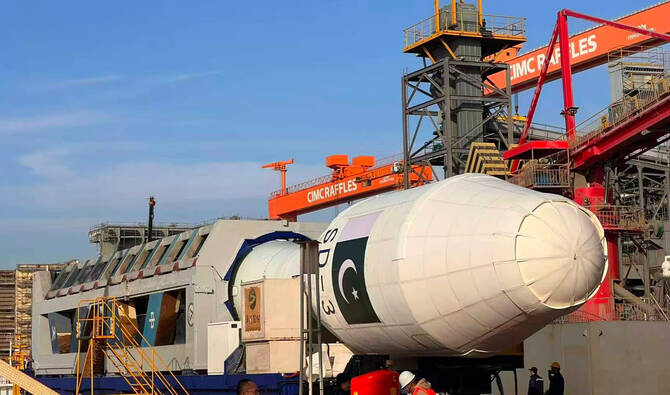
Pakistan launches second indigenous EO-2 satellite from China, SUPARCO says

An image released by SUPARCO on February 12, 2026, showing Pakistan's second indigenous Earth Observation satellite, EO-2, at China’s Yangjiang Seashore Launch Center. (SUPARCO)
Short Url
Updated 12 February 2026
Follow

Pakistan launches second indigenous EO-2 satellite from China, SUPARCO says

  • Earth observation satellite launched from Yangjiang Seashore Launch Center in China
  • EO-2 to enhance disaster response, governance, resource management capabilities

KARACHI: Pakistan has successfully launched its second indigenous Earth Observation satellite, EO-2, from China’s Yangjiang Seashore Launch Center, the national space agency SUPARCO said on Thursday.

The launch marks a significant step in Pakistan’s efforts to strengthen its domestic space and remote sensing capabilities, with the satellite expected to improve imaging continuity, disaster monitoring, agricultural planning and strategic resource management.

In a statement, Pakistan’s SUPARCO said the EO-2 satellite would enhance the country’s earth observation and imaging capabilities and support governance and planning functions across multiple sectors.

“Pakistan’s second indigenous EO-2 satellite has been successfully launched,” SUPARCO said, adding that the mission represents a “milestone” in the expansion of the country’s satellite fleet.

According to the agency, EO-2 will provide critical data for planning and resource management while improving the continuity and accuracy of national earth observation systems.

The satellite is expected to support disaster management, urban planning, environmental monitoring and infrastructure development by supplying updated geospatial imagery and data.

SUPARCO said the launch demonstrates growing indigenous capability in satellite development and reflects Pakistan’s broader objective of strengthening its national space program through locally developed platforms.

Pakistan has gradually expanded its space cooperation with China in recent years, including satellite launches and joint missions, as Islamabad seeks to build technical capacity and reduce reliance on external data sources.

The EO-2 satellite is expected to play a key role in improving data availability for federal and provincial authorities, particularly in areas vulnerable to floods, climate stress and rapid urbanization.


Fears of fuel shortage in Pakistan as tankers wait to fill up

Updated 5 sec ago
Follow

Fears of fuel shortage in Pakistan as tankers wait to fill up

  • US-Israeli war with Iran has disrupted shipping, damaged oil and gas facilities in Middle East
  • Pakistan, which depends on oil and gas from the Gulf, raised fuel prices by 20 percent last week

Sheikhupura, Pakistan: Tanker drivers in Pakistan said they were facing long waits at depots due to a shortage of fuel, as the government played down fears of another rise in prices.

The US-Israeli war with Iran has disrupted shipping and damaged oil and gas facilities in the Middle East, raising global oil prices as countries scramble to deal with concerns over supply.

Dozens of tankers, which supply fuel across Pakistan, were seen parked at the side of the road on Tuesday at depots near Lahore, the capital of Punjab, the country’s most populous province.

“There is no petrol at the depot for the past four days,” said one tanker driver, Abdul Shakoor.

“Iran has closed the border from their side. The depot is lying empty,” he told AFP.

Pakistan depends on oil and gas from the Gulf, and vessels transporting fuel were given naval escorts this week to ensure continuity of supplies during the Middle East crisis.

Last week, the government in Islamabad hiked prices by about 20 percent, triggering long lines and panic buying at filling stations across the country.

Petroleum Minister Ali Pervaiz Malik said in an interview broadcast late on Tuesday that there will be “no immediate significant changes” in the cost of fuel.

Prime Minister Shehbaz Sharif on Monday announced an austerity plan designed to save fuel, including slashing the working week for government employees to four days and shutting schools.

But Mazhar Mahmood, a tanker driver’s assistant, said: “The drivers went to the depot today as well, but the depot staff said there is no fuel available.”

He said he was told that fuel will be available in the next five to six days.

“The situation in the country is not good. There is no petrol in the country, which is why the vehicles are parked here.”