

Pakistan denounces five-year ban on two Kashmiri organizations

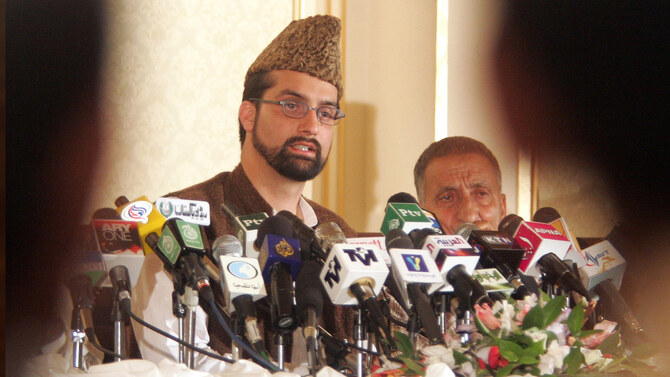
Chairman of All Parties Hurriyat Conference Mirwaz Umar Farooq speaks during a news conference in Islamabad on June 8, 2005. (Reuters/File)
Short Url
Updated 12 March 2025
Follow

Pakistan denounces five-year ban on two Kashmiri organizations

  • India declares Awami Action Committee and Jammu and Kashmir Ittihad-ul-Muslimeen ‘unlawful associations’
  • Pakistan says move an attempt to suppress political activities and stifle dissent, shows disregard of democratic norms

ISLAMABAD: Pakistan on Wednesday denounced a five-year ban on the Awami Action Committee and Jammu and Kashmir Ittihad-ul-Muslimeen organizations in Indian-administered Kashmir, calling it an attempt to “suppress political activities and stifle dissent.”

In a notification on Tuesday, the Indian Union Ministry of Home Affairs said both organizations were “unlawful” associations engaged in activities that were prejudicial to the integrity, sovereignty and security of the country.

The Awami Action Committee is led by political and religious leader Mirwaiz Umar Farooq, the chairman of the moderate faction of Kashmir’s main separatist political alliance. The Jammu and Kashmir Ittihad-ul-Muslimeen is led by Shia leader Masroor Abbas Ansari, who is also a senior leader of Farooq’s All Parties Hurriyat Conference.

Farooq’s family and aides are part of more than three decades of separatist activity by some Muslim politicians who have long resented what they see as heavy-handed New Delhi rule. Some want to join Pakistan, while others have called for complete independence for Kashmir.

“The recent decision increases the total number of outlawed Kashmiri political parties and organizations to 16,” the foreign office said, calling it a manifestation of India’s “iron-fisted” approach toward Kashmir. 

“It reflects a desire to suppress the political activities and stifle dissent. It also shows sheer disregard of democratic norms and international human rights law.”

The FO urged the government of India to remove the curbs on Kashmiri political parties, release all political prisoners and implement UN Security Council resolutions.

The Himalayan region of Jammu and Kashmir has long been a flashpoint between nuclear-armed neighbors India and Pakistan, with both claiming Kashmir in full but ruling it in part. UN peacekeepers have been deployed since 1949 to observe a ceasefire between India and Pakistan in Jammu and Kashmir.

The UN Security Council adopted several resolutions in 1948 and in the 1950s on the dispute between India and Pakistan over the region, including one which says a plebiscite should be held to determine the future of the mostly Muslim Kashmir.

Another resolution also calls upon both sides to “refrain from making any statements and from doing or causing to be done or permitting any acts which might aggravate the situation.”


Planning minister says Pakistan to set up advanced technology centers to support economic growth

Updated 13 sec ago
Follow

Planning minister says Pakistan to set up advanced technology centers to support economic growth

  • Ahsan Iqbal says planned centers to focus on artificial intelligence, quantum computing and nanotechnology
  • He also cites satellite technology as key tool for climate monitoring, early warning and disaster management

ISLAMABAD: Pakistan plans to set up technology Centers of Excellence, including facilities focused on quantum computing and nanotechnology, as it seeks to benefit from rapid advances in artificial intelligence and emerging technologies, state media reported on Friday.

The announcement was made by Planning and Development Minister Ahsan Iqbal, who said the government aims to position Pakistan to compete in future technologies that are expected to drive economic growth and reshape global industries.

Quantum computing, which uses the principles of quantum mechanics to process information far more quickly than conventional computers, has applications ranging from complex data analysis and cryptography to climate modeling and materials science. Nanotechnology focuses on engineering materials at the molecular level and is widely used in energy storage, medicine and electronics.

Addressing a ceremony in Islamabad, Iqbal said countries that master artificial intelligence, robotics, quantum computing and space technologies would lead the global economy in the coming decades.

“During the address, the minister said Pakistan’s efforts to align itself with rapid advancements in artificial intelligence, robotics, space innovation and emerging technologies reflect the country’s ambition to participate confidently in shaping the future,” Radio Pakistan reported.

“Ahsan Iqbal further announced that the government plans to establish three Centers of Excellence, including a National Center for Quantum Computing and a National Center for Nanotechnology, aimed at upgrading the national economy,” it added.

He informed the ceremony that measures were underway to develop a new Silicon Valley in Pakistan “to promote cross-fertilization of ideas and innovation by bringing talent, research and industry together under one roof.”

The minister also highlighted the role of technology in tackling climate challenges, noting that satellite systems are increasingly used worldwide for disaster management, early warning systems and climate monitoring.

Pakistan, one of the world’s most climate-vulnerable countries, can benefit from satellite technology to track weather patterns, manage floods and improve disaster preparedness, he said, adding that more than 9,000 satellites currently orbit the Earth and are transforming how economies and governments operate.

Iqbal said the planned centers would support Pakistan’s broader “Uraan Pakistan” vision, which focuses on exports, digital development, energy and infrastructure, environmental resilience and social equity, Radio Pakistan reported.