

Planning minister says Pakistan to set up advanced technology centers to support economic growth

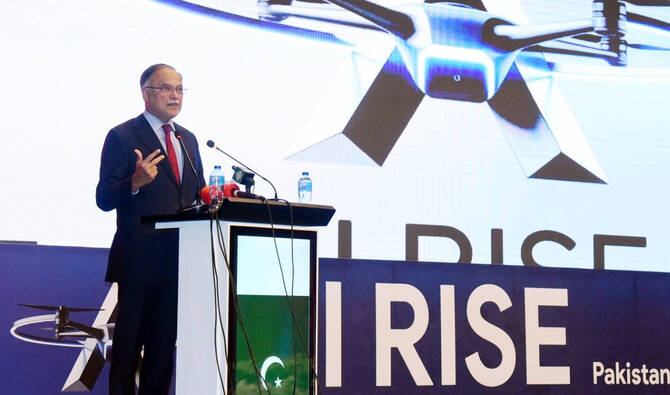
Planning Minister Ahsan Iqbal speaks at the “AI Rise Pakistan Expo 2025” in Islamabad, Pakistan, on December 26, 2025. (Planning Ministry)
Short Url
Updated 26 December 2025
Follow

Planning minister says Pakistan to set up advanced technology centers to support economic growth

  • Ahsan Iqbal says planned centers to focus on artificial intelligence, quantum computing and nanotechnology
  • He also cites satellite technology as key tool for climate monitoring, early warning and disaster management

ISLAMABAD: Pakistan plans to set up technology Centers of Excellence, including facilities focused on quantum computing and nanotechnology, as it seeks to benefit from rapid advances in artificial intelligence and emerging technologies, state media reported on Friday.

The announcement was made by Planning and Development Minister Ahsan Iqbal, who said the government aims to position Pakistan to compete in future technologies that are expected to drive economic growth and reshape global industries.

Quantum computing, which uses the principles of quantum mechanics to process information far more quickly than conventional computers, has applications ranging from complex data analysis and cryptography to climate modeling and materials science. Nanotechnology focuses on engineering materials at the molecular level and is widely used in energy storage, medicine and electronics.

Addressing a ceremony in Islamabad, Iqbal said countries that master artificial intelligence, robotics, quantum computing and space technologies would lead the global economy in the coming decades.

“During the address, the minister said Pakistan’s efforts to align itself with rapid advancements in artificial intelligence, robotics, space innovation and emerging technologies reflect the country’s ambition to participate confidently in shaping the future,” Radio Pakistan reported.

“Ahsan Iqbal further announced that the government plans to establish three Centers of Excellence, including a National Center for Quantum Computing and a National Center for Nanotechnology, aimed at upgrading the national economy,” it added.

He informed the ceremony that measures were underway to develop a new Silicon Valley in Pakistan “to promote cross-fertilization of ideas and innovation by bringing talent, research and industry together under one roof.”

The minister also highlighted the role of technology in tackling climate challenges, noting that satellite systems are increasingly used worldwide for disaster management, early warning systems and climate monitoring.

Pakistan, one of the world’s most climate-vulnerable countries, can benefit from satellite technology to track weather patterns, manage floods and improve disaster preparedness, he said, adding that more than 9,000 satellites currently orbit the Earth and are transforming how economies and governments operate.

Iqbal said the planned centers would support Pakistan’s broader “Uraan Pakistan” vision, which focuses on exports, digital development, energy and infrastructure, environmental resilience and social equity, Radio Pakistan reported.


Pakistan’s Mahnoor Omer named among TIME’s ‘Women of the Year’ for 2026

Updated 01 March 2026
Follow

Pakistan’s Mahnoor Omer named among TIME’s ‘Women of the Year’ for 2026

  • Omer moved a Pakistani court against the so-called ‘period tax’ in Sept. 2025 which has since sparked a national debate
  • Taxes on sanitary pads in Pakistan can add up to 40 percent to retail price, UNICEF says only around 12 percent women use such products

ISLAMABAD: Pakistani women’s rights activist Mahnoor Omer, who fought against taxes on menstrual products, has been named among the TIME magazine’s ‘Women of the Year’ for 2026.

Omer’s efforts have been recognized alongside 16 activists, artists, athletes and businesswomen in the TIME’s Women of the Year 2026 list, including Olympic gold medalist Sydney McLaughlin-Levrone and Oscar-nominated filmmaker Chloe Zhao.

Dissatisfied with the efforts to educate Pakistani girls about sexual violence, Omer founded the Noor Foundation at the age of 14 and held her own workshops with village girls about everything from climate change to menstruation, according to the TIME magazine.

Two years later, a conversation with a domestic worker about the price of pads made her realize that not everyone could afford these essentials. She moved a court against the so-called “period tax” in Sept. 2025 and the case has sparked a national debate on the subject, considered a taboo by many in Pakistan, since its first hearing late last year.

“A decade and one law degree after her interest in activism was sparked, Omer, now 25, is putting her passion and expertise to work in the name of gender equity,” TIME wrote about Omer on its website.

Taxes imposed on sanitary products in Pakistan can add up to 40 percent to the retail price. UNICEF estimates just 12 percent of women in the country use commercially produced pads or tampons. The alternative, using cloth, risks health impacts including rashes and infections, and can make it impossible for girls to attend school while menstruating.

Omer’s suit, which awaits the government response, has sparked a national discussion. She says she spoke about menstruation to her father and male cousins, who thanked her for standing up for their daughters.
The 25-year-old, who is currently enrolled in a master’s degree in gender, peace, and security at the London School of Economics, sees this case as just the first of many.

“I’m not free until every woman is free,” she was quoted as saying by TIME. “I want to leave no stones unturned in terms of what I can do with the next few decades, as a lawyer for the women in my country and gender minorities in general.”