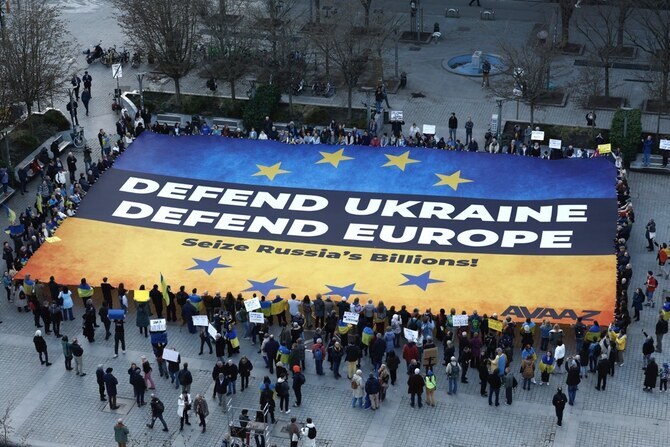
UNITED NATIONS: The European Union has a message for the Trump administration: It will continue supporting Ukraine against Russia’s illegal invasion, step up humanitarian aid when others pull back, and boost global teamwork to address the world’s challenges.
EU foreign policy chief Kaja Kallas never mentioned the United States in her speech to the UN Security Council on Tuesday. But her points were clearly aimed at President Donald Trump ‘s dismissive language about Europe, his massive cutbacks in aid to poor and conflict-torn countries, and his administration’s reluctance to acknowledge that Russia invaded Ukraine.
Following talks in Saudi Arabia on Tuesday, the Trump administration said it was lifting its suspension of military aid and intelligence sharing for Ukraine, and Kyiv signaled that it was open to a 30-day ceasefire in the war with Russia. The US-Ukraine deal is now pending Moscow’s agreement.
Looking at the world 80 years after the UN was founded on the ashes of World War II, Kallas said its foundations are facing “unprecedented pressure.” She cited blatant violations of the UN Charter, “attempts to replace the rule of law by the rule of force,” and universal principles promoting peace, human rights and development “under heavy fire.”
At a news conference afterward, she said, “The world is more dangerous now than it has ever been since the Cold War.”
Kallas told the council, “The EU will remain the UN’s reliable partner of choice” and will defend the UN Charter, which says every country must respect the sovereignty and territorial integrity of all nations.
That’s why it has supported Ukraine’s right to self-defense and stands with Kyiv “for a just and lasting peace in line with the Charter,” she said, stressing that Russia must lose its “colonial war.”
The EU will always support rising humanitarian needs, with almost 2 billion euros this year, she said, a dig at the Trump administration, which dismantled the US aid agency and is eliminating 83 percent of its programs.
Kallas also stressed the need to boost multilateralism and engage with partners, which “is the only way forward in solving issues.”
She was asked afterward about a Trump comment that the EU was created to destroy the US when it comes to trade and was asked whether the 27-nation bloc could overcome that antagonism.
Surrounded by diplomats from all EU member nations, Kallas replied that the EU is “a peace project” created to ensure there would be no more wars among its members.
Right now, “our relations with third parties around the world show that everybody is looking at us because we are the reliable, predictable partner,” she said. “So, I really see the possibility to grow Europe’s geopolitical presence.”
The EU came under attack from Russia during the Security Council meeting.
After Kallas pledged to continue EU support to Ukraine, Russia’s UN ambassador blasted the European bloc for what it called a long history of anti-Russian sentiment.
“This sensible club aimed at integration, which used to promote cooperation with Russia, has today definitively turned into a fossilized, aggressive Russophobia bloc, which has staked its energy, economic, social and financial wellbeing on a pointless confrontation with its eastern neighbor,” Vassily Nebenzia said.
“Today, more than ever, it’s clear that the EU is seriously losing in this confrontation,” he said.
Kallas retorted that Nebenzia’s comments were a good example of rewriting history and how “misinformation and disinformation” and “lies” must be fought.
She said countries are afraid of Russia because of the countries it has attacked, “and these fears are not ungrounded.”


![]()


EU’s top diplomat pledges unified support for Ukraine and global humanitarian aid in dig at US
Short Url
https://arab.news/vmeup
EU’s top diplomat pledges unified support for Ukraine and global humanitarian aid in dig at US
- EU foreign policy chief Kaja Kallas never mentioned the US in her speech to the UN Security Council
- Her points were clearly aimed at President Donald Trump ‘s dismissive language about Europe


Germany eyes lasers, spy satellites in military space spending splurge
SINGAPORE: Germany is weighing investments ranging from spy satellites and space planes to offensive lasers under a 35 billion euro ($41 billion) military space spending plan aimed at countering growing threats from Russia and China in orbit, the country’s space commander said.
Germany will build an encrypted military constellation of more than 100 satellites, known as SATCOM Stage 4, over the next few years, the head of German Space Command Michael Traut told Reuters on the sidelines of a space event ahead of the Singapore Airshow.
He said the network would mirror the model used by the US Space Development Agency, a Pentagon unit that deploys low-Earth-orbit satellites for communications and missile tracking.
Rheinmetall is in talks with German satellite maker OHB about a joint bid for an unnamed German military satellite project, Reuters reported last week.
The potential deal comes as Europe’s top three space firms — Airbus, Thales and Leonardo — are seeking to build a European satellite communications alternative to Elon Musk’s Starlink.
Traut said Germany’s investment in military space architecture reflected a sharply more contested space environment since Russia’s full-scale invasion of Ukraine in 2022. Berlin and its European allies, he said, needed to bolster their deterrence posture by investing not only in secure communications but also in capabilities that could hinder or disable hostile space systems.
“(We need to) improve our deterrence posture in space, since space has become an operational or even warfighting domain, and we are perfectly aware that our systems, our space capabilities, need to be protected and defended,” Traut said.
INSPECTOR SATELLITES AND LASERS
Germany will channel funding into intelligence-gathering satellites, sensors and systems designed to disrupt adversary spacecraft, including lasers and equipment capable of targeting ground-based infrastructure, Traut said.
He added that Germany would prioritize small and large domestic and European suppliers for the program.
Traut emphasized Germany would not field destructive weapons in orbit that could generate debris, but said a range of non-kinetic options existed to disrupt hostile satellites, including jamming, lasers and actions against ground control stations.
He also pointed to so-called inspector satellites — small spacecraft capable of maneuvering close to other satellites — which he said Russia and China had already deployed.
“There is a broad range of possible effects in the electromagnetic spectrum, in the optical, in the laser spectrum, and even some active physical things like inspector satellites,” he said.
“You could even go after ground segments of a space system in order to deny that system to your adversary or to tell him, ‘If you do something to us in space, we might do something to you in other domains as well.’”
Germany will build an encrypted military constellation of more than 100 satellites, known as SATCOM Stage 4, over the next few years, the head of German Space Command Michael Traut told Reuters on the sidelines of a space event ahead of the Singapore Airshow.
He said the network would mirror the model used by the US Space Development Agency, a Pentagon unit that deploys low-Earth-orbit satellites for communications and missile tracking.
Rheinmetall is in talks with German satellite maker OHB about a joint bid for an unnamed German military satellite project, Reuters reported last week.
The potential deal comes as Europe’s top three space firms — Airbus, Thales and Leonardo — are seeking to build a European satellite communications alternative to Elon Musk’s Starlink.
Traut said Germany’s investment in military space architecture reflected a sharply more contested space environment since Russia’s full-scale invasion of Ukraine in 2022. Berlin and its European allies, he said, needed to bolster their deterrence posture by investing not only in secure communications but also in capabilities that could hinder or disable hostile space systems.
“(We need to) improve our deterrence posture in space, since space has become an operational or even warfighting domain, and we are perfectly aware that our systems, our space capabilities, need to be protected and defended,” Traut said.
INSPECTOR SATELLITES AND LASERS
Germany will channel funding into intelligence-gathering satellites, sensors and systems designed to disrupt adversary spacecraft, including lasers and equipment capable of targeting ground-based infrastructure, Traut said.
He added that Germany would prioritize small and large domestic and European suppliers for the program.
Traut emphasized Germany would not field destructive weapons in orbit that could generate debris, but said a range of non-kinetic options existed to disrupt hostile satellites, including jamming, lasers and actions against ground control stations.
He also pointed to so-called inspector satellites — small spacecraft capable of maneuvering close to other satellites — which he said Russia and China had already deployed.
“There is a broad range of possible effects in the electromagnetic spectrum, in the optical, in the laser spectrum, and even some active physical things like inspector satellites,” he said.
“You could even go after ground segments of a space system in order to deny that system to your adversary or to tell him, ‘If you do something to us in space, we might do something to you in other domains as well.’”
Latest updates


Recommended


© 2026 SAUDI RESEARCH & PUBLISHING COMPANY, All Rights Reserved And subject to Terms of Use Agreement.