

China-US trade war heats up as Beijing’s tariffs take effect

1 / 2
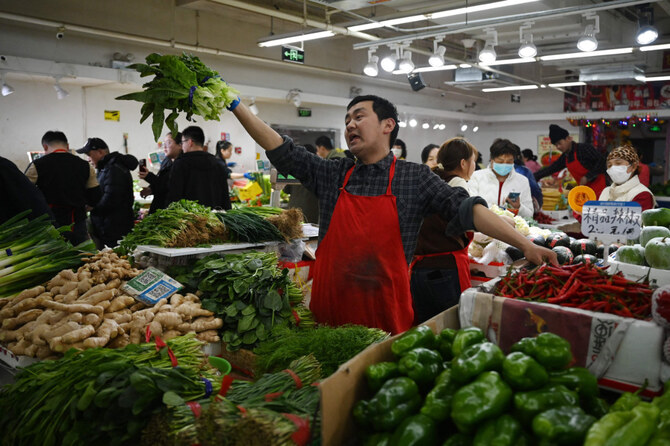
People shop for vegetables in a market in Beijing on March 9, 2025. Consumer prices in China fell last month, with authorities struggling to kickstart spending and trade headwinds intensifying as US tariffs kick in under Donald Trump. (AFP)
2 / 2
A vendor shouts out his price for lettuce in a market in Beijing on March 9, 2025, as China's trade war with the US escalates, triggered by Trump's tariffs. (AFP)
Short Url
Updated 10 March 2025
Follow

China-US trade war heats up as Beijing’s tariffs take effect

  • After imposing a blanket 10 percent tariff on all Chinese goods in early February, Trump hiked the rate to 20 percent last week
  • China retaliated by imposing levies of 10 and 15 percent on several US farm products, a move designed to hurt Trump’s voter base

BEIJING: China’s tariffs on certain US agricultural goods in retaliation for President Donald Trump’s latest hike on Chinese imports came into force Monday, as trade tensions mount between the world’s two leading economies.
Since retaking office in January, Trump has unleashed a barrage of tariffs on major US trading partners, including China, Canada and Mexico, citing their failure to stop illegal immigration and flows of deadly fentanyl.
After imposing a blanket 10 percent tariff on all Chinese goods in early February, Trump hiked the rate to 20 percent last week.
Beijing reacted quickly, its finance ministry accusing Washington of “undermining” the multilateral trading system and announcing fresh measures of its own.
Those tariffs come into effect Monday and see levies of 10 and 15 percent imposed on several US farm products.
Chicken, wheat, corn and cotton from the United States will now be subject to the higher charge.
Soybeans, sorghum, pork, beef, aquatic products, fruit, vegetables and dairy will face the slightly lower rate.
The tariffs will not apply to goods that left before March 10, however, as long as they arrive in China by April 12.
Analysts say Beijing’s retaliatory tariffs are designed to hurt Trump’s voter base while remaining restrained enough to allow room to hash out a trade deal.
The increasing trade headwinds add to difficulties faced by Chinese leaders currently seeking to stabilize the country’s wavering economy.
Sluggish consumer spending, a prolonged debt crisis in the vast property sector and high youth unemployment are among the issues now facing policymakers.
Analysts say China’s exports — which last year reached record highs — might not provide the same economic lifeline for Beijing as its trade war with Washington intensifies.

Experts say the full effects of the recent wave of tariffs have yet to be fully felt, though early signs already indicate a downturn in shipments.
China’s exports grew 2.3 percent year-on-year during the first two months of 2025, official data showed Friday, missing expectations and slowing significantly from the 10.7 percent growth recorded in December.
“As exports face downside risk with trade war looming, the fiscal policy needs to become more proactive,” wrote Zhiwei Zhang, president and chief economist at Pinpoint Asset Management.
The latest trade data came as Chinese officials congregated in Beijing for the country’s largest annual political gathering, known as the “Two Sessions.”
During a speech to delegates on Wednesday, Premier Li Qiang laid out the government’s economic strategy for the year ahead, acknowledging “an increasingly complex and severe external environment.”
Li also announced that the government’s official growth target for the year ahead would be “around five percent” — the same as 2024.
Many economists consider that goal to be ambitious, considering the hurdles facing China’s economy.
“If fiscal spending starts to ramp up again soon then that could more than offset the near-term hit to growth from tariffs,” wrote Julian Evans-Pritchard of Capital Economics.
“However, given the wider headwinds... we still aren’t convinced that fiscal support will be sufficient to deliver anything more than a short-lived boost,” he added.


Junta leader Gen. Mamdi Doumbouya is declared winner of Guinea’s election, provisional results show

Updated 31 December 2025
Follow

Junta leader Gen. Mamdi Doumbouya is declared winner of Guinea’s election, provisional results show

  • Mamady Doumbouya took power in 2021 coup

CONAKRY, Guinea: Guinea coup leader ​Mamady Doumbouya has been elected president, according to provisional results announced on Tuesday, completing the return to civilian rule in the bauxite- and iron ore-rich West African nation.
The former special forces commander, thought to be in his early 40s, seized power in 2021, toppling then-President Alpha Conde, who had been in office since 2010. It was one in a series of nine coups that have reshaped politics in West and Central Africa since 2020.
The provisional results announced ‌on Tuesday showed Doumbouya ‌winning 86.72 percent of the December 28 vote, ‌an ⁠absolute majority ​that allows ‌him to avoid a runoff.
The Supreme Court has eight days to validate the results in the event of any challenge.
Doumbouya’s victory, which gives him a seven-year mandate, was widely expected. Conde and Cellou Dalein Diallo, Guinea’s longtime opposition leader, are in exile, which left Doumbouya to face a fragmented field of eight challengers.
Doumbouya reversed pledge not to run
The original post-coup charter in Guinea barred junta members from running ⁠in elections, but a constitution dropping those restrictions was passed in a September referendum.
Djenabou Toure, the ‌country’s top election official who announced the results on ‍Tuesday night, said turnout was 80,95 percent. However ‍voter participation appeared tepid in the capital Conakry, and opposition politicians rejected ‍a similarly high turnout figure for the September referendum.
Guinea holds the world’s largest bauxite reserves and the richest untapped iron ore deposit at Simandou, officially launched last month after years of delay.
Doumbouya has claimed credit for pushing the project forward and ensuring Guinea benefits ​from its output.
His government this year also revoked the license of Emirates Global Aluminium’s subsidiary Guinea Alumina Corporation following a refinery dispute, ⁠transferring the unit’s assets to a state-owned firm.
The turn toward resource nationalism — echoed in Mali, Burkina Faso and Niger — has boosted his popularity, as has his relative youth in a country where the median age is about 19.
Political space restricted, UN says
Political debate has been muted under Doumbouya. Civil society groups accuse his government of banning protests, curbing press freedom and restricting opposition activity.
The campaign period was “severely restricted, marked by intimidation of opposition actors, apparently politically motivated enforced disappearances, and constraints on media freedom,” UN rights chief Volker Turk said last week.
On Monday, opposition candidate Faya Lansana Millimono told a press conference the election was marred by “systematic fraudulent practices” and ‌that observers were prevented from monitoring the voting and counting processes.
The government did not respond to a request for comment.