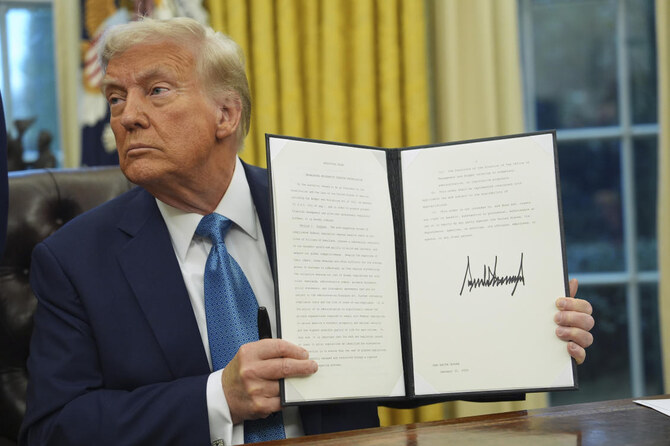
WASHINGTON: President Donald Trump will put in place 25 percent tariffs on imports from Canada and Mexico and 10 percent tariffs on goods from China effective on Saturday, the White House said, but it provided no word on whether there would be any exemptions to the measures that could result in swift price increases to US consumers.
Trump had been threatening the tariffs to ensure greater cooperation from the countries on stopping illegal immigration and the smuggling of chemicals used for fentanyl, but he has also pledged to use tariffs to boost domestic manufacturing and raise revenues for the federal government.
“Starting tomorrow, those tariffs will be in place,” White House press secretary Karoline Leavitt told reporters on Friday. “These are promises made and promises kept by the president.”
The tariffs carry both political and economic risks for Trump, who is just two weeks into his second term. Many voters backed the Republican on the promise that he could tamp down inflation, but the possibility of tariffs could trigger higher prices and potentially disrupt the energy, auto, lumber and agricultural sectors.
Trump had said he was weighing issuing an exemption for Canadian and Mexican oil imports, but Leavitt said she had no information to share on the president’s decision on any potential carveouts.
The United States imported almost 4.6 million barrels of oil daily from Canada in October and 563,000 barrels from Mexico, according to the Energy Information Administration. US daily production during that month averaged nearly 13.5 million barrels a day.
Trump has previously stated a 10 percent tariff on Chinese imports would be on top of other import taxes charged on products from the country.
Shortly after Leavitt spoke, the S&P 500 stock index sold off and largely erased its gains on the day.
“We should expect all three countries to retaliate,’’ said Wendy Cutler, a former US trade negotiator. China responded aggressively to tariffs Trump imposed on Chinese goods during his first term, targeting the president’s supporters in rural America with retaliatory taxes on US farm exports.
Both Canada and Mexico have said they’ve prepared the option of retaliatory tariffs to be used if necessary, which in turn could trigger a wider trade conflict that economic analyzes say could hurt growth and further accelerate inflation.
Canadian Prime Minister Justin Trudeau said Friday that Canada is ready is a respond if Trump goes ahead with the tariffs, but he did not give details.
“We’re ready with a response, a purposeful, forceful but reasonable, immediate response,” he said. “It’s not what we want, but if he moves forward, we will also act.”
Trudeau said tariffs would have “disastrous consequences” for the U.S, putting American jobs at risk and causing prices to rise. Trudeau reiterated that less than 1 percent of the fentanyl and illegal crossings into the US come from Canada.
Mexican President Claudia Sheinbaum said Friday that Mexico has maintained a dialogue with Trump’s team since before he returned to the White House, but she emphasized that Mexico has a “Plan A, Plan B, Plan C for what the United States government decides.”
“Now it is very important that the Mexican people know that we are always going to defend the dignity of our people, we are always going to defend the respect of our sovereignty and a dialogue between equals, as we have always said, without subordination,” Sheinbaum said.
Liu Pengyu, spokesman for the Chinese embassy in Washington, said the two countries should resolve their differences through dialogue and consultation. “There is no winner in a trade war or tariff war, which serves the interests of neither side nor the world,” Liu said in a statement. “Despite the differences, our two countries share huge common interests and space for cooperation.”
A study this month by Warwick McKibbin and Marcus Noland of the Peterson Institute for International Economics concluded that the 25 percent tariffs on Canada and Mexico and 10 percent tariffs on China “would damage all the economies involved, including the US’’
“For Mexico,’’ the study said, “a 25 percent tariff would be catastrophic. Moreover, the economic decline caused by the tariff could increase the incentives for Mexican immigrants to cross the border illegally into the US — directly contradicting another Trump administration priority.’’
Cutler, now vice president at the Asia Society Policy Institute, said the extent of the economic damage will depend on how long the tariffs are in effect.
If it’s just a few days, “that’s one thing. If they are in place for weeks onto months, we’re going to see supply chain disruptions, higher costs for US manufacturers, leading to higher prices for US consumers,’’ she said. “It could have macroeconomic impacts. It could affect the stock market. Then internationally it could lead to more tension with our trading partners and make it harder for us to work with them.”


![]()

White House says Trump tariffs on Canada, Mexico and China will come Saturday
Short Url
https://arab.news/wvgwp
White House says Trump tariffs on Canada, Mexico and China will come Saturday
- “Starting tomorrow, those tariffs will be in place,” White House press secretary Karoline Leavitt told reporters on Friday
- The tariffs carry both political and economic risks for Trump


Latest updates


Recommended


© 2026 SAUDI RESEARCH & PUBLISHING COMPANY, All Rights Reserved And subject to Terms of Use Agreement.