

US pulls non-emergency staff from South Sudan after clashes

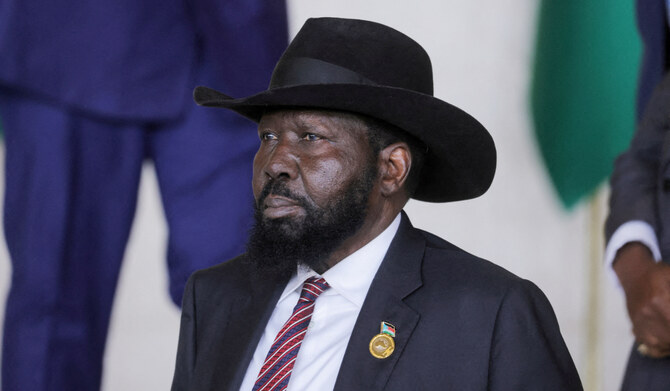
South Sudan's President Salva Kiir Mayardit prepares for a group photo during the opening of an African Union summit in Addis Ababa, Ethiopia, February 15, 2025. (REUTERS)
Short Url
Updated 10 March 2025
Follow

US pulls non-emergency staff from South Sudan after clashes

  • South Sudan, the world’s youngest country, ended its five-year civil war in 2018 with the power-sharing agreement between bitter rivals Kiir and Machar

NAIRIBI: The US has ordered all non-emergency staff in South Sudan to leave, the State Department said on Sunday, as rising tensions provoke international concern.
A fragile power-sharing agreement between President Salva Kiir and First Vice President Riek Machar has been threatened by recent clashes between their allied forces in the northeastern Upper Nile State.
On Friday, a UN helicopter came under attack during a rescue mission, which killed a crew member.  An army general also died during the operation, the UN said.

BACKGROUND

President Salva Kiir urged calm and told citizens there would be no return to war, but international observers sounded the alarm.

“Due to the risks in the country, on March 8, 2025, the Department of State ordered the departure of non-emergency US government employees from South Sudan,” the State Department said on Sunday.
“Armed conflict is ongoing and includes fighting between various political and ethnic groups. Weapons are readily available to the population.”
South Sudan, the world’s youngest country, ended its five-year civil war in 2018 with the power-sharing agreement between bitter rivals Kiir and Machar.
But the president’s allies have accused Machar’s forces of fomenting unrest in Nasir County, in Upper Nile State, in league with the so-called White Army, a loose band of armed youths in the region from the same ethnic Nuer community as the vice president.
Kiir urged calm late on Friday and told citizens there would be no return to war, but international observers sounded the alarm.
The UN human rights commission for South Sudan warned on Saturday that the country was seeing an “alarming regression” that threatened to undo years of progress to peace.
The International Crisis Group, a think tank, meanwhile, said: “South Sudan is slipping rapidly toward full-blown war.”
It warned the country risked “large scale ethnic massacres if the situation is not soon contained.”


Philippines probes Bondi Beach suspects’ visit, downplays militant training reports

Updated 12 sec ago
Follow

Philippines probes Bondi Beach suspects’ visit, downplays militant training reports

  • Suspects spent 4 weeks in the Philippines last month
  • Govt says no evidence visit linked to militant activity

MANILA: The Philippine National Police launched on Wednesday a probe into the recent visit to the country of a father and son whom Australian authorities have identified as suspects in last week’s mass shooting in Sydney.

Two gunmen killed 15 people and wounded dozens of others during Hanukkah celebrations at Sydney’s Bondi Beach on Sunday.

The suspected shooters, identified by Australian authorities as Sajid Akram and his son Naveed Akram, traveled to the Philippines last month.

The news has prompted various media outlets to speculate that there are links between their visit and the Sydney attack — an allegation Manila has since denied.

The investigation launched by the Philippine police seeks to establish the purpose of the suspects’ travel and their movement while in the country.

“This matter is being investigated as we seek to determine the reason behind their visit to the Philippines. We are finding out which places they went to, who they talked to, and where they stayed while they were in the country,” Philippine National Police acting chief Lt. Gen. Jose Melencio Nartatez Jr. said in a statement.

Bureau of Immigration data shows that 50-year-old Akram and his 24-year-old son arrived in the Philippines from Sydney on Nov. 1. They left the country on Nov. 28 via a connecting flight from Davao in the southern Philippines to Manila, with Sydney as their final destination.

According to a police statement, Philippine authorities, including the government and military, said there was no evidence the trip was related to any militant activity in the country and was “not considered as a serious security concern.”

Australian media reports linking the suspects to Daesh and alleging the group used the Philippines as its training ground were denied by the Philippine government.

“Information from operating units on the ground indicates no ongoing training and recruitment,” Department of National Defense spokesperson Arsenio Andolong told Arab News.

“There is no indication of imminent domestic terrorist threats.”

Presidential Communications Office Undersecretary and Palace Press Officer Claire Castro also dismissed the claims as “misleading” and “portraying the Philippines as a training hotspot for violent extremist groups.”

She told reporters that the National Security Council “maintained there is no confirmation to allegations that the father-and-son suspects in the recent mass shooting in Bondi Beach, Sydney, Australia, received training in the Philippines.”

Castro added that Philippine security forces “have significantly weakened” Daesh-affiliated groups since the 2017 Marawi siege.

The southern Philippine city in Mindanao island was in 2017 taken over by groups affiliated with Daesh. After five months of fighting and hundreds of deaths, the Philippine army reclaimed the area.

“Both UN and the US government assessments indicate that these groups now operate in a fragmented and diminished capacity,” Castro said.

“Violence in Mindanao is largely driven by historical conflicts and local clan disputes rather than the operational capacity of ISIS-affiliated organizations.”