NAIROBI: South Sudan is in “alarming regression” as clashes in recent weeks in the northeast threaten to undo years of progress toward peace, the UN commission on human rights in the country warned on Saturday.
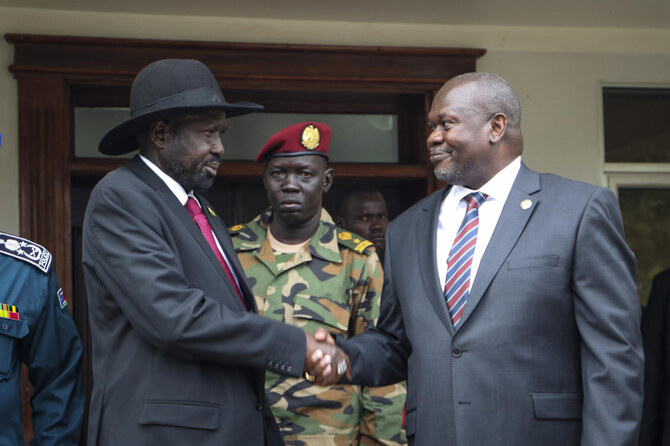
A fragile power-sharing agreement between President Salva Kiir and First Vice President Riek Machar has been put in peril by the clashes between their allied forces in the country’s Upper Nile State.
On Friday, a UN helicopter attempting to rescue soldiers in the state was attacked, killing one crew member and wounding two others.
An army general was also killed in the failed rescue mission, the UN Mission in South Sudan (UNMISS) said Friday.
The incident sent shudders through the young and impoverished nation, long plagued by political instability and violence.
Kiir late Friday urged calm and pledged no return to war.
In a statement on Saturday, the chair of the UN commission, Yasmin Sooka, said South Sudan was “witnessing an alarming regression that could erase years of hard-won progress.”
“Rather than fueling division and conflict, leaders must urgently refocus on the peace process, uphold the human rights of South Sudanese citizens, and ensure a smooth transition to democracy,” she said.
South Sudan, the world’s youngest country, ended a five-year civil war in 2018 with the power-sharing agreement between bitter rivals Kiir and Machar.
But Kiir’s allies have accused Machar’s forces of fomenting unrest in Nasir County, in Upper Nile State, in league with the so-called White Army, a loose band of armed youths in the region from the same ethnic Nuer community as the vice president.
“What we are witnessing now is a return to the reckless power struggles that have devastated the country in the past,” commissioner Barney Afako said in the UN Commission statement.
He added that the South Sudanese had endured “atrocities, rights violations which amount to serious crimes, economic mismanagement, and ever worsening security.”
“They deserve respite and peace, not another cycle of war.”

‘Alarming regression’ in South Sudan, UN warns
Short Url
https://arab.news/rnjp7
‘Alarming regression’ in South Sudan, UN warns
- The chair of the UN commission, Yasmin Sooka, said South Sudan was “witnessing an alarming regression that could erase years of hard-won progress“
- “Rather than fueling division and conflict, leaders must urgently refocus on the peace process”
Libya’s Red Castle museum opens for first time since fall of Qaddafi
Libya’s national museum, formerly known as As-Saraya Al-Hamra or the Red Castle, has reopened in Tripoli, allowing the public access to some of the country’s finest historical treasures for the first time since the revolt that toppled Muammar Qaddafi.
The museum, Libya’s largest, was closed in 2011 during a NATO-backed uprising against longtime ruler Qaddafi, who appeared on the castle’s ramparts to deliver a fiery speech.
Renovations were started in March 2023 by the Tripoli-based Government of National Unity (GNU), which came to power in 2021 in a UN-backed political process.
“The reopening of the National Museum is not just a cultural moment but a live testimony that Libya is building its institutions,” GNU Prime Minister Abdulhamid Al-Dbiebah said at a reopening ceremony on Friday.
Built in the 1980s, the museum’s 10,000 square meters of gallery space features mosaics and murals, sculptures, coins, and artefacts dating back to prehistoric times and stretching through Libya’s Roman, Greek and Islamic periods.
The collection also includes millennia-old mummies from the ancient settlements of Uan Muhuggiag in Libya’s deep south, and Jaghbub near its eastern border with Egypt.
“The current program focuses on enabling schools to visit the museum during this period, until it is officially opened to the public at the beginning of the year,” museum director Fatima Abdullah Ahmed told Reuters.
Libya has since recovered 21 artefacts that were smuggled out of the country after Qaddafi’s fall, notably from France, Switzerland, and the United States, the chairman of the board of directors of the antiquities department Mohamed Farj Shakshoki told Reuters ahead of the opening.
Shakshoki said that talks are ongoing to recover more than two dozen artefacts from Spain and others from Austria.
In 2022, Libya received nine artefacts, including funerary stone heads, urns and pottery from the US
Libya houses five UNESCO World Heritage sites, which it said in 2016 were all endangered due to instability and conflict.
In July, Libya’s delegation to UNESCO said the ancient city of Ghadames, one of the sites, had been removed from the list as the security situation had improved.
The museum, Libya’s largest, was closed in 2011 during a NATO-backed uprising against longtime ruler Qaddafi, who appeared on the castle’s ramparts to deliver a fiery speech.
Renovations were started in March 2023 by the Tripoli-based Government of National Unity (GNU), which came to power in 2021 in a UN-backed political process.
“The reopening of the National Museum is not just a cultural moment but a live testimony that Libya is building its institutions,” GNU Prime Minister Abdulhamid Al-Dbiebah said at a reopening ceremony on Friday.
Built in the 1980s, the museum’s 10,000 square meters of gallery space features mosaics and murals, sculptures, coins, and artefacts dating back to prehistoric times and stretching through Libya’s Roman, Greek and Islamic periods.
The collection also includes millennia-old mummies from the ancient settlements of Uan Muhuggiag in Libya’s deep south, and Jaghbub near its eastern border with Egypt.
“The current program focuses on enabling schools to visit the museum during this period, until it is officially opened to the public at the beginning of the year,” museum director Fatima Abdullah Ahmed told Reuters.
Libya has since recovered 21 artefacts that were smuggled out of the country after Qaddafi’s fall, notably from France, Switzerland, and the United States, the chairman of the board of directors of the antiquities department Mohamed Farj Shakshoki told Reuters ahead of the opening.
Shakshoki said that talks are ongoing to recover more than two dozen artefacts from Spain and others from Austria.
In 2022, Libya received nine artefacts, including funerary stone heads, urns and pottery from the US
Libya houses five UNESCO World Heritage sites, which it said in 2016 were all endangered due to instability and conflict.
In July, Libya’s delegation to UNESCO said the ancient city of Ghadames, one of the sites, had been removed from the list as the security situation had improved.
© 2025 SAUDI RESEARCH & PUBLISHING COMPANY, All Rights Reserved And subject to Terms of Use Agreement.