

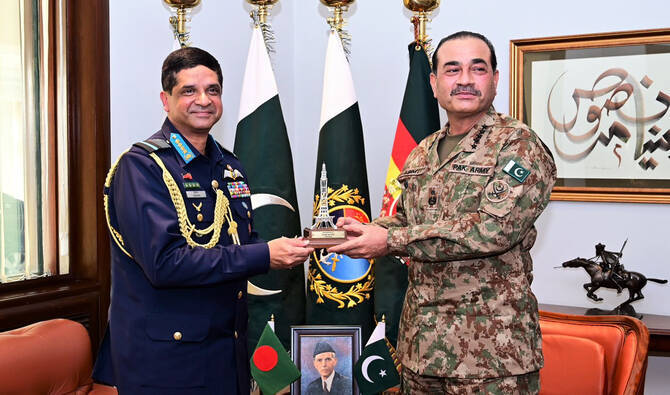

DHAKA: Bangladesh appears to be moving with caution as Dhaka and Islamabad forge closer ties and explore a potential defense deal, experts said on Friday.
Following decades of acrimonious ties, relations between Bangladesh and Pakistan have been growing since a student-led uprising ousted former Prime Minister Sheikh Hasina in 2024.
Talks on a potential defense deal covering the sale of Pakistan’s JF-17 fighter jets to Dhaka emerged after Bangladesh’s Air Chief Marshal Hasan Mahmood Khan visit to Rawalpindi last week, where he met with his Pakistani counterpart Air Chief Marshal Zaheer Ahmed Baber Sidhu and Field Marshal Syed Asim Munir, Pakistan’s chief of defense forces.
Bangladesh’s military media wing, the Inter-Services Public Relations, said the procurement of fighter jets for the Bangladesh Air Force is “in the very rudimentary level,” and currently “under an evaluation process.”
“The evaluation process will determine which country’s offer proves befitting for us. The Air Chief’s visit to Pakistan is part of the evaluation process … earlier he visited China, Italy (too),” ISPR Director Lt. Col. Sami Ud Dowla Chowdhury told Arab News.
“Discussions are underway with different countries. Nothing concrete has come yet.”
Talks between the high-ranking military officials are the latest development in Bangladesh-Pakistan ties, which have included resumption of direct trade for the first time since the 1971 war and the expected launch of a regular route from Dhaka to Karachi at the end of this month, following over a decade of suspension.
Though efforts to expand relations can be seen from both sides, the current interim government of Bangladesh led by economist and Nobel Prize laureate Muhammad Yunus has been “showing some kind of pragmatism,” said Prof. Delwar Hossain of Dhaka University’s international relations department.
“Bangladesh is stepping very cautiously in comparison with the advancement from the Pakistan side. Bangladesh is trying to make a balanced approach,” he told Arab News.
“The present government is always saying that the development of a relationship with Pakistan doesn’t necessarily mean that Bangladesh is moving toward a particular camp. Rather, Bangladesh is interested in having a balanced relationship with all the great powers.”
Trade and economy are “naturally” more preferable areas of cooperation for Dhaka, Hossain said, adding that “we need more time to determine” how far military cooperation will be expanded.
Ishfaq Ilahi Choudhury, a defense expert and retired air officer of Bangladesh Air Force, said that Bangladesh is “very much in need of advanced aircraft” because its military has not procured new fighter jets in at least two decades.
“Air frigate fighters are badly needed for the Bangladesh Air Force. We had some F-7 produced by China, but they stopped producing these fighters nowadays. Here, Pakistan can be a source for our fighter jets, but it involves … geopolitics,” he told Arab News, alluding to how Dhaka’s defense ties with Pakistan may be perceived by its archrival neighbor India.
Pakistan’s JF-17 fighter jets, a multi-role combat aircraft jointly developed with China, has drawn international interest following its success last May, when Pakistani and Indian forces engaged in their worst fighting since 1999.
Islamabad said it shot down several Indian fighter jets during the aerial combat, a claim Indian officials later acknowledged after initially denying any losses, but without specifying the number of jets downed.
“We shouldn’t also forget that both India and Pakistan are at each other’s foot. Here, our friendship with Pakistan shouldn’t go at the cost of our friendship with India,” Choudhury said.
“With this (potential) defense purchase deal with Pakistan, we have to remain very cautious so that it proves sustainable in the long term.”


